Solve vs resolve can be confusing because both words are used when we talk about fixing something.
For example, we can solve a problem, but we can also resolve a problem. So, are they exactly the same?
Not quite.
The two verbs are closely related, but they are normally used in different situations. Solve is especially common with problems, puzzles, questions, and difficult situations that need an answer.
Resolve is often used for conflicts, disagreements, disputes, concerns, and situations that need to be settled.
The difference can feel small, especially for English learners. Native speakers often choose one word naturally because they have heard it many times in real conversations.
Learners, however, may need a clear rule to understand why one sounds better than the other.
This difference matters in everyday English, school writing, business communication, and formal situations.
You may hear someone say, “We need to solve this problem,” while another person says, “We need to resolve this conflict.”
Both sentences are correct, but the words focus on slightly different ideas.
By the end of this guide, you will understand when to use solve, when to use resolve, how their grammar works, and which common mistakes to avoid.
You will also see simple examples from everyday life so you can use both words naturally.
What Does “Solve” Mean?
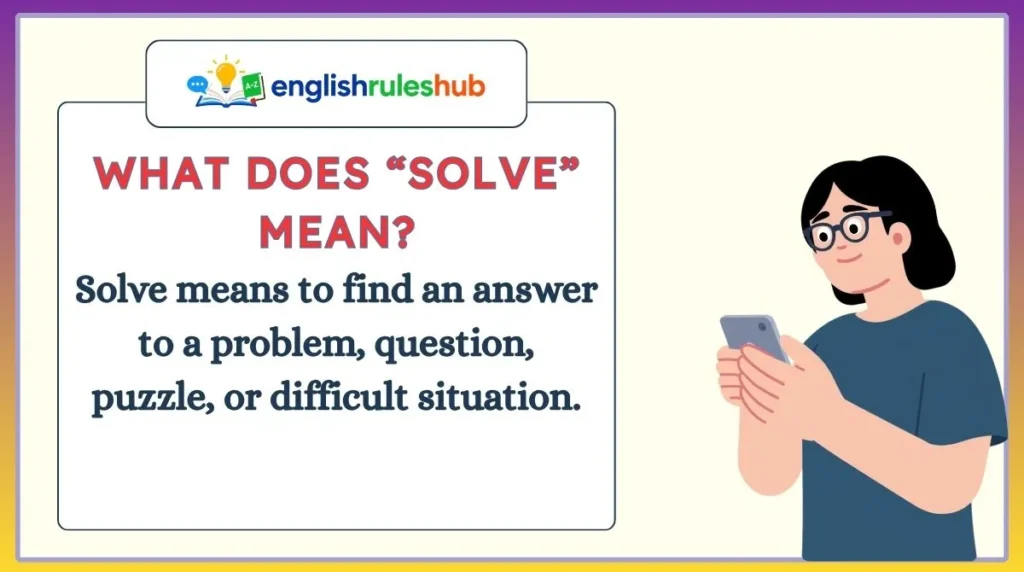
Solve means to find an answer to a problem, question, puzzle, or difficult situation.
When you solve something, you usually work out what the answer is or find a way to fix the difficulty.
For example:
- I need to solve this math problem.
- Can you solve this puzzle?
- We must solve the problem before Friday.
- She finally solved the mystery.
- He is trying to solve the technical issue.
- They found a way to solve the traffic problem.
- The students worked together to solve the question.
- We need to solve this problem quickly.
The word solve is very common in English. It can be used in both everyday and formal language.
When Do We Use “Solve”?
We commonly use solve when something has a problem or question that needs an answer.
Some common combinations are:
- solve a problem
- solve a puzzle
- solve a mystery
- solve a question
- solve an equation
- solve an issue
- solve a difficulty
- solve a crime
- solve a case
For example, a student may say:
“I cannot solve this math question.”
A police officer might say:
“The detectives solved the case.”
A manager might say:
“We need to solve this problem before the meeting.”
In each example, there is something that needs an answer, explanation, or practical solution.
Grammar Rule for “Solve”
Solve is normally a transitive verb. This means it usually takes an object.
The basic pattern is:
Subject + solve + object
Examples:
- She solved the problem.
- We solved the puzzle.
- He solved the mystery.
- They solved the issue.
We generally do not say:
“I solved.”
That sounds incomplete unless the situation already makes the object clear in a special context.
Instead, say:
“I solved the problem.”
Solve in Different Tenses
The verb changes normally in different tenses:
- Present: I solve problems.
- Third person: She solves problems.
- Past: He solved the problem.
- Present perfect: They have solved the problem.
- Future: We will solve the problem.
The noun form is solution.
For example:
We need to solve the problem.
We need to find a solution to the problem.
A Common Learner Confusion
Students sometimes think solve can be used with every difficult situation.
That is not always natural.
For example, solve a math problem is very natural. Solve a puzzle is also natural.
But when two people have an argument, English often prefers resolve:
We need to resolve our disagreement.
You can sometimes hear “solve a conflict,” but resolve a conflict is the more natural and common choice.
The key idea is simple: solve often points toward finding an answer or solution, while resolve often points toward settling something that is unsettled.
What Does “Resolve” Mean?
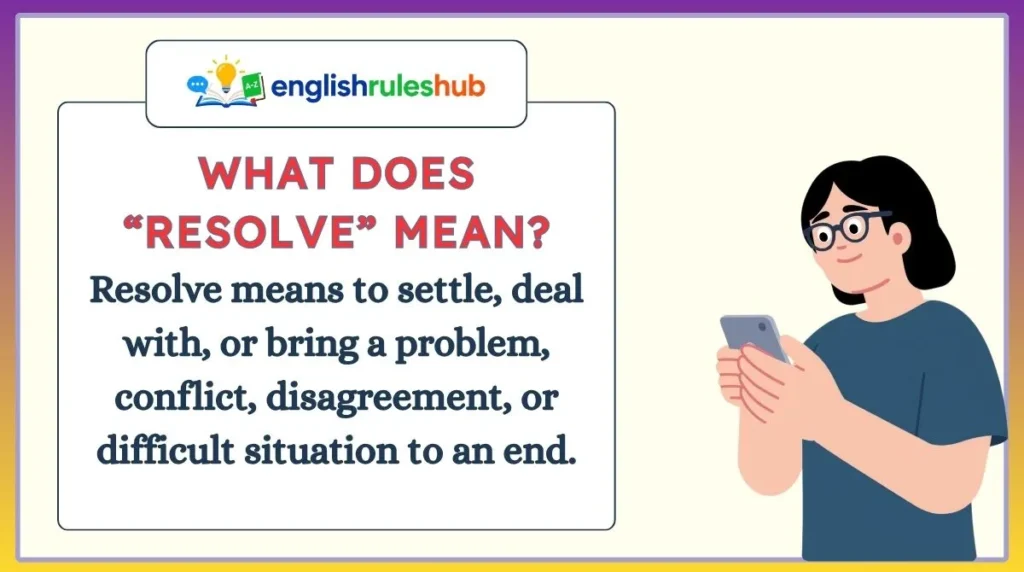
Resolve means to settle, deal with, or bring a problem, conflict, disagreement, or difficult situation to an end.
When you resolve something, you usually make the situation settled or clear.
For example:
- We need to resolve this conflict.
- The two sides finally resolved their disagreement.
- She wants to resolve the issue.
- The company is working to resolve the complaint.
- They met to resolve the dispute.
- We should resolve this matter as soon as possible.
- The manager helped them resolve their argument.
- The problem was eventually resolved.
When Do We Use “Resolve”?
Resolve is especially common with conflicts, disagreements, disputes, complaints, concerns, and matters.
Common combinations include:
- resolve a conflict
- resolve a dispute
- resolve a disagreement
- resolve an argument
- resolve a complaint
- resolve an issue
- resolve a concern
- resolve a matter
- resolve a misunderstanding
- resolve a crisis
For example:
The manager helped resolve the disagreement between the workers.
Here, the goal is not simply to find an answer. The goal is to settle the disagreement.
Another example:
Customer service quickly resolved my complaint.
The company dealt with the complaint and brought the situation to a satisfactory end.
Grammar Rule for “Resolve”
Like solve, resolve is normally a transitive verb.
The basic structure is:
Subject + resolve + object
Examples:
- We resolved the conflict.
- She resolved the issue.
- They resolved the dispute.
- The manager resolved the complaint.
The past form is resolved, and the present participle is also formed normally:
- resolve
- resolves
- resolved
- resolving
For example:
The manager is resolving the problem.
They have resolved the disagreement.
Resolve Can Also Mean “Make a Firm Decision”
There is another important meaning of resolve.
It can mean to make a firm decision to do something.
For example:
She resolved to study harder.
This means she made a strong decision that she would study harder.
Another example:
He resolved to stop wasting time.
This meaning is different from “settle a conflict,” but it is still an important use of the word.
The noun resolution can also mean a firm decision:
My New Year’s resolution is to exercise more.
So, depending on the sentence, resolve can relate either to settling something or making a firm decision.
A Common Learner Confusion
Because resolve and solve both involve fixing something, learners sometimes use them interchangeably.
Sometimes that works.
For example:
We need to solve the problem.
We need to resolve the problem.
Both may be understood, although the first is usually more natural when talking about finding an answer.
But with a disagreement, resolve is usually the better choice:
We need to resolve the disagreement.
The main idea to remember is that resolve often carries the feeling of settling something that is causing tension, uncertainty, or disagreement.
Difference Between Solve and Resolve (Detailed)
The easiest way to understand solve vs resolve is to look at what kind of situation each word normally describes.
| Word | Main idea | Common objects | Example |
|---|---|---|---|
| Solve | Find an answer or solution | problem, puzzle, mystery, equation, case | She solved the puzzle. |
| Resolve | Settle or bring something to an end | conflict, dispute, disagreement, complaint, issue | They resolved the conflict. |
1. Solve Focuses on Finding an Answer
When you solve something, you normally discover the answer or find a way to deal with a difficulty.
Think about a math problem.
You look at the numbers, think carefully, and find the answer. You solve the problem.
The same idea works with a mystery.
A detective collects information and discovers who committed the crime. The detective solves the mystery.
So, solve = find the answer or solution.
2. Resolve Focuses on Settling Something
When you resolve something, the main idea is often that an unsettled situation becomes settled.
Imagine two coworkers arguing about a project.
They talk to each other, understand the problem, and agree on what to do. They resolve the disagreement.
Nothing necessarily needed a mathematical answer. Instead, the disagreement needed to be settled.
So, resolve = settle or bring to a satisfactory end.
3. “Problem” Can Work With Both
This is one reason learners find these words difficult.
We can say:
We need to solve the problem.
We can also say:
We need to resolve the problem.
However, the meaning can have a slightly different focus.
Solve the problem usually suggests finding a solution to the problem.
Resolve the problem emphasizes dealing with the problem and getting the situation settled.
In everyday English, solve the problem is often the safer and more common choice.
4. Conflicts Usually Take “Resolve”
With words such as conflict, dispute, disagreement, and argument, resolve is normally the natural choice.
For example:
The two countries are trying to resolve the dispute.
We need to resolve this disagreement.
They talked calmly and resolved their conflict.
“Solve a disagreement” is understandable, but it does not sound as natural as resolve a disagreement.
5. Puzzles Usually Take “Solve”
We normally say:
Can you solve this puzzle?
Not:
Can you resolve this puzzle?
A puzzle has an answer that you need to discover, so solve is the normal verb.
The same applies to many academic situations:
solve an equation
solve a math problem
solve a riddle
solve a question
6. Both Can Be Used With “Issue”
The word issue is flexible.
We can say:
We need to solve the issue.
We can also say:
We need to resolve the issue.
Both are possible, but resolve the issue is very common in business, customer service, workplace, and formal communication.
For example:
Our support team will resolve your issue as quickly as possible.
This sounds natural and professional.
7. Sentence Structure Is Very Similar
Both verbs normally follow the same basic pattern:
Subject + verb + object
With solve:
The teacher solved the problem.
With resolve:
The teacher resolved the disagreement.
The grammar structure is not the main difference. The type of object and the meaning are what matter most.
8. Meaning in One Simple Comparison
Think of these two questions:
Solve: “What is the answer?”
Resolve: “How can we settle this?”
That is not a perfect rule for every sentence, but it is a very useful guide for beginners.
Grammar Rules You Must Remember
Rule #1: Use “Solve” for Problems, Puzzles, and Questions
Use solve when you need to find an answer or solution.
Examples:
I cannot solve this math problem.
Can you solve this puzzle?
The detective solved the mystery.
A useful pattern is:
solve + problem/puzzle/mystery/equation
Rule #2: Use “Resolve” for Conflicts and Disagreements
Use resolve when people or groups have a conflict, dispute, disagreement, or argument that needs to be settled.
Examples:
They finally resolved their disagreement.
The two sides are trying to resolve the conflict.
We need to resolve this dispute peacefully.
A useful pattern is:
resolve + conflict/dispute/disagreement/argument
Rule #3: Both Words Can Work With Some General Problems
Some nouns can be used with either verb, especially problem and issue.
For example:
We need to solve the problem.
We need to resolve the problem.
And:
The company needs to solve the issue.
The company needs to resolve the issue.
The choice depends on the focus. If you are thinking about finding an answer, solve is a strong choice. If you are thinking about settling or dealing with the situation, resolve often sounds better.
Rule #4: “Resolve” Can Mean “Make a Firm Decision”
Do not forget this second meaning.
For example:
She resolved to improve her English.
This means she made a firm decision.
The structure is:
resolve + to + base verb
Examples:
He resolved to work harder.
They resolved to be more careful.
I resolved to wake up early.
Do not confuse this use with resolve a conflict. They are two different meanings of the same verb.
Common Mistakes Students Make
Mistake 1: Using “Solve” With Every Conflict
A learner may say:
❌ We need to solve our disagreement.
The meaning is understandable, but this is not the most natural choice.
Better:
✅ We need to resolve our disagreement.
The reason is simple: a disagreement is something you usually settle, rather than something you simply find an answer to.
Mistake 2: Using “Resolve” for Every Puzzle
Some learners think resolve sounds more formal, so they use it everywhere.
For example:
❌ I need to resolve this crossword puzzle.
Better:
✅ I need to solve this crossword puzzle.
A puzzle has an answer, so solve is the natural word.
Mistake 3: Thinking the Words Are Always Interchangeable
Although their meanings overlap, they are not identical.
Compare:
She solved the mystery.
She resolved the mystery.
The first sentence is natural. The second sounds unusual because mysteries are normally solved.
Now compare:
They solved the disagreement.
They resolved the disagreement.
The second sentence is much more natural.
Mistake 4: Forgetting the Object
Because both verbs are transitive, learners often need an object after them.
Instead of:
❌ We need to solve.
Say:
✅ We need to solve the problem.
Instead of:
❌ They need to resolve.
Say:
✅ They need to resolve the conflict.
Of course, in conversation, the object can sometimes be understood from context:
“Have you solved it?”
That is perfectly natural because it gives the verb an object.
Mistake 5: Confusing “Resolve to” With “Resolve Something”
These two patterns have different meanings.
She resolved the problem.
Here, she settled or dealt with the problem.
But:
She resolved to study harder.
Here, she made a firm decision.
Remember the structures:
resolve + object = settle something
resolve + to + verb = firmly decide to do something
Easy Trick to Remember the Difference
Here is a simple classroom trick:
Solve = find the answer.
Resolve = settle the situation.
Imagine a student sitting at a desk with a difficult math question.
The student thinks, calculates, and finds the answer.
They solve the problem.
Now imagine two friends who are angry with each other.
They sit down, talk about what happened, apologize, and agree on a way forward.
They resolve their disagreement.
You can also remember this small pair:
Puzzle → solve
Conflict → resolve
For example:
Solve the puzzle.
Resolve the conflict.
This trick will help you in many everyday situations.
Another useful clue is the kind of noun after the verb.
If the noun sounds like something with an answer, choose solve.
If the noun sounds like something that needs to be settled, choose resolve.
A Quick Memory Test
Ask yourself:
“Am I looking for an answer?”
If yes, solve is probably right.
Ask:
“Am I trying to settle a disagreement or difficult situation?”
If yes, resolve is probably right.
This is not an absolute rule because English has many flexible expressions, but it is an excellent starting point for learners.
Daily Life Examples (Very Important)
Real conversations make these words easier to remember.
Example 1: At School
Student: I don’t understand this math question.
Friend: Give it to me. Maybe we can solve it together.
Here, solve is correct because the question has an answer.
Example 2: At Work
Manager: We have a disagreement about the new schedule.
Employee: We should sit down and resolve it.
Here, resolve fits because there is a disagreement that needs to be settled.
Example 3: Customer Service
Customer: My order still hasn’t arrived.
Agent: I’m sorry about that. I’ll try to resolve the issue today.
Here, resolve sounds natural because the agent is dealing with a customer problem.
Example 4: A Puzzle
Brother: Can you solve this riddle?
Sister: Let me think. I think I know the answer!
The riddle has an answer, so we use solve.
Example 5: Friends
Friend 1: Are you still angry with Ali?
Friend 2: No. We talked yesterday and resolved our disagreement.
The disagreement has been settled.
Example 6: A Mystery
Reporter: Did the police solve the case?
Officer: Yes. They found enough evidence to identify the person responsible.
A case or mystery is commonly solved.
Example 7: Family
Mother: Why are you two arguing?
Son: We disagree about who should use the computer first.
Mother: Sit down and resolve the problem calmly.
Here, resolve emphasizes settling the situation.
Example 8: Technology
User: My computer keeps shutting down.
Technician: I’ll check it and try to solve the problem.
The technician is looking for the cause and a solution.
Example 9: Business
Manager: The customer has made a complaint.
Employee: I’ll contact her and try to resolve the complaint.
This sounds professional and natural.
Example 10: Personal Decision
Friend: Are you going to change your study routine?
Student: Yes. I’ve resolved to study every evening.
Here, resolved to means “made a firm decision.”
Practice Section
Choose solve or resolve to complete each sentence.
1. Can you ______ this math problem?
Answer: solve
A math problem normally has an answer that you need to find.
2. The two teams need to ______ their disagreement.
Answer: resolve
A disagreement needs to be settled.
3. The detective finally ______ the mystery.
Answer: solved
A mystery is normally solved when its answer is discovered.
4. The manager promised to ______ the customer’s complaint.
Answer: resolve
A complaint is something that can be dealt with and settled.
5. She ______ to improve her English this year.
Answer: resolved
The pattern resolve + to + verb means to make a firm decision.
FAQs
What is the main difference between “solve” and “resolve”?
Solve usually means to find an answer or solution to a problem, puzzle, mystery, or question. Resolve usually means to settle a conflict, disagreement, dispute, complaint, or difficult situation. They overlap in some contexts, but they are not always interchangeable.
Can we use “solve” and “resolve” with “problem”?
Yes, both are possible.
Solve the problem usually focuses on finding an answer or solution. Resolve the problem focuses more on dealing with the situation and bringing it to an end. In everyday English, “solve the problem” is often the more common choice.
Should I say “solve a conflict” or “resolve a conflict”?
Resolve a conflict is the natural choice in most situations.
For example:
The two sides need to resolve the conflict.
“Solve a conflict” can be understood, but native speakers usually prefer resolve when talking about conflicts.
Is “resolve” more formal than “solve”?
Resolve can sound more formal or professional in some contexts, especially with words such as issue, dispute, complaint, matter, and conflict. However, both words are common in everyday English. The choice should depend mainly on meaning, not simply on formality.
Can “resolve” be used in a question?
Yes. You can easily use resolve in questions.
For example:
How can we resolve this conflict?
Did they resolve the disagreement?
Can you resolve this issue?
The grammar is completely normal.
Can “solve” be used for people’s disagreements?
It can sometimes be understood, but resolve is usually the better word.
For example:
We need to resolve our disagreement.
This sounds more natural than:
We need to solve our disagreement.
Use solve when you are mainly finding an answer, and resolve when you are settling a disagreement or conflict.
Final Conclusion
The difference between solve and resolve becomes much easier when you focus on the type of situation you are describing.
Use solve when you need to find an answer or solution. We solve problems, puzzles, mysteries, equations, and cases.
Use resolve when you need to settle something, especially a conflict, disagreement, dispute, complaint, or issue.
Remember the simple trick: solve means find the answer; resolve means settle the situation.
There are also situations where both words can work, especially with general words such as problem and issue. In those cases, think about what you want to emphasize.
And remember one special pattern: resolve to + verb means to make a firm decision.
You do not need to memorize dozens of difficult rules. Start by learning common word combinations and use them in your own sentences. After you see and hear these verbs often, the difference will begin to feel natural.
Keep practicing, and soon you will be able to choose between solve and resolve with confidence.

I am Benjamin Clark, an English language writer passionate about simplifying grammar, vocabulary, and word meanings. I create clear, accurate, and practical content to help learners improve their English skills with confidence every day.