English has many verbs that do not follow the usual -ed rule. The verb stink is one of them. This is why learners often stop and wonder: Should I say stink, stank, or stunk?
The confusion becomes even greater because all three words are connected to the same basic idea: having a very bad smell. However, they are not always used in the same way. Their forms change depending on the time of the action and the grammar of the sentence.
For example, you can say, “These shoes stink.” You can also say, “These shoes stank yesterday.” If you use a helping verb such as have or had, you normally need stunk: “These shoes have stunk for days.”
This small difference matters in everyday English. People use stink when talking about food, clothes, rooms, garbage, animals, places, and even situations. You may also hear stink used in a less literal way, such as “This situation stinks.”
The good news is that the rule is easier than it first appears. Once you understand which form goes with present time, simple past, and perfect tenses, the three words become much easier to choose.
By the end, you will know exactly when to use stink, stank, and stunk, how their sentence structures work, what common mistakes to avoid, and how native speakers use these forms in everyday conversation.
What Does “Stink” Mean?
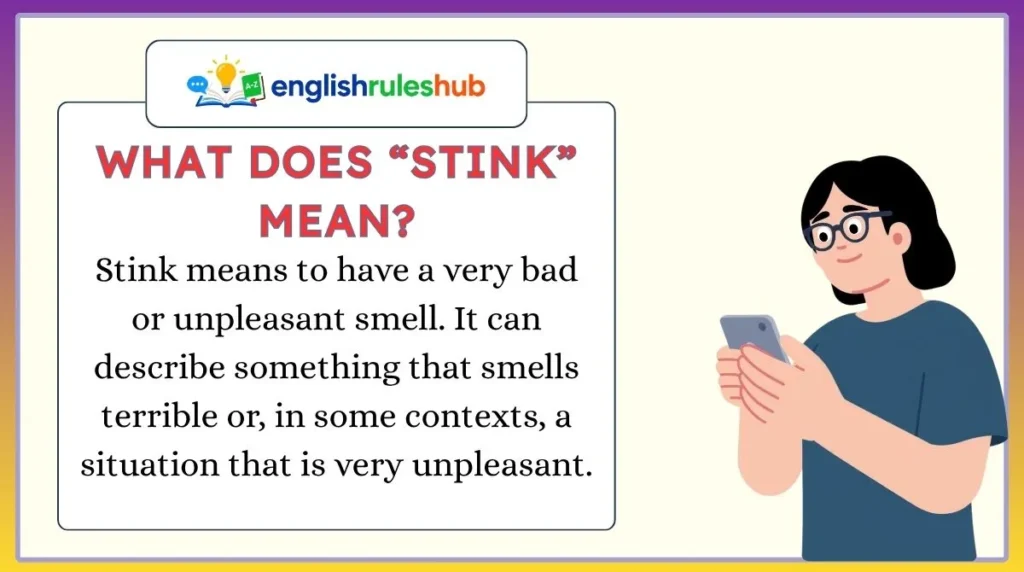
Stink means to have a very bad or unpleasant smell. It can describe something that smells terrible or, in some contexts, a situation that is very unpleasant.
As a verb, stink is an irregular verb. It does not normally become stinked in standard English. Its common forms are:
- Present: stink
- Simple past: stank
- Past participle: stunk
The present form is used when the bad smell is happening now, happens regularly, or is generally true.
For example:
“Your socks stink.”
The speaker is talking about the smell right now.
You can also use stink with subjects such as I, you, we, and they:
- I stink after playing football.
- You stink of smoke.
- We stink after working outside all day.
- They stink after the long journey.
With he, she, and it in the simple present, the verb usually takes -s:
stink → stinks
So we say:
- The kitchen stinks.
- His shoes stink.
- This milk stinks.
- The dog stinks.
Notice that the word stink can describe both people and things. It does not always mean that something is literally rotten. A person can also say that someone stinks of perfume, smoke, sweat, or cigarettes.
Examples with “Stink”
- These old shoes stink.
- The garbage stinks in this heat.
- My room stinks because I forgot the food inside.
- Your jacket stinks of smoke.
- That fish really stinks.
- The bathroom stinks after the pipe broke.
- My feet stink after wearing these shoes all day.
- This place stinks!
The word can also be used figuratively.
For example:
“This deal stinks.”
Here, the speaker does not mean that the deal has a bad smell. The meaning is closer to “This deal is bad or unfair.”
Another example is:
“That excuse stinks.”
Again, this means the excuse seems bad, weak, or unconvincing.
Common Confusion About “Stink”
One common mistake is treating stink like a regular verb:
❌ The garbage stinked yesterday.
In standard English, this should normally be:
✅ The garbage stank yesterday.
Another mistake is using stink after have when the past participle is needed:
❌ The garbage has stink for two days.
✅ The garbage has stunk for two days.
The key is to look at the words around the verb. Stink is mainly the present form, while stank and stunk have different grammatical jobs.
What Does “Stank” Mean?
Stank is the simple past form of stink.
Use stank when you are talking about a bad smell that happened or existed in the past.
For example:
“The kitchen stank yesterday.”
The kitchen smelled very bad yesterday. The sentence places the bad smell in the past.
Unlike stink, stank does not need an -ed ending. It is an irregular past form.
The basic pattern is:
Subject + stank + complement
Examples:
- The room stank.
- The fish stank.
- His shoes stank.
- The garbage stank.
You can also add a past-time expression:
- The kitchen stank yesterday.
- The bathroom stank last night.
- The old car stank after the trip.
- The fish stank all morning.
Examples with “Stank”
- The kitchen stank after we cooked the fish.
- His shoes stank yesterday.
- The garbage stank in the summer heat.
- The bathroom stank after the pipe broke.
- My jacket stank of smoke after the party.
- The old refrigerator stank when we opened it.
- The whole room stank after the food was left outside.
- The dog stank after rolling in something dirty.
These sentences describe something that smelled bad in the past.
“Stank” and Time Expressions
A useful way to recognize stank is to look for a finished past time.
Words and phrases such as these often point toward the simple past:
- yesterday
- last night
- last week
- this morning, when the morning is finished
- two days ago
- when I was a child
- after the accident
- earlier
For example:
“The car stank yesterday.”
“The bathroom stank last night.”
“The fish stank two days ago.”
However, a time expression is not always required. The context can make the past meaning clear:
“We opened the box, and it stank.”
The word opened is past tense, so stank naturally fits the story.
Common Confusion About “Stank”
Some learners think stank is simply another form of stink that can be used anywhere.
It cannot.
For example:
❌ The room stank right now.
If you mean the room smells bad now, say:
✅ The room stinks right now.
Similarly:
❌ The room has stank for a week.
The usual standard form is:
✅ The room has stunk for a week.
So remember: stank belongs mainly to the simple past.
Difference Between Stink, Stank, and Stunk
The easiest way to understand these three forms is to connect each one with its grammatical role.
| Form | Main grammar use | Example |
|---|---|---|
| stink | Present/base form | These shoes stink. |
| stinks | Simple present with he/she/it | The room stinks. |
| stank | Simple past | The room stank yesterday. |
| stunk | Past participle | The room has stunk for days. |
The biggest difference is time and sentence structure.
Stink: Present or Base Form
Use stink when talking about something in the present or when using the base form after certain helping verbs.
Examples:
“These socks stink.”
“I think this food will stink if we leave it outside.”
After will, we use the base form:
will + stink
Not:
❌ will stank
And not:
❌ will stunk
Stank: Simple Past
Use stank when the action or condition happened in the past.
“The room stank yesterday.”
Here, stank is the main past-tense verb.
The basic structure is:
Subject + stank
For example:
The garbage + stank.
Stunk: Past Participle
Stunk is normally used as the past participle.
It commonly appears after helping verbs such as:
- have
- has
- had
Examples:
“The room has stunk all week.”
“The room had stunk before we cleaned it.”
The structure is:
have/has/had + stunk
This is one of the most important rules to remember.
Why “Stunk” Can Feel Confusing
Many learners hear native speakers use stunk and assume it is simply another past form.
In standard grammar, stank is the traditional simple past form, while stunk is the past participle.
So:
✅ The room stank yesterday.
✅ The room has stunk for three days.
However, English usage can vary by region and style, and some speakers use stunk as a simple past form in informal speech. You may therefore hear sentences such as “It stunk yesterday.” This is common enough to be recognized, especially in American English.
For learners, though, the safest pattern is:
stink → stank → stunk
That gives you a clear standard model for formal and careful English.
Grammar Rules You Must Remember
Rule #1: Use “Stink” for the Present
When something smells bad now or regularly, use stink or stinks, depending on the subject.
Examples:
These shoes stink.
This room stinks.
Remember the subject-verb rule:
- I/you/we/they stink
- he/she/it stinks
For example:
They stink after playing football.
But:
He stinks after playing football.
Rule #2: Use “Stank” for the Simple Past
When the bad smell happened in a finished past situation, stank is the traditional simple past form.
Examples:
The fish stank yesterday.
The kitchen stank after dinner.
His clothes stank after the trip.
The important point is that stank can stand alone as the main past-tense verb.
Rule #3: Use “Stunk” After Have, Has, or Had
When you use the present perfect or past perfect, use stunk.
Examples:
The room has stunk for days.
The garbage has stunk since Monday.
The bathroom had stunk before we cleaned it.
The pattern is:
has/have + stunk
or
had + stunk
Do not use stank after these helping verbs in standard English:
❌ The room has stank for days.
✅ The room has stunk for days.
Rule #4: Use the Base Form After “Will” and “Did”
This rule is especially useful because learners sometimes try to put stank or stunk after did and will.
After will, use the base form:
✅ The food will stink if we leave it here.
Not:
❌ The food will stank.
After did, use the base form too:
✅ Did the room stink yesterday?
Not:
❌ Did the room stank yesterday?
This is a general English rule. Once did carries the past tense, the main verb goes back to its base form.
Common Mistakes Students Make
The confusion usually happens because English has three related forms, and learners may know the words but not know which grammar pattern controls them.
Mistake 1: Using “Stinked”
Some learners add -ed because they know that many English verbs form the past this way.
❌ The garbage stinked yesterday.
✅ The garbage stank yesterday.
Stink is an irregular verb, so it does not normally use stinked as its standard simple past form.
Mistake 2: Using “Stank” After “Has”
❌ The room has stank all day.
✅ The room has stunk all day.
The word has tells you that you need the past participle.
Think:
has + stunk
Mistake 3: Using “Stank” After “Did”
❌ Did it stank?
✅ Did it stink?
This may feel strange at first. But did already shows the past.
Compare:
It stank.
Did it stink?
The first sentence has no helping verb, so stank carries the past tense. In the question, did carries the past tense, so the main verb returns to stink.
Mistake 4: Using “Stunk” as the Main Present Verb
❌ My shoes stunk right now.
✅ My shoes stink right now.
If you are talking about the smell now, use the present form.
Mistake 5: Forgetting “Stinks”
Learners sometimes say:
❌ This room stink.
When the subject is singular, standard simple present grammar requires:
✅ This room stinks.
The same pattern appears with many other verbs:
He works.
She walks.
It smells.
It stinks.
Easy Correction Tip
Before choosing the word, ask yourself two questions:
1. Am I talking about now?
Use stink/stinks.
2. Am I talking about the past?
Then ask whether you have a helping verb.
- No helping verb → stank
- Have/has/had → stunk
This small check can prevent most mistakes.
Easy Trick to Remember the Difference
Here is a simple memory trick:
Stink = now
Stank = past
Stunk = have/has/had
You can remember the three forms as a little ladder:
Today → stink
Yesterday → stank
Have/has/had → stunk
For example:
Today:
“My shoes stink.”
Yesterday:
“My shoes stank.”
For several days:
“My shoes have stunk.”
There is also a useful classroom trick. Put the three forms into three boxes:
NOW → STINK
PAST → STANK
PERFECT → STUNK
If you see yesterday, last night, or another finished past event, stank is a strong choice.
If you see has, have, or had, think stunk.
If you are simply describing the smell now, think stink/stinks.
One more useful point: stink is also the base form after words such as do, does, did, can, could, will, would, should, and might.
For example:
Did it stink?
Can it stink that badly?
Will it stink tomorrow?
It might stink later.
That is because modal and auxiliary verbs often require the base form.
Daily Life Examples
These examples show how people might actually use these words in normal conversation.
1. Talking About Shoes
A: Why are you opening the window?
B: Your football shoes stink!
Here, stink is present because the shoes smell bad now.
2. Talking About Yesterday
A: How was the old apartment?
B: It was nice, but the bathroom stank.
The speaker is describing a past experience, so stank fits the traditional simple past.
3. Talking About a Long-Lasting Smell
A: Why does the kitchen still smell bad?
B: It has stunk since yesterday.
The word has is followed by the past participle stunk.
4. Asking a Question
A: Did something stink in the fridge?
B: Yes. There was some old cheese inside.
Notice:
Did + stink
Not:
❌ Did something stank?
5. Talking About Food
A: Is this milk still good?
B: No. Smell it. It stinks.
The present form is used because the milk smells bad now.
6. Talking About a Trip
A: Why did you wash your jacket?
B: It stank after the camping trip.
The bad smell happened after a past event.
7. Talking About Garbage
A: Who forgot to take out the garbage?
B: I think it was Tom. The bag stinks.
The smell is happening now.
8. Talking About a Room
A: Was the room clean?
B: It looked clean, but it stank.
The speaker is describing a past visit.
9. Using the Perfect Tense
A: Why did you leave the house?
B: The kitchen has stunk for two days. I couldn’t stand it anymore.
Here, has stunk shows that the bad smell began earlier and continued up to the present.
10. Using “Stink” Figuratively
A: Did you accept that offer?
B: No. The deal stinks.
Here, stinks does not describe a physical smell. It means the deal seems bad, unfair, or unpleasant.
Practice Section
Choose the correct form in each sentence: stink, stinks, stank, or stunk.
1. These old socks ______ after the game.
2. The kitchen ______ yesterday.
3. This garbage ______ terrible right now.
4. The bathroom has ______ for two days.
5. Did the fish ______ when you opened the box?
Answers
1. stank
The sentence describes a completed past situation: after the game. In a standard simple-past pattern, stank works.
2. stank
Yesterday clearly points to the simple past.
3. stinks
The word right now tells us that the smell is happening in the present. The subject this garbage is singular, so use stinks.
4. stunk
After has, use the past participle: has stunk.
5. stink
After did, use the base form: Did the fish stink?
A good way to practice is to say the answers aloud. English grammar becomes easier when your eyes, ears, and mouth all get used to the pattern.
FAQs
What is the difference between stink, stank, and stunk?
Stink is the present or base form, stank is traditionally the simple past form, and stunk is the past participle.
For example: “It stinks now.” “It stank yesterday.” “It has stunk for days.”
That three-part pattern is the most useful one for learners to remember.
Is “stank” the past tense of “stink”?
Yes. Stank is the traditional simple past form of stink.
For example: “The garbage stank yesterday.”
You may also hear stunk used as a simple past form in some varieties of English, especially informal American speech. However, learners can safely use stank for the standard simple-past pattern.
Is “stunk” a past tense or past participle?
Stunk is the past participle in the standard pattern.
It is used with have, has, or had:
“The room has stunk all week.”
“The room had stunk before we cleaned it.”
Some speakers also use stunk as a simple past form, but the traditional learner-friendly pattern is stink–stank–stunk.
Can I say “Did it stank?”
No, not in standard English.
After did, use the base form:
✅ Did it stink?
The word did already carries the past meaning, so the main verb stays in its base form.
This same rule applies to many irregular verbs: Did he go?, not Did he went?
Is “stink” formal or informal?
Stink is a normal English word and is used in both everyday and informal speech. However, it can sound stronger and more direct than words such as smell bad or have an unpleasant odor.
For example, “The garbage stinks” is natural everyday English. In a formal report, “The garbage has an unpleasant odor” may sound more suitable.
Can “stink” describe something other than a smell?
Yes. Stink can be used figuratively to say that something is very bad, unfair, unpleasant, or disappointing.
For example:
“That deal stinks.”
“This situation stinks.”
In these sentences, there is no literal bad smell. The word expresses a strong negative opinion.
Final Conclusion
The three forms stink, stank, and stunk may look confusing at first, but their main grammar pattern is quite simple.
Use stink or stinks when you are talking about the present. For example, “The kitchen stinks.”
Use stank for the traditional simple past: “The kitchen stank yesterday.” Use stunk as the past participle after have, has, or had: “The kitchen has stunk for days.”
Also remember an important question rule: after did, use stink, not stank. So say, “Did it stink?”
English speakers sometimes use stunk as a simple past form in informal speech, so you may hear it in conversation. Still, the pattern stink–stank–stunk is an excellent starting point for learners.
Try making a few sentences of your own. Once you connect each form with its grammar job, choosing the right word becomes much more natural.

I am Benjamin Clark, an English language writer passionate about simplifying grammar, vocabulary, and word meanings. I create clear, accurate, and practical content to help learners improve their English skills with confidence every day.