English has many words that look almost the same but have very different meanings. “Please” and “pleas” are a good example. They differ by only one letter, so beginners and even some advanced learners can mix them up.
You may see please in everyday conversations, emails, requests, and polite questions. For example, someone may say, “Please help me,” or “Could you please open the door?” It is one of the most common words in spoken English.
The word pleas, however, has a different meaning. It is the plural form of plea, a noun. A plea is a serious request for help, mercy, or a certain action. It can also be used in a legal situation, such as when a person enters a plea in court.
This small spelling difference creates a big meaning difference. If you write “I made several please”, the sentence is wrong because please is not the plural of plea.
Likewise, replacing please with pleas in a polite request can completely change the meaning.
The good news is that the difference is easy to understand once you know the basic grammar.
By the end of this guide, you will know what please means, what pleas means, how they work in sentences, when to use each word, common mistakes to avoid, and an easy trick to remember them.
What Does “Please” Mean?
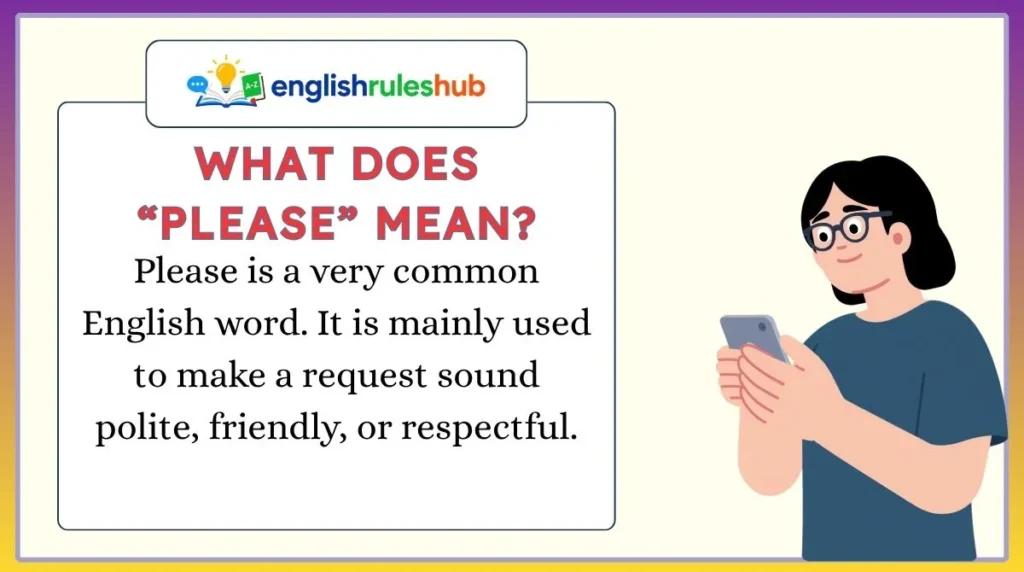
Please is a very common English word. It is mainly used to make a request sound polite, friendly, or respectful.
When you ask someone to do something, adding please can make your request softer.
Compare these two sentences:
- Give me your pen.
- Please give me your pen.
The first sentence can sound direct. The second sounds more polite.
Please can be used in many different places in a sentence. You can put it at the beginning, in the middle, or sometimes at the end.
Please as a polite word
The most common use of please is to make a request.
For example:
- Please close the window.
- Please give me a glass of water.
- Can you please help me?
- Please wait here for a moment.
- Could you please call me later?
- Please do not touch that.
- Would you please check this document?
- Please come inside.
In each sentence, please shows politeness.
Please in questions
Please is also very common in questions.
For example:
- Could you please repeat that?
- Can you please speak slowly?
- Would you please sit down?
- Can you please send me the file?
Notice that please does not change the basic grammar of the question. It simply makes the request more polite.
Please at the beginning or end
You can often put please at different positions.
For example:
- Please open the door.
- Open the door, please.
Both sentences are grammatically correct. The meaning is almost the same.
You can also say:
- Please help me.
- Help me, please.
In everyday speech, both forms are natural.
Please with modal verbs
Please often appears with words such as can, could, would, and will.
Examples include:
- Could you please help me?
- Can you please wait outside?
- Would you please explain this again?
- Will you please turn off the light?
The word please makes the request sound more courteous.
Please can also be a verb
There is another use of please that learners should know. Please can also be a verb meaning “to make someone happy” or “to satisfy someone.”
For example:
- The gift pleased her.
- He wants to please his parents.
- This answer will please your teacher.
Here, please is not a polite request word. It is a verb.
The sentence “I want to please my parents” means “I want to make my parents happy.”
A common confusion
One important point is that please is not the plural form of plea.
For example:
- ❌ I heard three please from the crowd.
- ✅ I heard three pleas from the crowd.
The first sentence is incorrect if you mean three serious requests.
What Does “Pleas” Mean?
Pleas is the plural form of the noun plea.
A plea is a serious request or an appeal for something. The plural form is pleas.
So:
- one plea
- two pleas
- several pleas
- many pleas
The word pleas is normally used as a noun, not as a polite word for making everyday requests.
Pleas as serious requests
A plea can be a strong or emotional request for help, mercy, support, or action.
For example:
- Her pleas for help were ignored.
- The family made pleas for information.
- His pleas for mercy were heard.
- The villagers made several pleas for clean water.
- The child’s pleas finally changed her mind.
- They ignored our pleas for assistance.
- The man’s pleas were very emotional.
- The organization made pleas for donations.
In these examples, pleas means serious requests or appeals.
Plea in legal English
Plea is also an important word in legal English.
In court, a person may enter a plea such as:
- guilty
- not guilty
- no contest
For example:
- The defendant entered a plea of not guilty.
- He changed his plea in court.
- The judge accepted her guilty plea.
The plural form can be pleas when talking about more than one plea.
For example:
- The court heard several pleas from the defendants.
The legal meaning is different from the everyday meaning of a polite request.
Pleas can show strong emotion
A plea is often stronger than an ordinary request.
Imagine a friend saying:
“Please give me some water.”
That is a normal polite request.
Now imagine someone trapped somewhere shouting:
“His pleas for help could be heard from outside.”
This describes a much more serious situation.
The word pleas often suggests urgency, emotion, desperation, or seriousness.
A common confusion
Because pleas looks like please, learners sometimes use it in polite requests.
For example:
- ❌ Pleas open the door.
- ✅ Please open the door.
The correct word for a polite request is please.
On the other hand:
- ❌ We heard several please for help.
- ✅ We heard several pleas for help.
Here, the correct noun is pleas.
Difference Between Please and Pleas
The easiest way to understand the difference is to remember that please is usually connected with polite requests, while pleas is the plural of plea.
| Word | Grammar | Main meaning | Example |
|---|---|---|---|
| please | Adverb / verb | Used to make a request polite; also means to make someone happy | Please help me. |
| pleas | Plural noun | More than one serious request or appeal | Her pleas were ignored. |
| plea | Singular noun | One serious request or appeal | His plea for help was answered. |
Usage difference
Use please when you are directly asking someone to do something politely.
For example:
Please call me tomorrow.
You are talking directly to the person and making a request.
Use pleas when you are talking about several requests or appeals.
For example:
The man’s pleas for help were ignored.
You are not using pleas to make the request. You are describing the requests themselves.
That is the key difference.
Grammar logic
The grammar also helps you identify the correct word.
Please can work as a polite adverb:
Please + verb
Examples:
- Please sit down.
- Please wait.
- Please listen.
- Please call me.
It can also appear with a modal question:
Can/Could/Would + subject + please + verb?
Examples:
- Could you please help me?
- Can you please wait?
- Would you please explain this?
Pleas, however, is a plural noun.
It normally refers to more than one plea.
Examples:
- several pleas
- many pleas
- their pleas
- desperate pleas
- emotional pleas
- repeated pleas
You can say:
Their pleas were ignored.
But you cannot normally use pleas as a polite replacement for please.
Sentence structure difference
Look at these structures:
Please + verb
- Please open the door.
- Please wait outside.
Subject + verb + pleas
- Her pleas were ignored.
- Their pleas touched the judge.
Pleas + for + noun
- pleas for help
- pleas for mercy
- pleas for support
- pleas for information
Examples:
- They made pleas for help.
- The family made several pleas for information.
The sentence structure gives you a strong clue about which word you need.
Meaning comparison
Think of these two sentences:
Please help me.
This is a direct, polite request.
His pleas for help were ignored.
This means that he made serious requests for help, but nobody responded.
The first sentence uses please to make the request polite.
The second uses pleas as a noun to describe the requests.
Grammar Rules You Must Remember
Rule #1: Use “please” for polite requests
When you politely ask someone to do something, use please.
Examples:
- Please pass the salt.
- Please wait for me.
- Please call your mother.
Do not use pleas in these sentences.
❌ Pleas wait for me.
✅ Please wait for me.
Rule #2: “Pleas” is the plural of “plea”
If you have more than one plea, the correct plural form is pleas.
For example:
- one plea
- two pleas
- several pleas
- many pleas
Example:
The organization received several pleas for help.
Here, pleas is a noun.
Rule #3: Use “please” with polite questions
When asking someone to do something politely, please can be used with can, could, would, or will.
Examples:
- Could you please help me?
- Can you please send the email?
- Would you please close the window?
The word pleas cannot replace please in these structures.
Rule #4: “Pleas” often describes serious or emotional appeals
The noun pleas often appears when the request is important, urgent, emotional, or serious.
Common expressions include:
- pleas for help
- pleas for mercy
- pleas for support
- pleas for information
- desperate pleas
- emotional pleas
- repeated pleas
Example:
Despite repeated pleas for help, nobody came.
The word pleas here means serious appeals.
Common Mistakes Students Make
Many mistakes happen because please and pleas sound almost identical when spoken quickly.
Their spelling is also very similar. However, their grammar and meaning are different.
Mistake 1: Writing “pleas” instead of “please”
Incorrect:
Pleas help me with this homework.
Correct:
Please help me with this homework.
A quick way to correct this is to ask yourself:
Am I politely asking someone to do something?
If yes, you probably need please.
Mistake 2: Using “please” as the plural of “plea”
Incorrect:
The victim made several please for help.
Correct:
The victim made several pleas for help.
Here, pleas is a plural noun.
The singular form is plea:
The victim made a plea for help.
More than one:
The victim made several pleas for help.
Mistake 3: Confusing “pleas” with “please” in writing
Because the words sound similar, a learner may write:
Pleas send me the details.
This is a spelling mistake.
The correct sentence is:
Please send me the details.
Remember that the polite word ends with -se:
please
Mistake 4: Thinking every request needs “plea”
A normal request does not usually need the noun plea.
For example:
Please give me your notebook.
This is a normal request.
You would not normally say:
I made a plea for your notebook.
That sounds very serious and unusual. A plea is generally a strong appeal, not an ordinary everyday request.
Mistake 5: Forgetting that “please” has another meaning
Please can also be a verb.
For example:
She wants to please her boss.
This means she wants to make her boss happy.
Compare:
Please sit down.
Here, please is used in a polite request.
The performance pleased the audience.
Here, pleased is the verb meaning “made happy.”
Easy Trick to Remember the Difference
Here is a simple classroom trick:
Please = polite request.
Pleas = plural of plea.
You can remember the word please by connecting it with polite language.
When you say:
Please help me.
you are asking politely.
When you see pleas, think:
one plea → two pleas
For example:
His plea was ignored.
More than one:
His pleas were ignored.
Another useful trick is to look at the word that comes after it.
If you see:
please + verb
you probably have the correct word.
Examples:
- Please come.
- Please wait.
- Please listen.
- Please sit.
If you see:
several/many/their + pleas
you are probably talking about the noun.
Examples:
- several pleas
- many pleas
- their pleas
- repeated pleas
You can also remember this little sentence:
“Please” asks politely; “pleas” are requests.
That one sentence can help you remember the difference for a long time.
Daily Life Examples
The best way to learn these words is to see how people actually use them.
Example 1: Asking for help
A: I can’t open this file.
B: Please send it to me. I’ll check it.
Here, please makes the request polite.
Example 2: Asking someone to wait
A: Can I speak to Mr. Khan?
B: Please wait here for a few minutes.
Again, please is used for a polite request.
Example 3: Asking someone to repeat something
A: Sorry, I didn’t hear you.
B: Could you please repeat that?
This is a very natural spoken-English expression.
Example 4: A serious request for help
The family made several pleas for help after the accident.
Here, pleas means serious requests or appeals.
Example 5: A request for information
The police received several pleas for information from the family.
The word pleas describes multiple serious appeals.
Example 6: Asking someone to be quiet
Please keep your voice down. The baby is sleeping.
This is a normal polite request.
Example 7: A desperate appeal
Despite their pleas, the company refused to change its decision.
Here, pleas means repeated or serious appeals.
Example 8: Asking for a favor
Could you please lend me your pen?
This is a common everyday request.
Example 9: A plea for mercy
The prisoner made a plea for mercy.
There is only one plea, so we use the singular noun plea.
Example 10: More than one appeal
The organization made several pleas for donations.
Because there were several appeals, we use pleas.
Practice Section
Choose the correct word: please or pleas.
1. ______ open the window.
a) Please
b) Pleas
2. The family made several ______ for help.
a) please
b) pleas
3. Could you ______ send me the address?
a) please
b) pleas
4. His repeated ______ were ignored.
a) please
b) pleas
5. ______ don’t forget your keys.
a) Please
b) Pleas
Answers
1. Please
“Please open the window” is a polite request.
2. pleas
“Several pleas” means several serious requests or appeals.
3. please
“Could you please…” is a common polite-question structure.
4. pleas
“Repeated pleas” means repeated serious requests.
5. Please
“Please don’t forget…” is used to make a polite request or reminder.
A little extra practice
Try making two sentences of your own:
- One sentence using please as a polite request.
- One sentence using pleas as a plural noun.
For example:
Please call me tonight.
Their pleas for help were ignored.
If you can make these two sentence types correctly, you already understand the main difference.
FAQs
What is the difference between “please” and “pleas”?
Please is commonly used to make a request polite. It can also be a verb meaning “to make happy.”
Pleas is the plural noun form of plea. It means two or more serious requests or appeals.
Can “pleas” be used in a polite request?
No. You should use please for a normal polite request.
For example:
Please help me.
Not:
Pleas help me.
The word pleas is a noun and cannot normally replace the polite word please.
Is “please” formal or informal?
Please can be used in both formal and informal English.
You can say “Please sit down” to a friend, a teacher, a customer, or a colleague. It is a normal and polite English word.
Is “pleas” the plural of “please”?
No. This is a very common mistake.
Pleas is the plural of plea.
The forms are:
- plea = one serious request
- pleas = more than one serious request
Please is a different word.
Can “please” be used in questions?
Yes. Please is very common in polite questions.
Examples include:
Could you please help me?
Can you please explain this?
Would you please wait here?
It makes the request sound more polite.
What is an example of “pleas” in a sentence?
A simple example is:
The children made pleas for help.
This means the children made several serious requests for help.
Another example is:
Her pleas for mercy were ignored.
Here, pleas means serious appeals.
What is the singular form of “pleas”?
The singular form is plea.
For example:
He made a plea for help.
The plural is:
They made several pleas for help.
Are “please” and “pleas” pronounced the same?
They can sound very similar, especially in fast speech, but the spelling and meaning are different.
Please ends with the sound found in words such as “these.”
Pleas has the same final sound as the plural ending in words such as “keys.”
In everyday speech, context often helps listeners understand which word is meant.
Final Conclusion
Please and pleas look almost the same, but they have completely different jobs in English.
Use please when you want to make a request polite. You can use it in sentences such as “Please help me” or “Could you please wait?” It is one of the most useful words in everyday English.
Use pleas when you mean more than one plea. A plea is a serious request or appeal, often connected with help, mercy, support, or information. For example, “Their pleas for help were ignored.”
The easiest memory trick is simple: please is for polite requests, while pleas means multiple appeals or requests.
Do not worry if these words confused you before. Their spelling is very close, so the mistake is understandable. The important thing is to notice the meaning and grammar of the sentence.
With a little practice, you will quickly know which word to choose. Please ask, write, and speak with confidence—and remember that pleas is the plural of plea.

I am Benjamin Clark, an English language writer passionate about simplifying grammar, vocabulary, and word meanings. I create clear, accurate, and practical content to help learners improve their English skills with confidence every day.