Continually and continuously look almost the same, and both words describe something that happens again and again.
That is why many English learners use them as if they have exactly the same meaning. However, there is a small but useful difference between them.
The main idea is simple. Continually usually means something happens repeatedly, often with breaks in between. Continuously usually means something continues without stopping or interruption for a period of time.
For example, if your phone keeps ringing several times during the morning, you can say, “My phone has been continually ringing.”
There are breaks between the calls. But if a machine runs without stopping for two hours, you can say, “The machine has been running continuously for two hours.”
This difference may seem small, but it can help you choose the right word in everyday English. You may see these adverbs in conversations, books, emails, news reports, and formal writing.
The good news is that you do not need to memorize a difficult grammar rule. Once you understand the ideas of repetition and no interruption, the difference becomes much easier.
By the end of this guide, you will know what each word means, how to use it, where learners often make mistakes, and how to remember the difference with a simple trick.
What Does “Continually” Mean?
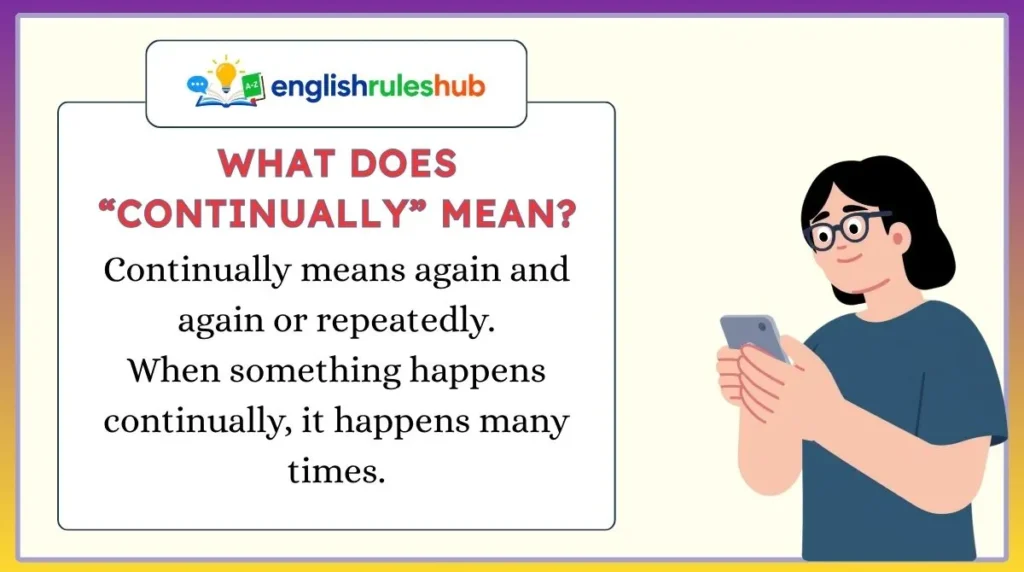
Continually means again and again or repeatedly.
When something happens continually, it happens many times. It may happen regularly or frequently, but it does not necessarily happen without a break.
Think about a person who keeps asking you the same question. They may ask it, stop, and then ask again a few minutes later. The action is repeated, so you can describe it as happening continually.
For example:
My little brother continually asks me for my phone.
He does not ask every single second. He asks many times.
Another example is:
It continually rains in this area during the winter.
The rain does not have to fall every second. It may stop and start again, but it happens frequently.
When Should You Use “Continually”?
Use continually when you want to talk about an action, event, problem, or situation that happens repeatedly.
There can be short or long breaks between the events.
The word often describes things that happen more than once:
- repeatedly
- frequently
- again and again
- over and over
For example, if someone makes the same mistake several times, you could say:
He continually makes the same mistake.
The important point is that the mistake happens repeatedly. There is no suggestion that he is making the mistake every second.
Grammar Rule for “Continually”
Continually is an adverb. It can describe a verb, adjective, or the way an action happens.
A common structure is:
Subject + continually + verb
For example:
She continually changes her plans.
You can also use it with forms of “be”:
He is continually complaining about his job.
It can also appear later in a sentence:
The children were talking continually during the trip.
The exact position can change depending on the sentence, but its basic meaning stays connected to repeated action.
Examples of “Continually”
- My neighbor continually plays loud music at night.
- She continually checks her phone during class.
- The child continually asks the same question.
- He continually changes his mind.
- Our dog continually barks when someone comes to the door.
- The students were continually making noise.
- The company is continually looking for better ways to help its customers.
- Traffic continually becomes worse during the evening rush hour.
Notice that none of these examples necessarily means the action happens without even a tiny break. The idea is repetition.
A Common Confusion About “Continually”
Some learners think that continually means “without stopping.” That is not usually the clearest meaning.
Imagine a student who keeps interrupting the teacher:
The student continually interrupts the teacher.
This means the student interrupts again and again. The student is not necessarily speaking every second.
So remember:
Continually = repeated events or actions.
What Does “Continuously” Mean?
Continuously means without stopping or interruption.
When something happens continuously, it keeps going for a period of time without a break.
Think about water flowing from a tap. If the tap is open and the water keeps flowing without being turned off, the water is flowing continuously.
For example:
The river flows continuously throughout the year.
The idea is that the flow does not stop.
Another example is:
The machine worked continuously for ten hours.
Here, the machine kept working during those ten hours without stopping.
When Should You Use “Continuously”?
Use continuously when you want to show that something continues without interruption.
It is especially useful when talking about:
- machines
- sounds
- movement
- work
- processes
- light
- water
- activity that does not stop
For example:
The fan has been running continuously since morning.
This tells us that the fan has not stopped.
You could also say:
The baby cried continuously for twenty minutes.
The focus is on the crying continuing without a break.
Grammar Rule for “Continuously”
Like continually, continuously is an adverb.
A common structure is:
Subject + continuously + verb
For example:
The machine continuously produces electricity.
You can also use it with continuous verb forms:
The engine was running continuously.
Another common structure is:
Subject + has/have been + verb-ing + continuously
For example:
It has been raining continuously for three hours.
This suggests that the rain has not stopped during that period.
Examples of “Continuously”
- The machine has been running continuously all day.
- The baby cried continuously for an hour.
- The fan runs continuously during the summer.
- The water flowed continuously from the broken pipe.
- The computer was working continuously throughout the night.
- The lights remained continuously on during the test.
- The workers operated the machine continuously for six hours.
- The rain fell continuously throughout the afternoon.
In each example, the important idea is no interruption.
A Common Confusion About “Continuously”
Learners sometimes use continuously when they really mean repeatedly.
Imagine your friend calls you five times during the day.
You could say:
My friend continually called me today.
That means your friend called you again and again.
But saying:
My friend continuously called me for five hours
would suggest that the calls or calling continued without interruption for five hours. That is a very different picture.
So remember:
Continuously = continuing without a break.
Difference Between Continually and Continuously
The easiest way to understand the difference is to compare repetition with uninterrupted continuation.
| Word | Main idea | Are there breaks? | Simple meaning | Example |
|---|---|---|---|---|
| Continually | Repeated action | Usually yes | Again and again | She continually checks her phone. |
| Continuously | Uninterrupted action | No | Without stopping | The machine runs continuously. |
Continually = Again and Again
When something happens continually, it happens repeatedly.
For example:
Tom continually forgets his keys.
Tom forgets his keys many times. He remembers them at other times, but the problem keeps happening.
You can imagine this pattern:
forget → stop → remember → forget → stop → forget
The action is repeated.
Continuously = Without Stopping
Now consider:
The machine continuously makes a loud noise.
The machine keeps making the noise without stopping.
You can imagine:
noise → noise → noise → noise → noise
There is no clear break.
Compare These Two Sentences
Consider these examples:
The dog continually barked during the night.
This suggests the dog barked many times. There may have been quiet periods between the barking.
Now:
The dog barked continuously for thirty minutes.
This suggests the barking continued for thirty minutes without a break.
That is the key difference.
Usage Difference
Use continually when the action is repeated.
Use continuously when the action is uninterrupted.
Compare:
She continually visits her grandmother.
She visits many times.
She stayed continuously at her grandmother’s house for a week.
The second sentence suggests she remained there without leaving during that period.
Grammar Logic
Both words are adverbs, and both come from the adjective continual/continuous.
They are close in meaning, but English uses them to focus on different ideas.
Continually focuses on how often something happens.
Continuously focuses on whether something stops.
This gives you a useful question to ask yourself:
“Does it happen many times, or does it keep going?”
If it happens many times, continually may be the better choice.
If it keeps going without a break, continuously is usually the better choice.
Sentence Structure Difference
There is no special sentence structure that belongs only to one word. Both are adverbs and can modify verbs.
For example:
He continually talks during the lesson.
He talks continuously during the lesson.
The first sentence suggests he talks repeatedly, perhaps stopping and starting.
The second suggests he keeps talking without much or any interruption.
The grammar is similar. The meaning and focus are different.
Meaning Comparison
Here is another simple way to see it:
Continually: “It keeps happening.”
Continuously: “It keeps going.”
That tiny difference can help you choose the right word in many situations.
Grammar Rules You Must Remember
Rule #1: Use “Continually” for Repeated Actions
When an action happens over and over, use continually.
Example:
He continually forgets his password.
He forgets it many times. The action is repeated.
Another example:
She continually asks for help.
She asks more than once.
Rule #2: Use “Continuously” for Actions Without a Break
When something keeps going without interruption, use continuously.
Example:
The machine has been running continuously for eight hours.
The machine did not stop during those eight hours.
Rule #3: Continually Does Not Mean Every Second
Do not assume that continual activity must happen all the time.
The children continually asked questions.
This means they asked many questions repeatedly. They did not necessarily speak every second.
The word is about repeated occurrence, not exact nonstop activity.
Rule #4: Continuously Emphasizes Uninterrupted Time
Use continuously when the lack of a break matters.
The alarm sounded continuously for ten minutes.
The important detail is that the alarm kept sounding during that period.
If the alarm sounded, stopped, and sounded again several times, continually would better express the repeated action:
The alarm continually sounded throughout the morning.
Common Mistakes Students Make
Mistake 1: Treating Both Words as Exactly the Same
Because the words look and sound similar, students often use them without thinking about the difference.
For example:
Wrong choice for the intended meaning:
The factory worked continuously every few hours.
If the factory starts and stops every few hours, continuously does not clearly express that idea.
A better sentence would be:
The factory worked continually throughout the day.
The exact best word can depend on the context, but the key question is whether the activity is repeated or uninterrupted.
Mistake 2: Using “Continuously” for Repeated Events
Imagine someone sends you several messages during the day.
You might say:
She continually sent me messages.
The messages came repeatedly.
If you say:
She continuously sent me messages for three days.
the listener may understand that the messages kept coming without interruption, which may not be what you mean.
Mistake 3: Thinking “Continually” Means “Always”
Continually does not always mean “always.”
For example:
He continually changes his plans.
This does not mean he changes his plans every moment.
It means he changes them repeatedly.
Mistake 4: Forgetting the Importance of “Without Stopping”
When you see a sentence with a clear time period and no interruption, continuously is often the natural choice.
For example:
The pump operated continuously for twelve hours.
The phrase “for twelve hours” plus the idea of no stopping makes continuously a good fit.
Easy Correction Tip
When you are unsure, replace the word in your mind.
Try:
continually = again and again
continuously = without stopping
If “again and again” sounds right, choose continually.
If “without stopping” sounds right, choose continuously.
Easy Trick to Remember the Difference
Here is a very simple memory trick:
Continually = Come back again.
Continuously = Continue without stopping.
Think about a phone.
If your phone rings five times today, it rings continually.
Ring → stop → ring → stop → ring
The action happens again and again.
Now imagine a phone alarm that keeps ringing for five minutes without a break.
It rings continuously.
Ring → ring → ring → ring
There is no interruption.
Another way to remember it is:
Continually asks “How many times?”
Continuously asks “Did it stop?”
This is not a strict mathematical test for every sentence, but it is a very useful learner-friendly guide.
A Real-Life Memory Example
Imagine your child keeps asking:
“Can I have your phone?”
Five minutes later:
“Can I have your phone?”
Then again:
“Can I have your phone?”
You might say:
My child continually asks for my phone.
Now imagine a baby crying for thirty minutes without stopping.
You might say:
The baby cried continuously for thirty minutes.
The first situation is repeated.
The second situation is uninterrupted.
Once you picture these two situations, the difference becomes much easier to remember.
Daily Life Examples
These examples show how the two words can appear in normal conversation.
Example 1: Phone Calls
A: Why didn’t you answer your phone?
B: I was in a meeting. My brother continually called me.
The brother called several times.
Example 2: A Running Machine
A: Is the generator working?
B: Yes. It has been running continuously since 8 a.m.
The generator has not stopped.
Example 3: A Noisy Child
A: How was your trip?
B: The children continually asked when we would arrive.
They asked many times during the trip.
Example 4: Heavy Rain
A: Did you go outside yesterday?
B: No. It rained continuously all afternoon.
The rain kept falling without a break.
Example 5: A Forgetful Friend
A: Why are you annoyed with Jack?
B: He continually forgets to return my books.
Jack repeats the same behavior.
Example 6: A Broken Tap
A: Why is the floor wet?
B: The tap has been leaking continuously.
The leak has not stopped.
Example 7: A Teacher’s Complaint
Teacher: You continually interrupt me while I am speaking.
The student interrupts again and again.
Example 8: A Machine at Work
Worker: How long has this machine been operating?
Manager: It has been operating continuously for six hours.
The machine has kept working without interruption.
Example 9: Changing Plans
A: What happened to your weekend trip?
B: Sarah continually changed her plans, so we couldn’t decide where to go.
Her plans changed repeatedly.
Example 10: A Long Sound
A: What was that noise?
B: The alarm sounded continuously for several minutes.
The alarm kept sounding without a break.
These examples show why the difference matters. In normal conversation, the words may sometimes overlap, but their main focus is different.
Practice Section
Choose continually or continuously in each sentence.
1. My little sister ______ asks me the same question.
Answer: continually
She asks the question again and again.
2. The machine has been running ______ for ten hours.
Answer: continuously
The machine has kept running without stopping.
3. He ______ changes his mind about the plan.
Answer: continually
He changes his mind repeatedly.
4. The water flowed ______ from the broken pipe.
Answer: continuously
The water kept flowing without interruption.
5. My phone has been ______ ringing all morning.
Answer: continually
The natural meaning here is that the phone has been ringing repeatedly throughout the morning, with breaks between calls.
Try making your own sentences now. Write one sentence with continually and another with continuously. If you can explain why you chose each word, you have understood the main difference.
FAQs
What is the main difference between continually and continuously?
Continually usually means something happens repeatedly or again and again. Continuously usually means something happens without stopping or interruption.
For example, “He continually calls me” means he calls many times. “The machine runs continuously” means it keeps running without a break.
Can continually and continuously be used in the same sentence?
Sometimes they can both appear in similar contexts, especially because their meanings overlap. However, they may give the sentence a slightly different focus.
Continually highlights repeated events, while continuously highlights uninterrupted activity. Choose the word that matches the meaning you want.
Is continually formal or informal?
Continually can be used in both everyday and formal English. It is not limited to formal writing.
For example, “He continually forgets his keys” sounds perfectly normal in conversation. It can also appear in more formal writing.
Is continuously formal or informal?
Continuously is also used in both spoken and written English. It is especially common when describing an action or process that happens without interruption.
For example, “The machine operated continuously for six hours” can be used in technical, workplace, or everyday contexts.
Can I use continually for something that happens all the time?
Yes, but be careful about the exact meaning. Continually normally suggests repeated occurrence rather than literal activity every second.
If you mean that something happens again and again, continually is a good choice. If you mean there is no break at all, continuously is usually clearer.
Is “continually” the same as “repeatedly”?
They are very close. Both can describe something that happens again and again.
However, continually can sometimes suggest an ongoing pattern over time, while repeatedly directly emphasizes repetition. In many everyday sentences, they can be used in similar ways.
Is “continuously” the same as “constantly”?
They can overlap, but they are not always identical.
Continuously strongly suggests no interruption. Constantly can mean very frequently or all the time, and it does not always require literal uninterrupted activity.
For example, “She constantly checks her phone” usually means she checks it very often, not necessarily every second.
Which word should I use for something that stops and starts?
If the action happens repeatedly with breaks, continually is usually the better choice.
For example:
The lights continually went on and off.
The lights change repeatedly, with stops or changes between events.
If something continues without a break, use continuously.
Final Conclusion
The difference between continually and continuously is small, but it becomes easy once you focus on the main idea.
Use continually when something happens again and again. There may be breaks between the events. For example, a person may continually call you, continually change plans, or continually make the same mistake.
Use continuously when something happens without stopping. A machine may run continuously, water may flow continuously, or rain may fall continuously for several hours.
The easiest memory trick is:
Continually = repeatedly.
Continuously = without interruption.
Do not worry if these words still feel similar at first. Native speakers sometimes use them in overlapping ways, too.
The goal is to understand the main difference and choose the word that best expresses your meaning.
Try using both words in your own daily sentences. After a little practice, choosing between them will feel much more natural.

I am Benjamin Clark, an English language writer passionate about simplifying grammar, vocabulary, and word meanings. I create clear, accurate, and practical content to help learners improve their English skills with confidence every day.