
Last updated on September 22nd, 2026 at 07:14 am
Many English learners get confused when they hear phrases like “That means…” and “That’s mean…”. They look very similar, especially when people speak quickly.
The problem becomes even bigger when learners see “thats mean” written without an apostrophe and are not sure whether it is correct.
This small grammar difference is important because these expressions have different meanings and different grammar rules.
One is normally used to explain the meaning or result of something. The other can describe something as unkind or unpleasant.
For example, you might say:
- That means you are right.
- That’s mean!
These two sentences are not interchangeable. The first sentence explains a meaning or result. The second sentence says that someone’s action or words are unkind.
There is also an important spelling point. “Thats” is not the standard spelling. When you mean “that is” or “that has,” you need an apostrophe: “that’s.”
By the end of this guide, you will understand the difference between “that’s mean” and “that means,” know when to use each expression, and avoid common mistakes in speaking and writing.
You will also see plenty of simple examples from daily English conversations, so the difference becomes natural instead of something you have to memorize.
What Does “That’s Mean” Mean?
“That’s mean” is usually short for “That is mean.”
Here, mean is an adjective. It describes a person, action, comment, or behavior as unkind, cruel, hurtful, or unpleasant.
For example:
That’s mean.
This means:
That is unkind.
Imagine that your friend laughs at another student because the student made a small mistake. You might say:
“That’s mean.”
You are not explaining the meaning of the situation. You are saying that the behavior is not kind.
The grammar is simple:
That + is + adjective
In the phrase “That’s mean,” the word “that’s” is a contraction of “that is.” The word “mean” works as an adjective.
So:
That’s mean.
= That is mean.
Here, mean does not mean “have a meaning.” It means unkind or nasty.
When Do We Use “That’s Mean”?
We use “that’s mean” when we react to something that is unfair, rude, hurtful, or unkind.
It is common in everyday spoken English, especially when someone has done something that hurts another person’s feelings.
For example:
- You told everyone my secret? That’s mean.
- She laughed when he fell down. That’s mean.
- You ate the last piece of cake without asking. That’s mean!
- Don’t say that to your brother. That’s mean.
- He made fun of her accent. That’s really mean.
- You knew I was waiting, and you left without me. That’s mean.
- It’s mean to laugh at someone’s mistake.
- That was a mean thing to say.
Notice that these examples are about behavior and feelings. The speaker is judging an action as unkind.
“Mean” Can Describe a Person Too
The word mean can also describe someone who often behaves in an unkind way.
For example:
He is mean to his little brother.
This means he treats his brother badly or unkindly.
You can also say:
She can be mean sometimes.
This means she sometimes behaves in an unkind way.
However, “that’s mean” usually reacts to a particular action or comment.
For example:
“You didn’t invite Tom?”
“No.”
“That’s mean.”
The speaker is saying that the action of not inviting Tom was unkind.
A Common Learner Confusion
A common mistake is to think “mean” always has something to do with “meaning.”
That is not true.
Look at these two sentences:
What does this word mean?
Here, mean is a verb. It asks about the definition or meaning of something.
But:
That’s mean.
Here, mean is an adjective. It means unkind.
The same word can have different meanings depending on the sentence.
Another important point is spelling:
thats mean ❌
that’s mean ✅
The apostrophe matters because that’s is the contraction of that is.
Annual vs Yearly vs Every Year
How to Choose the Right Expression in Real Conversations
Choosing between “that’s mean” and “that means” becomes easier when you first identify what you are trying to communicate.
If you are reacting to someone’s behavior and saying that it is unkind, “that’s mean” is the natural choice.
If you are explaining what a fact, action, or situation tells us, use “that means.” For example, if a friend takes your food without asking, you can say, “That’s mean.”
But if your friend tells you that the restaurant is closed, you might reply, “That means we need to find another place.”
In everyday conversations, this simple difference helps you choose the correct expression quickly.
Instead of memorizing both phrases separately, think about your purpose: Are you describing behavior, or are you explaining information?
What Does “That Means” Mean?
“That means” is used when you want to explain what something shows, tells us, represents, or results in.
Here, means is a verb.
For example:
That means you are ready.
This means:
That shows that you are ready.
Or:
That means we have to leave now.
This means that the situation tells us or requires us to leave now.
The basic grammar is:
That + means + information
The word means is the third-person singular form of the verb mean.
Compare:
I mean
You mean
We mean
They mean
But:
He means
She means
It means
That means
Because that works like a singular subject here, we use means, not mean.
When Do We Use “That Means”?
We use “that means” when one fact, statement, action, or situation gives us another meaning, result, or conclusion.
Here are some simple examples:
- The shop is closed. That means we have to come back tomorrow.
- You passed the test. That means you can join the next class.
- He isn’t answering his phone. That means he may be busy.
- It is raining. That means we should take an umbrella.
- She moved to London. That means she won’t be here next week.
- The bus is late. That means we may arrive late.
- You finished all your work. That means you can go home.
- He said no. That means he doesn’t agree with us.
In each example, “that means” connects one piece of information to another.
“That Means” Can Explain a Word or Statement
You can also use means when explaining the meaning of something.
For example:
“What does ‘tiny’ mean?”
“It means very small.”
You might then say:
“So that means the same as ‘very small.’”
The verb mean is about meaning or intention.
For example:
What does this sign mean?
That means you cannot park here.
The first sentence asks for an explanation. The second sentence gives the explanation.
“That Means” Can Show a Result
The expression is also very common when talking about results.
For example:
You forgot your keys. That means you can’t open the door.
The first fact leads to the second situation.
Another example:
The price has increased. That means we need more money.
Again, the second idea is a result or conclusion from the first.
Difference Between “That’s Mean” and “That Means” (Detailed)
The biggest difference is simple:
“That’s mean” = That is unkind.
“That means” = That shows, indicates, or has a particular meaning.
Although the words look almost identical, the grammar is different.
| Expression | Full form | Role of “mean” | Basic meaning |
|---|---|---|---|
| That’s mean | That is mean | Adjective | That is unkind |
| That means | That means | Verb | That shows/explains something |
| That’s | That is / That has | Contraction | Depends on the sentence |
| Thats | Not standard | — | Needs an apostrophe |
Usage Difference
Use “that’s mean” when you are judging someone’s behavior.
You made fun of him. That’s mean.
Use “that means” when you are explaining a meaning or result.
He didn’t come to class. That means he is absent.
The first sentence talks about kindness.
The second sentence talks about meaning or information.
Grammar Logic
This is one of the easiest ways to understand the difference.
In:
That’s mean.
The sentence is:
That + is + adjective
The word mean describes that.
Just like:
That’s funny.
That’s strange.
That’s unfair.
That’s mean.
All four use an adjective after “that’s.”
Now look at:
That means you are wrong.
The structure is:
That + verb + information
Here, means is an action. It tells us what something indicates or represents.
Compare:
That’s funny.
That means something different.
In the first sentence, funny describes something.
In the second sentence, means tells us what something indicates.
Sentence Structure Difference
The two expressions often follow different patterns.
That’s mean + .
Example:
That’s mean.
You can also add a noun:
That’s a mean thing to say.
But with that means, another idea often follows:
That means + clause.
For example:
That means we have to wait.
That means she is not coming.
That means you need more practice.
This structure is very useful in everyday conversation.
Meaning Comparison
Consider this short conversation:
Ali: I told everyone about Sara’s private problem.
Ahmed: That’s mean.
Ahmed is saying Ali’s action was unkind.
Now consider:
Ali: Sara isn’t coming today.
Ahmed: That means we need another person for the project.
Ahmed is explaining the result of Sara’s absence.
The words mean and means look related because they are related. But their jobs in these sentences are different.
How “Mean” Changes Meaning in Different Sentences
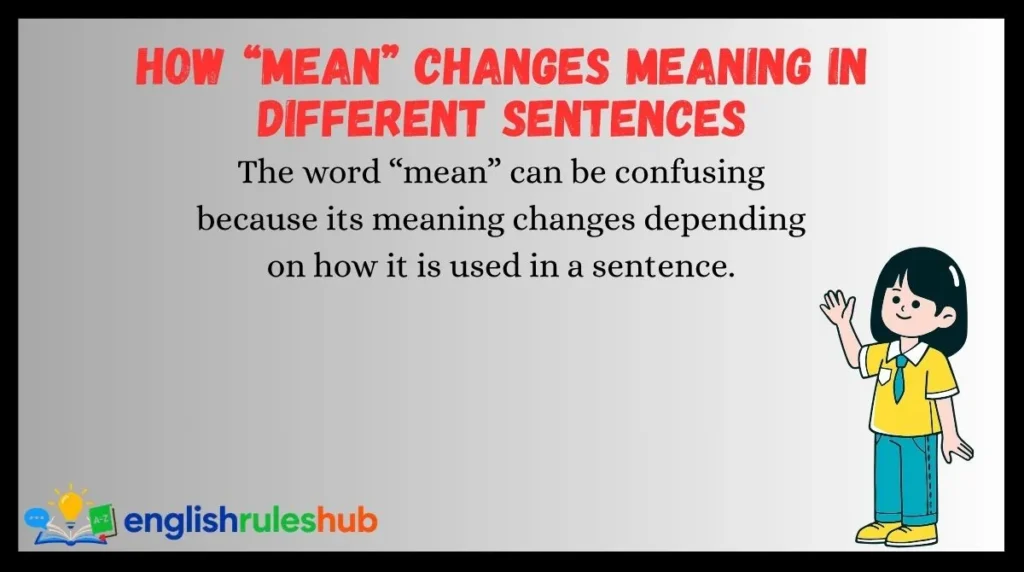
The word “mean” can be confusing because its meaning changes depending on how it is used in a sentence.
Sometimes it describes a person or action as unkind, while in other sentences it talks about meaning, intention, or a result.
For example, “That’s mean” describes behavior as unkind, but “What does this mean?” asks about the meaning of something.
You can also see it in sentences such as “I didn’t mean to hurt you,” where it talks about intention.
This is why learners should not decide the meaning of mean by looking at the word alone.
Instead, look at the words around it and understand what the speaker is trying to say.
Learning these different uses can make phrases like “that’s mean” and “that means” much easier to understand.
Grammar Rules You Must Remember
Rule #1: “That’s” Needs an Apostrophe
When you mean “that is,” write:
that’s
Not:
thats
For example:
That’s a good idea.
That’s strange.
That’s mean.
The apostrophe shows that letters have been left out of “that is.”
Rule #2: Use “That’s Mean” When “Mean” Describes Something
If mean means unkind, use “that’s mean.”
For example:
You ignored her on purpose. That’s mean.
Here, mean describes the action as unkind.
You can replace mean with another adjective:
That’s rude.
That’s unfair.
That’s cruel.
This helps you remember that mean is an adjective in this structure.
Rule #3: Use “That Means” to Explain a Meaning or Result
When you want to say “that shows,” “that tells us,” or “the result is,” use “that means.”
For example:
The door is locked. That means nobody is inside.
The second sentence explains what the first fact tells us.
Another example:
You don’t have enough money. That means you can’t buy it.
Rule #4: “That” Takes “Means” When It Is the Subject
Remember the verb form:
I mean
You mean
We mean
They mean
But:
He means
She means
It means
That means
So this is correct:
That means a lot to me.
This is incorrect:
That mean a lot to me.
The subject that is singular, so the verb needs -s.
Common Mistakes Students Make
Many learners make these mistakes because mean has several uses and because spoken English can make “that’s” and “that” sound similar.
Mistake 1: Writing “thats”
Wrong: Thats a good idea.
Correct: That’s a good idea.
The apostrophe is necessary when that’s = that is or that has.
Mistake 2: Using “That’s mean” to Explain a Result
Wrong: The restaurant is closed. That’s mean we can’t eat there.
Correct: The restaurant is closed. That means we can’t eat there.
Why?
Because you are explaining a result. You are not saying the restaurant is unkind.
Mistake 3: Using “That Means” to Say Something Is Unkind
Wrong: You laughed at her. That means.
Better: You laughed at her. That’s mean.
Here, you are reacting to someone’s behavior and calling it unkind.
Mistake 4: Forgetting the “S”
Wrong: That mean you are late.
Correct: That means you are late.
The verb needs -s because that is singular.
Mistake 5: Thinking “Mean” Always Means “Unkind”
The word mean has several meanings.
For example:
What does this word mean?
Here, it means “have as a definition.”
I didn’t mean to hurt you.
Here, it talks about intention.
That’s mean.
Here, it means unkind.
The average mean is 20.
In mathematics, mean has another meaning: the average.
So always look at the complete sentence.
Easy Trick to Remember the Difference
Here is a very simple trick.
When you see “that’s mean,” think:
“That is unkind.”
When you see “that means,” think:
“That tells me something.”
For example:
You broke her phone on purpose. That’s mean.
Think:
That is unkind.
Now:
The phone is broken. That means she can’t use it.
Think:
That tells us she can’t use it.
Another useful trick is to look at the word after means.
Very often, “that means” is followed by a complete idea:
That means + we have to go.
That means + he is busy.
That means + I need more time.
Meanwhile, “that’s mean” can stand alone as a reaction:
That’s mean!
That’s really mean.
Wow, that’s mean.
If you can replace mean with unkind, you probably need “that’s mean.”
If you can replace means with shows or indicates, you probably need “that means.”
Daily Life Examples (Very Important)
These examples show how native and fluent speakers may use the two expressions in normal conversations.
Example 1: Someone Makes Fun of a Friend
Tom: I laughed at Mike because he got the answer wrong.
Sam: That’s mean.
Sam thinks Tom’s action was unkind.
Example 2: A Shop Is Closed
Tom: The shop is closed today.
Sam: That means we have to go somewhere else.
Here, means explains the result.
Example 3: Someone Takes Your Food
Tom: I ate your sandwich.
Sam: You knew it was mine!
Tom: Sorry.
Sam: That’s mean!
The speaker is complaining about an unkind action.
Example 4: A Student Misses Class
Teacher: Sarah isn’t here today.
Student: That means she will miss the test.
The student is making a conclusion from the information.
Example 5: A Friend Cancels Plans
John: Mary canceled our dinner plans.
Ali: That means we’re free tonight.
Again, that means introduces the result.
Example 6: Someone Says Something Hurtful
Anna: I told my brother that his drawing was terrible.
Lucy: That’s mean.
Lucy is saying Anna’s comment was unkind.
Example 7: The Weather Changes
Dad: Look at those dark clouds.
Son: That means it’s going to rain.
The second speaker is explaining what the clouds probably indicate.
Example 8: Someone Doesn’t Share
Child: My brother ate all the cookies and didn’t give me any.
Mother: That’s mean.
The mother is describing the behavior as unkind.
Example 9: A Person Doesn’t Have a Ticket
Mike: I don’t have a ticket for the concert.
John: That means you can’t go inside.
Here, means shows the consequence.
Example 10: A Hurtful Joke
Emma: He made a joke about her mistake in front of everyone.
Lisa: That’s really mean.
Lisa is judging the behavior, not explaining a meaning.
Practice Section
Choose the correct option in each sentence: that’s mean or that means.
1. You laughed at him when he was crying. ________.
Answer: That’s mean.
The speaker is saying the behavior was unkind.
2. The bus has already left. ________ we have to wait for the next one.
Answer: That means.
The phrase introduces a result.
3. She didn’t invite her best friend to the party. ________.
Answer: That’s mean.
The speaker thinks the action was unkind.
4. The store closes at six. ________ we need to hurry.
Answer: That means.
The closing time creates a result or reason to hurry.
5. You told everyone my private message? ________!
Answer: That’s mean!
The speaker is reacting to an unpleasant or unkind action.
FAQs
What is the difference between “that’s mean” and “that means”?
“That’s mean” means “That is unkind.” It describes an action, comment, or behavior as hurtful or unpleasant.
“That means” is used to explain a meaning, result, or conclusion. For example, “The door is locked. That means nobody can enter.”
Is “thats mean” correct English?
No, “thats” without an apostrophe is not the standard spelling when you mean “that is.”
Write “that’s mean” when you mean “that is unkind.” The apostrophe is important because that’s is a contraction of that is.
Can I use “that means” in questions?
Yes, but the structure may change depending on what you want to ask.
For example, you can say, “What does that mean?” when asking about the meaning of something.
You can also ask, “Does that mean we have to leave?”
Is “that’s mean” formal or informal?
“That’s mean” is very common in everyday spoken English. It sounds natural and conversational.
In a more formal situation, you might choose words such as unkind, inappropriate, or inconsiderate, depending on the situation.
Why do we say “that means” instead of “that mean”?
Because that is singular when it acts as the subject of the sentence.
Just as we say “it means,” we say “that means.” The -s is required in the present simple.
Can “mean” have other meanings?
Yes. Mean has several common meanings.
It can refer to the definition of something, as in “What does this word mean?” It can also refer to intention, as in “I didn’t mean to hurt you.” And it can describe someone as unkind, as in “That’s mean.”
Final Conclusion
The difference between “that’s mean” and “that means” is small in spelling but important in meaning.
Use “that’s mean” when you mean “that is unkind.” It is normally a reaction to something rude, hurtful, unfair, or unpleasant.
Use “that means” when you are explaining what something shows, tells us, or results in. For example, “The road is closed. That means we need another route.”
Also remember that “thats” is not the correct standard spelling when you mean “that is.” Write “that’s” with an apostrophe.
A good memory trick is simple: “That’s mean” = unkind. “That means” = explains.
Once you notice what mean is doing in the sentence, the choice becomes much easier.
Pay attention to these phrases when you hear people speaking English, and try using them in your own conversations.
A few real examples and a little practice can make this grammar point feel completely natural.

I am Benjamin Clark, an English language writer passionate about simplifying grammar, vocabulary, and word meanings. I create clear, accurate, and practical content to help learners improve their English skills with confidence every day.
8 thoughts on “That’s Mean vs That Means: The Easy Difference Explained in 2026”