Last updated on September 22nd, 2026 at 07:45 am
English learners often get confused by taken and taking because both words come from the same verb: take.
They look similar, but they do very different jobs in a sentence. One small change in the form of the verb can change the whole meaning.
You may hear sentences such as “I am taking the bus” and “I have taken the bus before.” Both are correct, but they do not describe the same kind of action.
This is where many students become unsure about which form to choose.
The difference is important because these forms appear everywhere in daily English.
We use them when talking about travel, work, school, shopping, time, photos, medicine, and many other everyday activities.
The good news is that the rule is easier than it first seems. Taking is usually the -ing form of take, while taken is the past participle of take. Their grammar determines where and how they can be used.
By the end of this guide, you will understand when to use taken, when to use taking, how their sentence structures differ, and how to avoid common mistakes.
You will also see simple examples from everyday conversations so you can use both forms naturally.
What Does “Taken” Mean?
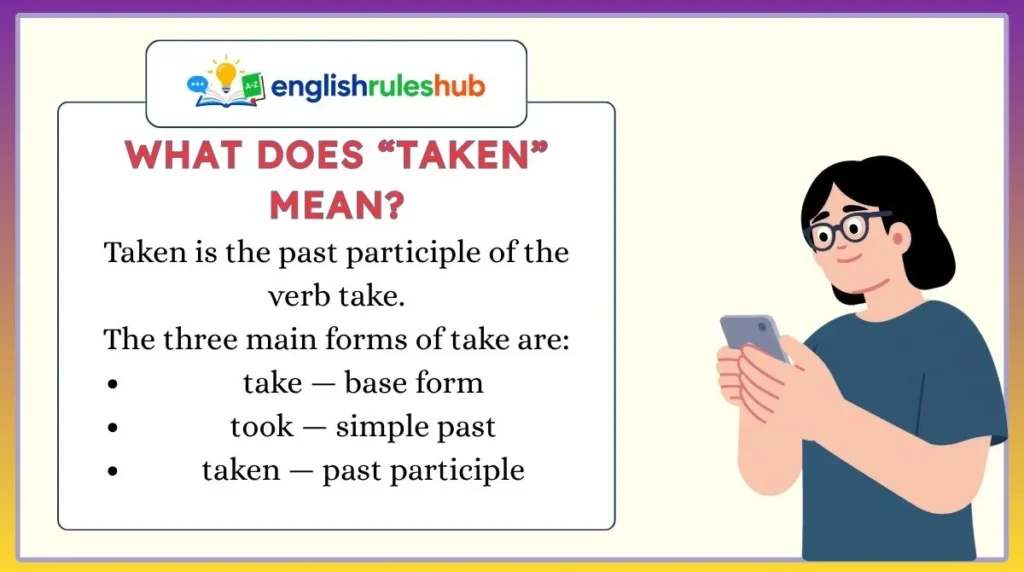
Taken is the past participle of the verb take.
The three main forms of take are:
- take — base form
- took — simple past
- taken — past participle
For example:
I take the train every morning.
I took the train yesterday.
I have taken the train many times.
The word taken normally does not work alone as the main verb in a normal sentence. It usually needs a helping verb such as have, has, had, is, are, was, or were, depending on the sentence structure.
One of the most common uses is in the present perfect tense.
Taken with “Have” or “Has”
Use have/has + taken when talking about an action that happened before now, especially when the exact time is not important.
Examples:
- I have taken this course before.
- She has taken my advice.
- We have taken several photos.
- He has taken the wrong bus.
- They have taken the test already.
- Have you taken your medicine?
- My brother has taken my phone.
- I have taken many trips by train.
Notice the pattern:
Subject + have/has + taken + object
For example:
She + has + taken + my book.
Taken with “Had”
We also use had + taken when talking about something that happened before another past event. This is the past perfect tense.
For example:
She had taken the medicine before she went to bed.
Here, taking the medicine happened first. Going to bed happened later.
Another example:
They had taken their seats before the movie started.
The action of taking their seats happened before the movie started.
Taken in Passive Sentences
Taken can also appear in the passive voice.
For example:
The picture was taken by Sarah.
Here, Sarah did the action, but the picture is the subject of the sentence.
More examples:
The documents were taken to the office.
My bag was taken from the car.
The photos were taken yesterday.
The pattern is often:
be + taken
The exact form of be changes according to the tense.
Common Learner Confusion About “Taken”
A common mistake is using taken after am, is, or are when the speaker actually wants to describe an action happening now.
For example:
❌ I am taken the bus.
This is incorrect if you mean that you are using the bus now.
The correct sentence is:
✅ I am taking the bus.
However, taken can appear after is or are in a passive sentence:
✅ The picture is taken by a professional photographer.
So, always look at the meaning and the sentence structure.
Annual vs Yearly vs Every Year
What Does “Taking” Mean?
Taking is the -ing form, or present participle, of the verb take.
The basic form is:
take → taking
We often use taking with forms of the verb be to describe an action that is happening now or around the present time.
For example:
I am taking a shower.
The action is happening now.
The basic structure is:
Subject + am/is/are + taking + object
Examples:
- I am taking the bus to work.
- She is taking a shower.
- They are taking pictures.
- We are taking an English class.
- He is taking his dog for a walk.
- Are you taking notes?
- The children are taking a break.
- I am taking some medicine.
Taking for an Action Happening Now
The most common use of taking is in the present continuous tense.
For example:
I am taking a taxi.
This means the action is happening now or is part of the current situation.
Compare:
I take a taxi to work every Friday.
This describes a habit.
I am taking a taxi today.
This describes what is happening today.
Taking for a Temporary Situation
We can also use taking when something is temporary.
For example:
She is taking an online course this month.
The course is happening around the present time. It does not necessarily mean she takes the same course every month.
Another example:
I am taking the train this week.
This may be a temporary choice rather than a regular habit.
Taking in Questions
Taking is very common in questions.
For example:
Are you taking the bus?
What are you taking to the party?
Are they taking pictures?
Why are you taking my book?
The word taking fits naturally after am, is, and are when the sentence describes an action in progress.
Common Learner Confusion About “Taking”
Students sometimes use taking when they need a past participle.
For example:
❌ I have taking the test.
The correct sentence is:
✅ I have taken the test.
After have or has in the present perfect, we need the past participle taken, not taking.
Similarly:
❌ She had taking my phone.
Correct:
✅ She had taken my phone.
A useful question to ask yourself is: What helping verb comes before the word?
If you see am/is/are and you are describing an action in progress, taking is often correct.
If you see have/has/had, taken is normally needed.
Taken vs Taking With Different Meanings of “Take”
The verb “take” has many meanings in English, so taken and taking can appear in many different situations.
They are not only used for transportation or physical actions. For example, “taking a break” means having a short rest, while “taking responsibility” means accepting responsibility for something.
You can also say, “I am taking a risk” when you are doing something that may have an uncertain result. With taken, you might say, “She has taken control of the situation,” meaning she has gained control.
The important point is that the basic meaning of take can change depending on the words around it.
However, the grammar rule stays the same: taking is the -ing form, while taken is the past participle. Learning common expressions with take can help you recognize both forms more easily.
Difference Between Taken and Taking (Detailed)
The biggest difference is their verb form and grammatical job.
| Word | Verb form | Common use | Example |
|---|---|---|---|
| taken | Past participle | Perfect tenses and passive voice | I have taken the test. |
| taking | -ing form / present participle | Continuous tenses and other -ing structures | I am taking the test. |
1. Taken Talks About a Completed Action in Perfect Tenses
When taken comes after have, has, or had, it usually connects the action to another time.
For example:
I have taken this exam before.
The exam was completed before now.
Another example:
She had taken the money before I arrived.
The taking happened before another past event.
The structure is:
have/has/had + taken
2. Taking Shows an Action in Progress
When taking comes after am, is, or are, it usually describes something happening now or around now.
For example:
I am taking a photo.
The action is in progress.
The structure is:
am/is/are + taking
3. The Meaning Can Change with the Helping Verb
Look at these two sentences:
I am taking the test.
This means I am doing the test now.
I have taken the test.
This means I completed the test at some time before now.
The difference is not simply between taken and taking. The whole verb structure changes.
4. Taking Can Describe an Ongoing Activity
Consider:
She is taking a cooking class.
This tells us about an activity she is doing around the present time.
Now compare:
She has taken a cooking class.
This means she completed or attended a cooking class before now.
The first sentence focuses on the current activity. The second focuses on the completed experience.
5. Taken Can Be Used in Passive Voice
For example:
The photo was taken by Tom.
The photo received the action.
We cannot normally replace taken with taking here.
❌ The photo was taking by Tom.
This is wrong because the sentence needs the past participle for the passive structure.
6. Sentence Structure Is the Key
A simple way to compare them is:
Taking:
am/is/are + taking
Taken:
have/has/had + taken
or:
be + taken
Examples:
He is taking my pen.
He has taken my pen.
The pen was taken by him.
These three sentences use the same basic verb but have different meanings and structures.
How Taken and Taking Work in Longer Sentences
When sentences become longer, learners sometimes have difficulty choosing between taken and taking because other words appear between the subject and the verb.
The best approach is to identify the helping verb and then check the structure. For example, “She is taking an English course because she wants to improve her writing” uses taking because the structure is is + taking.
In contrast, “She has taken several English courses because she wants to improve her writing” uses taken because the structure is has + taken.
Even when a sentence contains extra information, the basic verb pattern does not change. Look for am, is, are when you need the -ing form, and look for have, has, had or a passive structure when you need the past participle taken.
Grammar Rules You Must Remember
Rule #1: Use “Taking” After Am, Is, and Are for an Ongoing Action
When an action is happening now, use the present continuous form.
Example:
I am taking a shower.
Not:
❌ I am taken a shower.
The word am is followed by the -ing form when you are making the present continuous tense.
More examples:
She is taking a break.
They are taking photos.
We are taking the train.
Rule #2: Use “Taken” After Have, Has, and Had
When you make a perfect tense, use the past participle taken.
Example:
I have taken the medicine.
Not:
❌ I have taking the medicine.
More examples:
She has taken my advice.
We have taken the test.
They had taken their seats.
Remember:
have/has/had + taken
Rule #3: Use “Taken” in Passive Structures
The past participle taken is also used when the subject receives the action.
Example:
The picture was taken yesterday.
The picture did not take itself. Someone took it.
More examples:
My bag was taken from the room.
The documents were taken to the manager.
The photo was taken by my sister.
A useful pattern is:
was/were + taken
Rule #4: Do Not Choose the Word by Meaning Alone
Both forms come from take, so beginners sometimes try to choose based only on the meaning of take. Instead, look at the grammar around the word.
For example:
I am ___ a picture.
The word after am should be the -ing form:
✅ I am taking a picture.
But:
I have ___ a picture.
The word after have should be the past participle:
✅ I have taken a picture.
The helping verb often gives you the answer.
Common Mistakes Students Make
Students make mistakes with these two forms mainly because English has several different verb patterns. Learners may know that take changes to taken, but they may not know when each form belongs in a sentence.
Mistake 1: Using “Taken” After “Am”
❌ I am taken the bus.
✅ I am taking the bus.
Why? Because am + verb-ing makes the present continuous tense.
Mistake 2: Using “Taking” After “Have”
❌ She has taking the test.
✅ She has taken the test.
Why? Because has + past participle is the present perfect structure.
Mistake 3: Confusing “Took” and “Taken”
This is another very common problem.
❌ I have took the book.
✅ I have taken the book.
But:
✅ I took the book yesterday.
Remember that took is the simple past form, while taken is the past participle.
A useful verb chart is:
| Present | Past | Past Participle | -ing Form |
| take | took | taken | taking |
Mistake 4: Using “Taking” in a Passive Sentence
❌ The photo was taking by John.
✅ The photo was taken by John.
Here, the sentence is passive, so it needs the past participle taken.
Mistake 5: Thinking “Taken” Always Means the Action Is Happening Now
It does not.
Compare:
She is taking my picture.
The action is happening now.
She has taken my picture.
The picture has already been taken.
The helping verb changes the time and meaning.
Easy Correction Tip
When you are unsure, check the word before the blank.
Am/is/are → usually taking
Have/has/had → usually taken
Was/were + passive meaning → usually taken
This simple check can prevent many mistakes.
Easy Trick to Remember the Difference
Here is a classroom trick that works well:
Taking = doing it now.
Taken = already done, or used in a passive structure.
Think about taking a photograph.
If you say:
I am taking a photo.
Imagine your phone is in your hand right now. You are pressing the camera button.
If you say:
I have taken a photo.
The photo is already captured.
So you can remember:
Taking → action in progress
Taken → completed action in perfect tense / passive structure
You can also remember the grammar partners:
AM + TAKING
IS + TAKING
ARE + TAKING
but:
HAVE + TAKEN
HAS + TAKEN
HAD + TAKEN
This is more useful than trying to memorize a long grammar definition.
One more important point: taken does not always mean “already done.” In passive sentences, it tells us that something received the action.
For example:
The picture was taken by Ali.
The word taken is required because this is a passive sentence.
Daily Life Examples (Very Important)
These examples show how taking and taken sound in normal conversations.
1. On the Bus
A: Where are you going?
B: I am taking the bus to work.
The action is part of the person’s current plan or situation.
2. Talking About Experience
A: Have you ever taken a flight alone?
B: Yes, I have taken several flights alone.
Here, taken is used after have.
3. At a Restaurant
A: Are you ready to order?
B: Yes. I am taking the chicken sandwich.
In everyday speech, people may also say, “I’ll have the chicken sandwich,” but taking can be used in contexts where someone is choosing or getting something.
4. Taking Medicine
A: Did you take your medicine?
B: Yes, I have taken it already.
The action is complete, so taken follows have.
5. Taking a Picture
A: What are you doing?
B: I am taking a picture of the building.
The action is happening now.
6. Talking About a Previous Photo
A: Who took this picture?
B: It was taken by my brother.
This is a passive sentence.
7. At School
Teacher: Are you taking notes?
Student: Yes, I am taking notes.
The activity is happening now.
8. After an Exam
Friend: Have you taken the English test?
Student: Yes, I have taken it already.
The test has been completed.
9. At Work
Manager: Have you taken the documents to the office?
Employee: Yes, I have taken them there.
Again, taken follows have.
10. Talking About a Temporary Course
Friend: What are you doing these days?
Student: I am taking an English course.
The course is a current activity.
Practice Section
Choose taken or taking in each sentence.
1. I am ___ the train to Lahore.
- taken
- taking
2. She has ___ my advice.
- taken
- taking
3. We are ___ pictures at the park.
- taken
- taking
4. The photo was ___ by my friend.
- taken
- taking
5. Have you ___ your medicine?
- taken
- taking
Answers
1. taking — “I am taking” uses the present continuous form.
2. taken — “has taken” uses the present perfect structure.
3. taking — “are taking” describes an action in progress.
4. taken — “was taken” is a passive structure.
5. taken — “have taken” is present perfect.
If you remember the helping verbs, these questions become much easier.
FAQs About Taken vs Taking
What is the difference between taken and taking?
Taking is the -ing form of take and is commonly used with am, is, and are for actions in progress.
Taken is the past participle and is commonly used with have, has, and had, as well as in passive sentences.
Can I use “taken” in a question?
Yes. Taken is very common in questions when it follows have, has, or had.
For example:
Have you taken your keys?
Has she taken the test?
Had they taken their seats before the show began?
Can I use “taking” in a question?
Yes. Use taking when the question describes an action in progress.
For example:
Are you taking the bus?
Is she taking a class?
What are they taking?
The structure am/is/are + taking is common in these questions.
Is “taking” formal or informal?
Taking is neither simply formal nor informal. It is a normal English verb form used in both everyday speech and formal writing.
For example, you can say:
I am taking an English course.
in a casual conversation, a school setting, or a formal discussion.
Is “taken” formal or informal?
Taken is also a normal verb form used in all types of English.
You can use it in casual speech:
I have taken the bus.
You can also use it in formal writing:
The required steps have been taken.
The level of formality depends on the whole sentence, not on the word taken itself.
Is “I am taken” correct?
Yes, but the meaning is different from I am taking.
I am taking usually means you are doing the action.
I am taken can be passive or can describe a state in certain contexts.
For example:
I am taking the photograph.
means you are doing the action.
But:
I am taken to the hospital.
means someone is taking you to the hospital. You receive the action.
Is “I have taking” correct?
No. After have or has in the present perfect, use the past participle.
Correct:
I have taken the test.
Incorrect:
I have taking the test.
Remember:
have/has + taken
Is “I am taken the bus” correct?
No, not if you mean that you are using the bus.
Say:
I am taking the bus.
The pattern is am + verb-ing, so taking is needed.
Final Conclusion
The difference between taken and taking becomes much easier when you stop looking at the words separately and start looking at the grammar around them.
Taking is the -ing form of take. It is commonly used with am, is, and are to talk about an action happening now or around the present time.
Taken is the past participle of take. It is commonly used with have, has, and had, and it is also used in passive sentences.
Keep this simple pattern in your mind:
am/is/are + taking
have/has/had + taken
Also remember the complete verb forms:
take → took → taken → taking
Once you start noticing these patterns in conversations, books, movies, and everyday English, choosing the right form will feel much more natural.
Do a little practice each day, and soon you will use taken and taking without stopping to think about the rule.

I am Benjamin Clark, an English language writer passionate about simplifying grammar, vocabulary, and word meanings. I create clear, accurate, and practical content to help learners improve their English skills with confidence every day.