Last updated on September 23rd, 2026 at 07:49 am
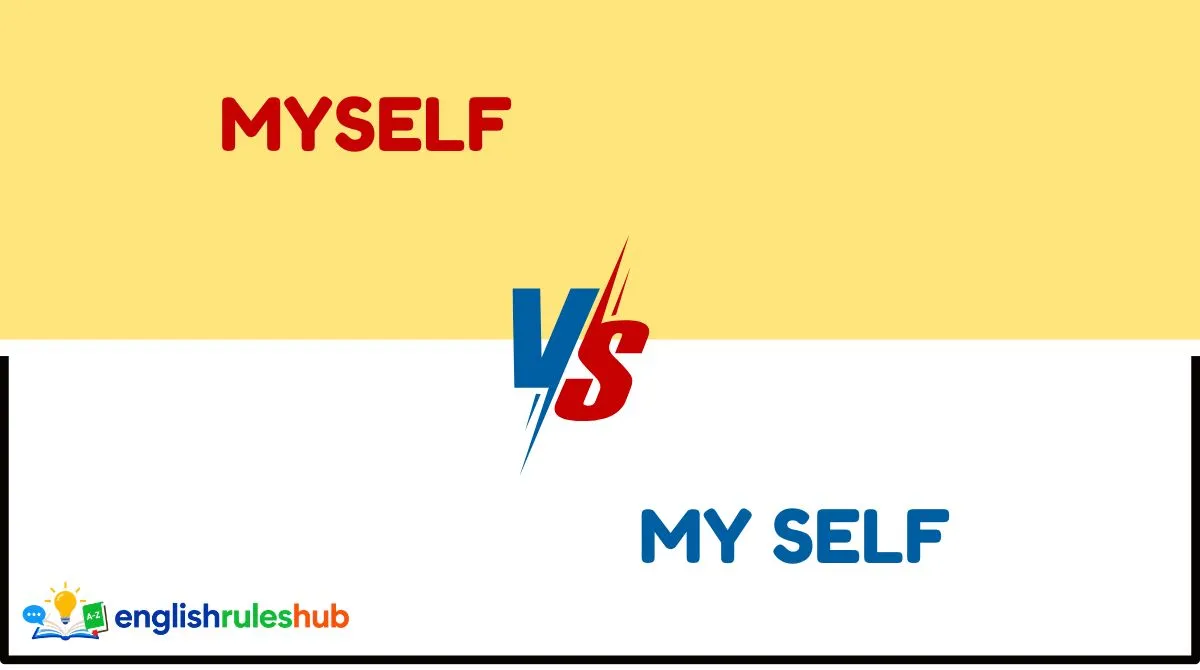
Myself and my self look almost the same, so it is easy to wonder whether they mean the same thing. Many English learners see both forms and think the difference is only a matter of spacing. It is not quite that simple.
The word myself is normally one word. It is a reflexive pronoun, and we use it when we talk about the speaker, especially when the speaker is also the person affected by an action. For example, “I hurt myself” means that I hurt me.
We also use myself to add emphasis. “I myself made the cake” means that I, not somebody else, made it.
But my self is different. Here, self is a noun. The word my simply tells us whose self we mean. This form is much less common in everyday English. You may see it when people talk about their identity, personality, feelings, or inner nature, as in “my true self” or “my former self.”
Understanding this small difference can make your writing much clearer. You will know when to write the single word myself, when the two-word form my self is possible, and why sentences such as “I did it myself” are correct.
What Does “Myself” Mean?
Myself is a pronoun. More specifically, it is the reflexive form of “I” or “me.” We normally use it when the person doing something and the person receiving the action are the same person.
Look at this simple sentence:
I hurt myself.
The subject is I. The object is myself. Both refer to the same person.
You can think of it like this:
I → myself
The action starts with me and comes back to me.
When Do We Use “Myself”?
There are several common uses of myself.
1. When the subject and object are the same person
This is the most important grammar use.
- I washed myself.
- I cut myself while cooking.
- I looked at myself in the mirror.
- I taught myself English.
- I bought myself a new phone.
- I blamed myself for the mistake.
- I told myself to stay calm.
- I promised myself that I would try again.
In each sentence, myself refers back to I.
For example:
I bought myself a book.
The person who bought the book is I, and the person who receives the book is also I.
2. To emphasize “I”
We can also use myself when we want to put extra focus on the speaker.
- I myself saw the accident.
- I myself checked the report.
- I myself cooked dinner.
- I myself don’t agree with that idea.
- I will speak to him myself.
The word does not necessarily mean that the action comes back to the speaker. Instead, it adds emphasis.
Compare:
I checked the door.
This is a normal statement.
I myself checked the door.
This gives extra attention to I. It can suggest, “I personally checked it.”
3. With “by myself”
By myself commonly means alone or without help.
- I live by myself.
- I did the homework by myself.
- I fixed the chair by myself.
- I went to the shop by myself.
- I learned how to cook by myself.
Here, by myself does not mean that the action is performed on the speaker. It means the speaker did something alone or without help.
4. With “to myself”
We also use to myself to mean that something is for the speaker’s own use or that the speaker has private time.
- I need some time to myself.
- I kept the room to myself.
- I had the whole house to myself.
- I was talking to myself.
These expressions are common in everyday English.
A Common Learner Confusion
Some learners think that myself should be used whenever they want to say “I.” That is not correct.
For example:
❌ Myself went to school yesterday.
Correct:
✅ I went to school yesterday.
Myself is not normally used as the ordinary subject of a sentence.
You should not replace I with myself just because you are talking about yourself.
Another common mistake is:
❌ He gave the book to myself.
Correct:
✅ He gave the book to me.
However, if the speaker is the subject and the action comes back to the speaker, myself may be correct:
✅ I gave the book to myself.
The grammar relationship matters.
What Does “My Self” Mean?
My self is two separate words: my + self.
Here, self is a noun. It can refer to a person’s identity, personality, character, feelings, or inner nature. A dictionary definition of self describes it in terms of a person’s characteristics, personality, abilities, and sense of identity.
Because self is a noun in this structure, my works as a possessive determiner.
Compare:
- my car
- my house
- my friend
- my idea
- my self
The grammar pattern is the same:
my + noun
However, my self is not normally the form you need when you simply mean “myself.”
When Can “My Self” Be Correct?
The two-word form can be correct when self is being used as a real noun.
It is especially common when self has a description before it.
For example:
- I want to become my true self.
- I am trying to understand my inner self.
- I no longer feel like my old self.
- After the holiday, I felt like my normal self again.
- She wanted to discover her real self.
- He is slowly becoming his better self.
- I finally feel like my former self.
- The experience changed my sense of self.
Notice something important here.
We do not usually say:
❌ I looked at my self in the mirror.
We normally say:
✅ I looked at myself in the mirror.
But we can say:
✅ I am trying to understand my true self.
The adjective true describes the noun self.
“My Self” and Personal Identity
The two-word form can appear when someone is talking about who they really are.
For example:
I want to be my true self.
Here, self means the person or personality that someone really is.
Another example:
I felt disconnected from my old self.
This means the speaker no longer felt like the person they used to be.
You may also see expressions such as:
- my inner self
- my true self
- my better self
- my former self
- my younger self
- my old self
- my real self
These are noun phrases.
Why Does “My Self” Sound Unusual Sometimes?
The problem is that self is already part of the very common word myself.
So learners may see:
myself
and assume they can simply separate it whenever they want:
my self
English does not work that way.
The single word myself has its own grammatical job as a pronoun. The two-word phrase my self has a different grammatical structure.
Think about these two sentences:
I hurt myself.
Here, myself is a reflexive pronoun.
I want to understand my true self.
Here, self is a noun, and my plus true describe it.
That small difference is important.
Myself vs My Self in Formal Writing
In formal writing, choosing between myself and my self depends on the job the word is doing in the sentence. When you need a reflexive pronoun, write myself as one word.
For example, “I completed the report myself” is correct because myself adds emphasis. Similarly, “I introduced myself to the new team” uses myself as a reflexive pronoun.
The two-word form my self is less common and usually appears when self has a specific meaning connected with identity or personality.
Expressions such as my true self, my professional self, and my former self can appear in essays or reflective writing.
When writing formally, do not separate myself simply because my and self seem like two meaningful words. First identify whether you need a pronoun or a noun phrase.
Difference Between “Myself” and “My Self” (Detailed)
The easiest way to understand the difference is to focus on grammar first, not just meaning.
| Feature | Myself | My self |
|---|---|---|
| Number of words | One | Two |
| Grammar | Pronoun | Possessive + noun |
| Main use | Reflexive or emphasis | Personal identity or nature |
| Common in daily English? | Very common | Less common |
| Example | I hurt myself. | I found my true self. |
| Can refer back to “I”? | Yes | Not normally as a reflexive pronoun |
| Can mean “alone”? | Yes, in “by myself” | No |
| Can emphasize “I”? | Yes | No |
1. “Myself” is a pronoun
A pronoun can take the place of a noun or refer back to one.
In:
I hurt myself.
Myself refers back to I.
The basic pattern is:
Subject + verb + reflexive pronoun
Examples:
- I blamed myself.
- I taught myself.
- I introduced myself.
- I prepared myself.
- I reminded myself.
2. “My self” contains a noun
In:
I discovered my true self.
The word self is a noun.
The structure is:
my + adjective + noun
Here:
- my = possessive determiner
- true = adjective
- self = noun
This is similar to:
my true character
or:
my real personality
3. Meaning is also different
Myself usually means me, especially in a reflexive or emphatic role.
My self usually refers to my identity, personality, or inner person.
Compare:
I hurt myself.
= I hurt me.
I want to understand my true self.
= I want to understand who I really am.
These are not the same idea.
4. “Myself” can mean “alone”
This is one of the most useful expressions for beginners.
I did it by myself.
= I did it alone or without help.
You cannot normally replace it with my self:
❌ I did it by my self.
Correct:
✅ I did it by myself.
5. “Myself” can add emphasis
Compare:
I will call him.
and:
I will call him myself.
The second sentence emphasizes that I personally will make the call.
But:
my self
does not work this way.
You cannot normally write:
❌ I will call him my self.
That changes the structure and does not express the intended meaning.
Sentence Structure Difference
A useful way to remember the grammar is:
myself = pronoun
my self = my + noun
Look at these examples:
I introduced myself.
Here, myself is the object of the verb introduced.
I want to find my true self.
Here, self is the object of the verb find, and my true describes it.
This is why spacing matters.
When “Self” Appears With Other Possessive Words
The word self can also appear in phrases with possessive words other than my. These expressions can help you understand why my self is sometimes correct.
For example, we can say your true self, his old self, her younger self, our best selves, and their former selves. In these phrases, self or selves acts as a noun.
Compare this with reflexive pronouns such as yourself, himself, herself, ourselves, and themselves.
These are normally written as single words when they are used reflexively or for emphasis. So, “She blamed herself” is different from “She wanted to understand her true self.”
The first uses a reflexive pronoun, while the second uses a possessive word plus the noun self. This pattern can help learners recognize the difference more easily.
Grammar Rules You Must Remember
Rule #1: Use “myself” when “I” and the object are the same person
This is the basic reflexive rule.
I hurt myself.
The subject is I, and the object is myself. They refer to the same person.
More examples:
- I shaved myself.
- I surprised myself.
- I taught myself to swim.
- I told myself to relax.
A simple question can help:
Who did the action?
If the answer is I, and the action also affects me, use myself.
Rule #2: Use “myself” for emphasis
You can use myself to stress that you personally did something.
- I made it myself.
- I checked it myself.
- I will talk to her myself.
- I myself saw what happened.
Here, myself adds the meaning of personally or I, not someone else.
Rule #3: Use “by myself” for being alone or without help
This expression is extremely common.
- I went there by myself.
- She left me by myself.
- I fixed the computer by myself.
- I completed the project by myself.
In these sentences, by myself means alone or without help.
Do not write:
❌ by my self
Write:
✅ by myself
Rule #4: Use “my self” only when “self” is acting as a noun
This is the rule that separates the two forms.
For example:
- I want to understand my true self.
- I miss my old self.
- I am trying to find my real self.
- I want to become my best self.
Here, self is a noun with a meaning related to identity or personality.
A useful test is to see whether another word can describe self.
If you can say:
my true self
my old self
my inner self
then the two-word form is possible.
Common Mistakes Students Make
The confusion usually comes from pronunciation. In normal speech, myself sounds like one word, and learners may not notice the grammar behind it.
Another reason is that learners know that my means possession and self means the person. They may therefore assume that my self is always correct.
It is not.
Mistake 1: Using “myself” as the subject
❌ Myself went to the market.
✅ I went to the market.
Use I as the normal subject.
Mistake 2: Separating “myself” in ordinary reflexive sentences
❌ I looked at my self in the mirror.
✅ I looked at myself in the mirror.
The reflexive pronoun is one word.
Mistake 3: Writing “by my self”
❌ I finished the work by my self.
✅ I finished the work by myself.
The standard expression is by myself.
Mistake 4: Using “myself” when “me” is needed
❌ Please send the message to myself.
In ordinary standard English, this should be:
✅ Please send the message to me.
But:
✅ I sent the message to myself.
Why?
Because in the second sentence, I and myself are the same person.
Mistake 5: Thinking “my self” is always wrong
This is the opposite mistake.
My self can be correct when self is a noun.
For example:
✅ I want to become my true self.
Here, the phrase means the person you really are.
So the correct lesson is not “always use myself.”
The better lesson is:
Use the form that matches the grammar and meaning.
Easy Trick to Remember the Difference
Here is a very simple trick.
Think: “One word = pronoun”
When you mean me, especially when the action comes back to you, use:
myself
For example:
I hurt myself.
You can mentally replace myself with me:
“I hurt me.”
The grammar tells you that the reflexive form is needed, so you use myself.
Think: “Two words = my + self”
When self is a noun describing your identity or personality, two words may be correct.
For example:
my true self
You can think of it as:
my + true + person/identity
The word self has a real noun meaning here.
Another Easy Test
Ask yourself:
Am I talking about an action happening to me?
If yes, myself is likely correct.
- I cut myself.
- I blamed myself.
- I introduced myself.
Or ask:
Am I talking about who I am?
If yes, you may need a noun phrase with self.
- my true self
- my old self
- my inner self
- my younger self
This little test will solve many problems.
Daily Life Examples (Very Important)
Real conversations make the difference easier to remember.
Example 1: Cooking
A: Who cooked dinner?
B: I cooked it myself.
Here, myself emphasizes that B personally cooked the dinner.
Example 2: Doing homework
A: Did your brother help you?
B: No. I did the homework by myself.
Here, by myself means without help.
Example 3: Looking in a mirror
I looked at myself in the mirror.
The person looking and the person being seen are the same person.
So myself is correct.
Example 4: Talking about personality
I don’t feel like my old self anymore.
Here, self is a noun. The speaker is talking about a former version of their personality or identity.
Example 5: Personal responsibility
Don’t worry. I will check it myself.
The speaker means, “I will personally check it.”
Example 6: Being alone
I went to the restaurant by myself.
This means the speaker went alone.
Example 7: Personal identity
I want to be my true self.
The speaker means they want to behave naturally and honestly rather than pretending to be someone else.
Example 8: Teaching
I taught myself how to use the computer.
The speaker learned without another person teaching them directly.
Example 9: Feeling different
After moving to a new city, I felt like a different person. I missed my old self.
Here, old self means the speaker’s former personality or way of life.
Example 10: Personal action
You don’t need to wait for anyone. I can do it myself.
The meaning is “I can do it without help.”
Practice Section
Choose the correct answer in each sentence.
1. I looked at ______ in the mirror.
a) my self
b) myself
2. I completed the project ______.
a) by myself
b) by my self
3. I want to become my true ______.
a) myself
b) self
4. I accidentally hurt ______ while playing football.
a) my self
b) myself
5. I will speak to the manager ______.
a) myself
b) my self
Answers
1. b) myself
“I looked at myself in the mirror” is a normal reflexive construction.
2. a) by myself
“By myself” means alone or without help.
3. b) self
“My true self” is a noun phrase. Self means the person or personality you really are.
4. b) myself
The subject is I, and the action affects the same person.
5. a) myself
Here, myself adds emphasis. The speaker means, “I will personally speak to the manager.”
FAQs
What is the difference between “myself” and “my self”?
Myself is a reflexive or emphatic pronoun. It can mean the speaker as the object of an action, or it can add emphasis to “I.”
My self contains the possessive word my and the noun self. It is used when self means a person’s identity, personality, or inner nature.
Is “my self” grammatically correct?
Yes, but it is not simply another spelling of myself.
It is correct when self is being used as a noun, especially in phrases such as my true self, my old self, and my inner self.
For ordinary reflexive use, write myself as one word.
Can I say “I did it by my self”?
No. The standard expression is:
I did it by myself.
By myself means alone or without help. It is a fixed and very common expression in English.
Can “myself” be used in a question?
Yes.
For example:
Did I hurt myself?
Can I do it myself?
Did I introduce myself correctly?
In these questions, myself follows the normal reflexive or emphatic rules.
Is “myself” formal or informal?
Myself is a normal English pronoun used in both everyday speech and writing.
Expressions such as I did it myself, I hurt myself, and by myself are very common.
However, using myself simply instead of I or me can be incorrect, especially in formal writing. For example, “Myself and John went there” should normally be “John and I went there.”
Should I write “I myself” or “my self”?
If you are emphasizing I, use I myself.
For example:
I myself checked the documents.
Do not write:
❌ I my self checked the documents.
If you are talking about identity or personality, a phrase such as my true self may be correct.
Final Conclusion
The difference between myself and my self becomes much easier when you stop thinking about the space and start thinking about the grammar.
Myself is normally one word. It is a reflexive pronoun used when I and the person affected by the action are the same. It is also used for emphasis and in expressions such as by myself and to myself.
My self is two words because self is being used as a noun. It often appears when we talk about identity, personality, or a particular version of ourselves, such as my true self, my old self, or my inner self.
For everyday English, the one-word form is much more common. When you write a sentence such as “I hurt myself,” “I did it myself,” or “I went by myself,” keep myself together.
The best way to remember the difference is simple: myself = pronoun; my self = my + noun.
Keep practicing with real sentences, and this small grammar problem will soon feel completely natural.

I am Benjamin Clark, an English language writer passionate about simplifying grammar, vocabulary, and word meanings. I create clear, accurate, and practical content to help learners improve their English skills with confidence every day.