
Last updated on September 22nd, 2026 at 07:22 am
Which and whatever can both be used when we talk about choices, but they do not mean exactly the same thing.
This is where many English learners get confused. You may hear someone say, “Choose whichever you like,” and then hear, “Take whatever you want.” The two sentences look similar, but there is an important difference in meaning.
The main idea is simple: which usually points to a choice from a known or limited group, while whatever gives a much more open choice. Understanding this small difference can make your English sound much more natural.
For example, if a friend asks, “Which shirt do you want, the blue one or the black one?” the choices are clear. You need to choose from those options.
But if your friend says, “Wear whatever you want,” there is no fixed list. You can choose any thing you want.
There is another important point. Whichever is not simply a longer form of which. It is often used to mean “any one from a particular group” or “it does not matter which one.”
Whatever is often used in a similar way, but it normally refers to things, actions, or choices in a wider sense.
By the end of this guide, you will understand the meaning, grammar, sentence patterns, common mistakes, and everyday use of whichever vs whatever.
You will also learn an easy trick that can help you choose the right word quickly when speaking or writing.
What Does “Whichever” Mean?
Whichever means “any one of a group” or “no matter which one.”
We use it when there is a choice between several known or possible options, but the exact choice does not matter.
Think about this example:
You can choose whichever dress you like.
This means you can choose any dress from the available dresses. The speaker knows there is a group of dresses, and the listener can select one.
The word whichever is often connected with a limited or understood set of choices.
For example:
- Take whichever book you want.
- Sit in whichever chair is free.
- Choose whichever color you prefer.
- You can buy whichever phone you like.
In each sentence, there is a group of possible choices.
When Should You Use “Whichever”?
Use whichever when you are talking about a choice and you mean:
“Any one from these choices.”
It can also mean:
“It does not matter which one.”
For example:
Choose whichever route is faster.
There may be several routes. You do not care which route the person chooses, as long as it is the faster one.
Another example is:
You can sit in whichever seat you prefer.
There are several seats. The listener can choose any suitable seat.
Grammar Rule for “Whichever”
Whichever can work as a determiner before a noun:
Choose whichever shirt you like.
Here, whichever comes before shirt.
It can also work as a pronoun, when the noun is understood:
Take whichever you want.
Here, we do not say whichever shirt because the listener already knows what is being discussed.
A useful sentence pattern is:
whichever + noun + subject + verb
For example:
Choose whichever book you want.
Another common pattern is:
whichever + subject + verb
For example:
Take whichever is cheaper.
Examples of “Whichever”
- Choose whichever color you like.
You can select any color from the available choices. - Take whichever book you want.
You may choose any book in the group. - Sit in whichever chair is comfortable.
You can select any suitable chair. - Whichever road you take, you will reach the village.
The particular road does not matter. - Buy whichever phone fits your budget.
There are different phones, and you can choose one that works for you. - You can order whichever meal you prefer.
Any suitable meal from the available choices is acceptable. - Whichever answer you choose, explain your reason.
The speaker allows a choice between possible answers. - Choose whichever comes first.
The exact item is not known yet, but any one that comes first can be selected.
Common Confusion About “Whichever”
Many learners think whichever means exactly the same as whatever. They can sometimes be close in meaning, but whichever usually has a stronger connection with a choice between identifiable options.
Compare:
Choose whichever shirt you like.
This sounds as if there are particular shirts available.
Choose whatever you like.
This gives a much wider meaning. It could include a shirt, a jacket, a hat, or something else.
So, when you can imagine a group of choices, whichever is often the better word.
When “Whichever” and “Whatever” Can Both Work
Sometimes whichever and whatever can both be grammatically correct, but the meaning can change slightly depending on which word you choose.
For example, “Choose whichever color you like” suggests that there is a particular group of colors available. “Choose whatever color you like” gives a more open feeling and does not focus as strongly on a specific group.
The choice between them depends on how clearly the speaker has defined the available options. If the listener can easily see or understand the choices, whichever often sounds natural.
If the speaker simply wants to give someone freedom to choose without focusing on a fixed group, whatever may be better.
This small difference is especially useful in everyday English because both expressions can sometimes appear in very similar sentences.
What Does “Whatever” Mean?
Whatever generally means “anything that,” “everything that,” or “no matter what.”
It gives a more open meaning than whichever.
For example:
You can eat whatever you want.
This means you can eat anything you want. The speaker is not focusing on a specific group of choices.
Another example:
Do whatever makes you happy.
This means do anything that makes you happy.
The word whatever is very common in everyday English. It can talk about things, actions, situations, and sometimes an attitude of not caring.
When Should You Use “Whatever”?
Use whatever when you want to give a person a broad or unlimited choice.
For example:
Take whatever you need.
This means the person can take anything they need.
You can also use whatever when the exact thing is not important:
Whatever you decide, I will support you.
Here, the speaker does not care which decision is made.
Another common use is:
Whatever happens, stay calm.
This means no matter what happens, stay calm.
Grammar Rule for “Whatever”
Whatever can come before a noun:
Choose whatever book you want.
It can also stand alone:
Take whatever you need.
It can introduce a clause:
Whatever you decide is fine with me.
A common pattern is:
whatever + noun + subject + verb
Example:
Buy whatever food you need.
Another pattern is:
whatever + subject + verb
Example:
Do whatever you want.
It can also mean “no matter what”:
Whatever happens, don’t worry.
Examples of “Whatever”
- Eat whatever you want.
You can eat anything you want. - Buy whatever you need.
There is no specific item that you must buy. - Do whatever makes you happy.
You can do anything that makes you happy. - Whatever happens, call me.
No matter what happens, contact me. - Take whatever you need from the kitchen.
You can take any needed item. - Choose whatever seems best.
The choice is open. - Whatever you decide, I will respect it.
The exact decision does not matter to the speaker. - You can wear whatever you like.
You are free to choose any clothes you want.
A Different Meaning of “Whatever”
In informal conversation, whatever can also show that someone does not care.
For example:
“I think you should take the blue one.”
“Whatever.”
Here, whatever does not mean “anything.” It can sound like “I don’t care” or “It makes no difference to me.”
Be careful with this use. Depending on your voice, it can sound rude or dismissive.
For polite English, it is usually better to say:
Either one is fine with me.
or:
I don’t mind which one we choose.
Annual vs Yearly vs Every Year
Difference Between Whichever and Whatever: Detailed Explanation
The easiest way to understand the difference is to focus on the type of choice.
Whichever usually points to one choice from a known or limited group.
Whatever usually gives a broader or more open choice.
| Point | Whichever | Whatever |
|---|---|---|
| Basic meaning | Any one from a group | Anything / no matter what |
| Main idea | Choice among options | Open or broad choice |
| Usually refers to | A specific group | Things, actions, situations, or broad choices |
| Example | Choose whichever shirt you like. | Wear whatever you like. |
| Meaning | Any shirt from the available choices | Any clothes you want |
| Common feeling | “Any one of these” | “Anything at all” |
| Can mean “no matter…”? | Yes: whichever | Yes: whatever |
Whichever Focuses on “Which One?”
A useful way to remember whichever is to connect it with the question “Which one?”
Imagine three cakes on a table.
You say:
Take whichever cake you want.
The listener chooses one cake from those cakes.
The group is understood.
Another example:
Use whichever key opens the door.
There are several keys, but only one or perhaps a few may work. The listener can use the suitable key.
Whatever Focuses on “What Thing?”
Whatever is connected with “what?”
Imagine someone asks:
What should I bring to the party?
You answer:
Bring whatever you like.
You are not giving a small, clear list. You are saying anything you want to bring is okay.
That is the main difference.
Compare These Two Sentences
Choose whichever dress you like.
This sounds like there is a group of dresses to choose from.
Now compare:
Wear whatever you like.
This is more open. The person can choose any clothes they want.
The difference may be small in some situations, but the feeling is still useful:
Whichever = any one from the choices.
Whatever = anything you want.
“Whichever” Can Be More Specific
Consider:
You can take whichever of these two bags you want.
This is clearly a limited choice. There are two bags.
But:
You can take whatever you want.
There is no clear limit in the sentence.
The second sentence gives much more freedom.
“Whatever” Can Talk About Actions
Whatever is not limited to objects.
For example:
Do whatever you think is right.
Here, whatever introduces an action or decision.
You cannot naturally replace it with whichever:
Do whichever you think is right.
This could be possible only if the context already gives a clear set of actions or options. Without that context, whatever is much more natural.
Whichever vs Whatever in Negative and Conditional Sentences
Both whichever and whatever can be useful when talking about situations where the exact choice or result does not change what happens next.
For example, “Whichever option you choose, the price will be the same” focuses on one option from a known set.
On the other hand, “Whatever you choose, I will support you” gives a broader meaning and does not focus as strongly on a particular list of options.
You can also use these words to introduce conditions: “Whichever route you take, you will reach the station” and “Whatever happens, stay calm.”
In these sentences, the speaker is saying that the final situation remains true regardless of the choice or event.
Understanding this pattern can help learners recognize these words more easily in longer sentences.
Grammar Rules You Must Remember
Rule #1: Use “Whichever” for a Choice From a Group
When the listener is choosing one option from a known group, whichever is often the best choice.
Choose whichever of these three cakes you want.
There are three clear options.
Quick check: Can you point to the choices? If yes, whichever may fit well.
Rule #2: Use “Whatever” for a Broad or Open Choice
When you mean anything you want, use whatever.
Eat whatever you want.
The speaker is not limiting the listener to a particular list.
Another example:
Buy whatever you need.
The choice is broad.
Rule #3: Both Words Can Mean “It Does Not Matter Which/What”
Both words can introduce the idea that the exact choice does not matter.
With whichever:
Whichever route you take, you will get there.
This means it does not matter which route you take.
With whatever:
Whatever you do, be careful.
This means no matter what you do, be careful.
The difference comes from which versus what.
Rule #4: “Whatever” Is Often Used With “No Matter What”
A useful structure is:
Whatever happens, stay calm.
This means:
No matter what happens, stay calm.
You can also say:
Whatever you choose, I will support you.
The exact choice is not important.
For whichever, you can think of:
Whichever one you choose, it will be fine.
This means:
No matter which one you choose, it will be fine.
Common Mistakes Students Make
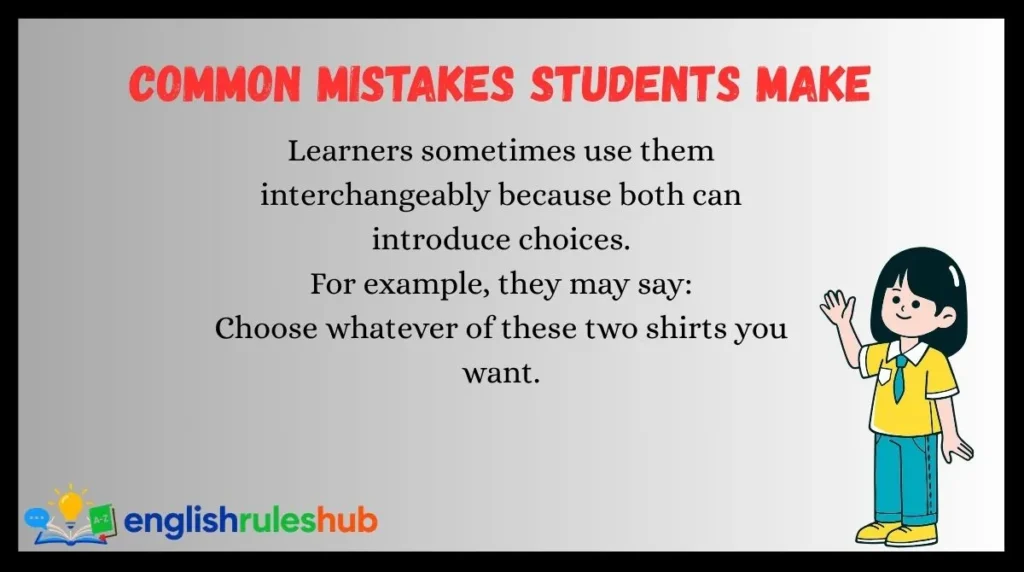
Mistake 1: Thinking “Whichever” and “Whatever” Are Always the Same
Learners sometimes use them interchangeably because both can introduce choices.
For example, they may say:
Choose whatever of these two shirts you want.
This is understandable, but whichever is often more natural when the sentence clearly points to a specific group:
Choose whichever of these two shirts you want.
The word whichever fits the idea of choosing one from the two.
Mistake 2: Using “Whichever” for Any Situation
A learner may say:
Do whichever you want.
This can work when the context gives clear alternatives. For example:
You can call me or send me a message. Do whichever you want.
But if there is no clear group of options, whatever is usually more natural:
Do whatever you want.
Mistake 3: Forgetting That “Whatever” Can Be Broader
Compare:
Choose whichever book you want.
and:
Read whatever you want.
The first sentence suggests a group of books. The second gives a wider choice.
A simple correction tip is to ask yourself:
“Am I choosing one from a group?”
If yes, consider whichever.
If the meaning is “anything” or “no matter what,” consider whatever.
Mistake 4: Thinking “Whatever” Always Sounds Rude
It does not.
For example:
You can choose whatever you want.
This is completely normal and polite.
But when someone simply replies:
Whatever.
the word can sound rude because it may show that the person does not care.
So, context and tone matter.
Easy Trick to Remember the Difference
Here is a very easy classroom trick:
WHICH → WHICHEVER → ONE FROM A CHOICE
WHAT → WHATEVER → ANYTHING
Think about the basic questions:
Which one?
You answer:
Whichever one you want.
Now think:
What do you want?
You can answer:
Whatever you want.
That connection makes the difference easier to remember.
The “Pointing Finger” Trick
Imagine you are standing in front of three shirts.
You point at the shirts and say:
Choose whichever shirt you like.
Your finger can point to one of the shirts.
Now imagine you simply tell your friend:
Wear whatever you like.
You are not pointing to a particular group. The person has a much wider choice.
So remember:
Whichever = I can imagine the choices.
Whatever = I am giving you a wide choice.
This is not a rule that works in every single sentence, but it is an excellent shortcut for beginners.
Daily Life Examples: Whichever vs Whatever
Example 1: Choosing Food
A: Which pizza should I order?
B: Order whichever one you like.
Here, there may be several pizzas on the menu.
Example 2: Open Food Choice
A: What should I bring for lunch?
B: Bring whatever you want.
The choice is wide.
Example 3: Choosing a Seat
Sit in whichever seat is free.
There is a group of seats, and the person can choose one.
Example 4: Choosing Clothes
Wear whatever you feel comfortable in.
The person has freedom to choose clothes.
Example 5: Choosing a Route
Take whichever road is shorter.
There are several roads, and the speaker is talking about choosing one.
Example 6: General Decision
Do whatever you think is best.
The speaker is giving broad freedom.
Example 7: Choosing a Pen
You can use whichever pen you want.
There are several pens available.
Example 8: General Permission
You can use whatever you need.
The choice is broad and is not limited to one named group.
Example 9: No Matter What Happens
Whatever happens, don’t panic.
This means:
No matter what happens, don’t panic.
Example 10: No Matter Which Choice
Whichever option you choose, I will help you.
The speaker knows there are several options and will help regardless of the selected one.
Practice Section
Choose whichever or whatever in each sentence.
1. You can choose _______ shirt from these three.
A. whichever
B. whatever
2. Eat _______ you want.
A. whichever
B. whatever
3. Sit in _______ chair is empty.
A. whichever
B. whatever
4. _______ happens, don’t worry.
A. Whichever
B. Whatever
5. Choose _______ option you think is better.
A. whichever
B. whatever
Answers
1. Whichever — There are three specific shirts, so we are choosing one from a group.
2. Whatever — The meaning is “eat anything you want.”
3. Whichever — There is a group of chairs, and the person can choose one.
4. Whatever — “Whatever happens” means “no matter what happens.”
5. Whichever — The word option suggests a group of available choices.
Frequently Asked Questions About Whichever vs Whatever
What is the main difference between whichever and whatever?
Whichever usually means “any one from a particular group.” Whatever usually means “anything” or “no matter what.” For example, “Choose whichever book you want” suggests a group of books, while “Read whatever you want” gives a wider choice.
Can we use whichever in questions?
Yes. Whichever can be used in questions when you are asking someone to choose from known options.
For example:
Whichever one do you want?
However, in everyday English, “Which one do you want?” is usually more natural and simple. Whichever is especially common in statements such as “Choose whichever one you prefer.”
Can we use whatever in questions?
Yes. Whatever can appear in questions, especially when the speaker wants to show surprise, confusion, or a broad choice.
For example:
Whatever do you mean?
This is more emphatic than simply asking, “What do you mean?”
You can also say:
Whatever should I do?
This expresses strong uncertainty or concern.
Is whichever more formal than whatever?
Neither word is simply “formal” or “informal.” Both are normal English words used in speech and writing.
However, whatever is extremely common in everyday conversation, while whichever may appear more often when discussing choices or alternatives.
Can whichever and whatever be used before a noun?
Yes.
For example:
Choose whichever color you like.
and:
Choose whatever color you like.
Both are grammatically possible. The first usually suggests a particular group of colors, while the second gives a broader sense of freedom.
Does whatever always mean “anything”?
No. Whatever has several uses.
It can mean anything that, as in “Take whatever you need.”
It can mean no matter what, as in “Whatever happens, stay calm.”
It can also be an informal response showing that someone does not care:
“We can go at 6.”
“Whatever.”
The meaning depends heavily on the sentence and tone.
Final Conclusion
The difference between whichever and whatever becomes much easier when you focus on the words behind them.
Whichever is connected with which. It usually refers to one choice from a known or limited group. For example, “Choose whichever dress you like” suggests that there is a group of dresses to choose from.
Whatever is connected with what. It usually gives a wider choice or means “anything” or “no matter what.” For example, “Wear whatever you like” gives the person broad freedom.
You do not need to memorize complicated grammar terms. Just ask yourself one simple question: “Am I choosing one from a group, or am I talking about anything?”
If it is one from a group, whichever may be right. If the meaning is broad or open, whatever is often the better choice.
The best way to learn this difference is to notice these words in real conversations and use them yourself. After a little practice, the choice between them will start to feel natural.

I am Benjamin Clark, an English language writer passionate about simplifying grammar, vocabulary, and word meanings. I create clear, accurate, and practical content to help learners improve their English skills with confidence every day.


9 thoughts on ““Which vs Whatever” Easy Difference, Meaning, and Examples in 2026”