Many English learners get confused by analysis and analyses because the two words look almost the same.
They are closely related, but they are not used in the same way. The main difference is simple: analysis is singular, while analyses is plural.
The confusion often comes from pronunciation and spelling. Analysis ends with -sis, while analyses ends with -ses.
Also, analyses does not look like the usual plural forms that students learn, such as books, cars, or teachers. It is an irregular plural form that comes from Greek.
You may see these words in school, college, business, science, news reports, research papers, and everyday discussions.
For example, a teacher may ask for an analysis of a poem, while a research report may contain several analyses of different results.
Knowing the difference matters because using the wrong form can make a sentence grammatically incorrect or unclear.
The good news is that the basic rule is easy once you see the pattern. One analysis means one detailed examination. Two or more analyses means more than one detailed examination.
By the end, you will know how to use both words correctly, how to pronounce them, how they work in sentences, and how to avoid the common mistakes learners make.
What Does “Analysis” Mean?
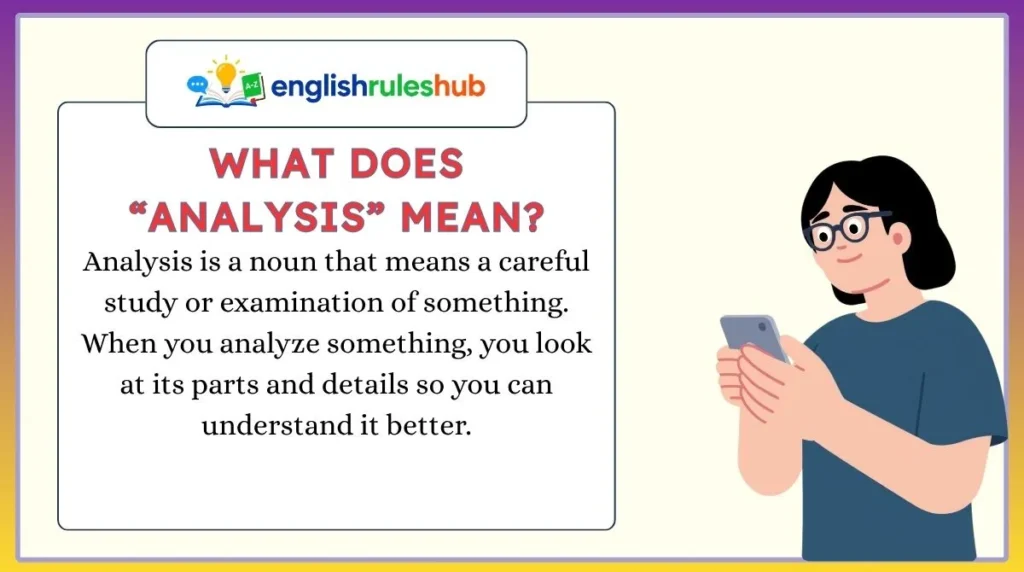
Analysis is a noun that means a careful study or examination of something. When you analyze something, you look at its parts and details so you can understand it better.
For example, a student may read a story carefully and explain its characters, message, and main ideas. That careful study is an analysis of the story.
The word analysis is singular. We use it when we are talking about one study, one examination, or one detailed explanation.
A useful way to remember it is:
One = analysis
We often use analysis with a, an, the, or a possessive word.
For example:
- an analysis
- the analysis
- my analysis
- her analysis
- this analysis
Because analysis starts with a vowel sound, we say an analysis, not a analysis.
Examples of “Analysis”
- The teacher gave an analysis of the poem.
- Her analysis of the problem was very clear.
- We need a detailed analysis before making a decision.
- His analysis showed that the plan had several weaknesses.
- The report contains an analysis of the company’s sales.
- I agree with your analysis of the situation.
- The doctor used the test results for further analysis.
- The student wrote a short analysis of the novel.
In each sentence, we are talking about one examination or study.
When Should You Use “Analysis”?
Use analysis when you are talking about one particular process of examining something carefully.
For example, imagine that a teacher asks you to study one poem. You write one detailed explanation about that poem. You can call it an analysis of the poem.
The same idea works in science.
If a scientist examines one sample and reports the result, that may be an analysis of the sample.
In business, one report may contain an analysis of sales.
In sports, a commentator may give an analysis of the match.
So, analysis is useful in many areas, not only in school.
The Grammar Rule for “Analysis”
The most important rule is:
Analysis is singular.
You can say:
- This analysis is useful.
- The analysis is complete.
- Her analysis was correct.
Notice the singular verbs is and was.
You should not normally say:
- This analysis are useful.
- The analysis were complete.
Those forms are incorrect when analysis refers to one thing.
A Common Learner Confusion
Some students think analysis means several studies because it sounds like a complicated or academic word. Others use analysis as both singular and plural.
That does not work in standard English.
Compare:
One analysis
The analysis is interesting.
More than one analysis
The analyses are interesting.
The spelling changes, and the verb usually changes too.
What Does “Analyses” Mean?
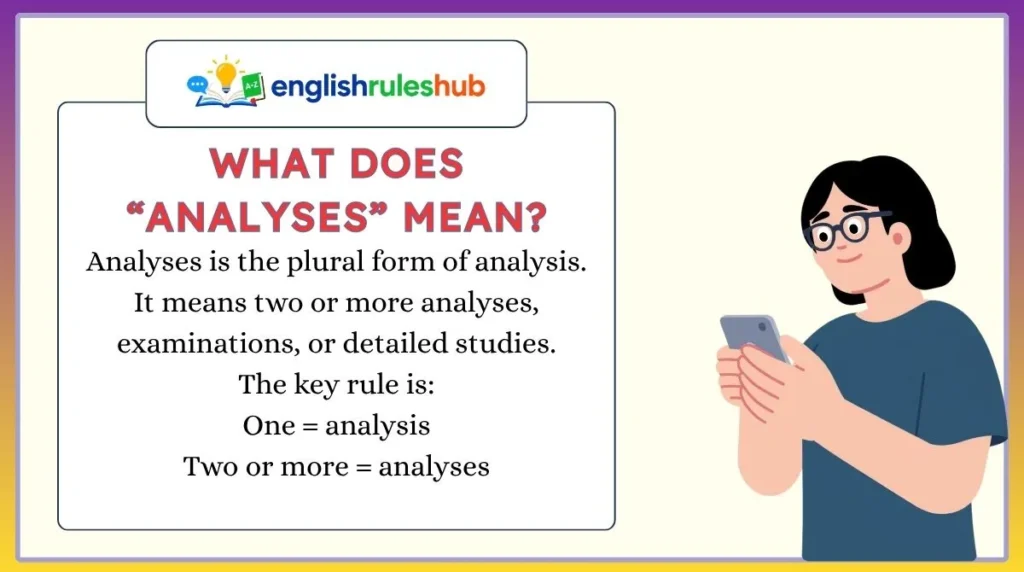
Analyses is the plural form of analysis.
It means two or more analyses, examinations, or detailed studies.
The key rule is:
One = analysis
Two or more = analyses
For example, if one researcher studies one group, we can talk about one analysis. If researchers study three different groups and examine each one separately, we can talk about three analyses.
The word analyses is often used when a writer is discussing several separate studies or examinations.
Examples of “Analyses”
- The researchers completed several analyses of the data.
- These analyses show different results.
- The report contains two separate analyses.
- The scientists compared their analyses of the samples.
- Our team performed several analyses before reaching a conclusion.
- The students presented their analyses of the three poems.
- Different analyses can lead to different conclusions.
- The researchers published new analyses of the survey results.
Here, the word refers to more than one examination or study.
When Should You Use “Analyses”?
Use analyses when you have two or more separate analyses.
For example, suppose a teacher gives students three poems. Each student studies the poems separately. You could say:
The students wrote three analyses.
There are three separate pieces of analysis, so the plural form is needed.
You can also use analyses when several experts study the same subject in different ways.
For example:
The researchers compared their analyses of the problem.
Each researcher may have produced a separate analysis. Therefore, the plural form analyses is correct.
The Grammar Rule for “Analyses”
The main grammar rule is:
Analyses is plural.
Because it is plural, it normally takes plural verbs.
For example:
- The analyses are useful.
- These analyses show a clear pattern.
- Several analyses were completed.
- Their analyses have different conclusions.
Compare this with the singular form:
- The analysis is useful.
- This analysis shows a clear pattern.
- One analysis was completed.
- Her analysis has a different conclusion.
This difference between is/are, was/were, and has/have is a useful clue.
Pronunciation Can Also Cause Confusion
The pronunciation changes too.
Analysis is generally pronounced:
uh-NAL-uh-sis
Analyses is generally pronounced:
uh-NAL-uh-seez
So the final sound is different.
If you hear someone say analyses, do not assume they are saying analysis. The pronunciation helps show whether the speaker means one or more than one.
Difference Between Analysis and Analyses
The difference between these words is mainly about number.
Analysis = singular
Analyses = plural
Think about them like this:
| Word | Number | Meaning | Example |
|---|---|---|---|
| Analysis | Singular | One detailed examination | The analysis is complete. |
| Analyses | Plural | Two or more detailed examinations | The analyses are complete. |
This is the most important difference you need to remember.
Analysis Refers to One
When there is only one study or examination, use analysis.
The scientist completed an analysis of the water.
There is one examination of the water.
I read your analysis of the book.
There is one particular analysis.
Her analysis was helpful.
Again, we are talking about one analysis.
Analyses Refers to More Than One
When there are two or more separate examinations, use analyses.
The scientists completed several analyses of the water.
There were several separate analyses.
I read their analyses of the book.
There is more than one analysis.
Their analyses were helpful.
The plural verb were supports the plural noun.
Grammar Logic
The spelling may look strange, but the grammar is straightforward.
English has many words borrowed from other languages that do not form their plurals by simply adding -s.
For example:
- analysis → analyses
- crisis → crises
- thesis → theses
- hypothesis → hypotheses
- basis → bases
So analyses follows a special plural pattern.
You do not create the plural by writing analysises.
That form is incorrect.
Sentence Structure
With analysis, singular structures are common:
This analysis is useful.
An analysis was completed.
Her analysis has several strong points.
With analyses, plural structures are common:
These analyses are useful.
Several analyses were completed.
Their analyses have several strong points.
Notice how the words around the noun change.
Singular:
The analysis is accurate.
Plural:
The analyses are accurate.
This is an important grammar clue.
Meaning Comparison
The basic meaning does not really change.
Both words refer to the careful examination of something.
The only major difference is quantity.
Analysis means one examination.
Analyses means more than one examination.
For example:
The report contains an analysis of the results.
This suggests one analysis.
But:
The report contains several analyses of the results.
This tells us there are multiple analyses.
Grammar Rules You Must Remember
Rule #1: Use “Analysis” for One
If you are talking about one detailed study, use analysis.
Example:
The analysis of the survey is complete.
There is one analysis.
Another example:
She gave an analysis of the problem.
Again, it is one examination.
Rule #2: Use “Analyses” for Two or More
When you have several separate examinations, use analyses.
Example:
The analyses of the survey are complete.
Here, there are multiple analyses.
Words such as several, many, different, and multiple can help you notice that the plural form is needed.
Rule #3: Match the Verb With the Noun
Because analysis is singular, use a singular verb.
The analysis is correct.
Because analyses is plural, use a plural verb.
The analyses are correct.
This simple trick can help you catch mistakes.
If you see analyses, look for a plural verb when the sentence needs one.
Rule #4: Never Use “Analysises”
A very common mistake is adding -es to the end of analysis to create what seems like a normal plural.
Do not write:
analysises
The correct plural is:
analyses
For example:
❌ The report contains three analysises.
✅ The report contains three analyses.
Learning the plural form as a complete word is easier than trying to build it every time.
Common Mistakes Students Make
Students often make mistakes with these words because English has many different plural patterns.
Mistake 1: Using “Analyses” for One
Incorrect:
This analyses is very useful.
Correct:
This analysis is very useful.
Why?
Because the sentence talks about one analysis.
The word this also gives us a clue that we are talking about one thing.
Mistake 2: Using “Analysis” for Several
Incorrect:
The analysis are different.
Correct:
The analyses are different.
The verb are tells us that the subject is plural. Therefore, the noun should also be plural.
Mistake 3: Writing “Analysises”
Incorrect:
We completed two analysises.
Correct:
We completed two analyses.
This is probably one of the easiest mistakes to make if you have not seen the plural form before.
Mistake 4: Saying “An Analyses”
Incorrect:
I wrote an analyses of the story.
Correct:
I wrote an analysis of the story.
The word an is singular, so it must be followed by the singular noun analysis.
You can say:
I wrote an analysis.
Or:
I wrote two analyses.
Not:
I wrote an analyses.
Mistake 5: Confusing “Analysis” With the Verb “Analyze”
These words are related, but they have different jobs.
Analyze is a verb.
Analysis is a noun.
For example:
We need to analyze the results.
Here, analyze is the action.
We need an analysis of the results.
Here, analysis is the noun for the examination.
The plural noun is analyses.
Easy Trick to Remember the Difference
Here is a simple classroom trick:
One analysis → two analyses
Say the pair together a few times:
analysis → analyses
You can also connect the words with numbers.
1 = analysis
2, 3, 4, 5… = analyses
Another helpful trick is to remember the ending.
Analysis ends with a sound like “sis.”
Analyses ends with a sound like “seez.”
So:
analysis = one
analyses = many
Think of analyses as the word you use when you have several pieces of careful study.
For example, imagine a teacher has three students. Each student studies the same painting and gives a different explanation.
The teacher could say:
I have three analyses of the painting.
But if only one student gives one explanation, the teacher could say:
I have one analysis of the painting.
This real-life picture makes the difference easier to remember.
A Quick Memory Sentence
Try remembering this:
One analysis, many analyses.
That one sentence covers the main rule.
You do not need to memorize a long grammar explanation every time you use these words.
Daily Life Examples
These words may sound academic, but they can appear in many real situations.
Example 1: At School
Student: Did you finish the analysis of the poem?
Teacher: Yes. Your analysis explains the main idea clearly.
Here, the teacher is talking about one student’s work.
Example 2: In a Science Class
Teacher: We need an analysis of this sample.
Student: Should we start now?
Teacher: Yes. Please record the results carefully.
Only one examination is being discussed, so analysis is correct.
Example 3: At Work
Manager: Have you finished the sales analysis?
Employee: Yes. I sent it this morning.
The manager is referring to one report or examination of sales data.
Example 4: Talking About Research
Student: What did the researchers find?
Teacher: Their analyses showed different patterns.
There were several separate examinations, so analyses is correct.
Example 5: Talking About a Movie
Friend: What did you think of the movie?
You: I read an interesting analysis of its ending.
You are talking about one particular written examination.
Example 6: Talking About Different Reports
Manager: Did you read the three reports?
Employee: Yes, and their analyses were very different.
There are multiple analyses, so analyses is needed.
Example 7: At University
Student: How many analyses do we need to include in the assignment?
Teacher: You need two separate analyses.
Because the student and teacher are talking about two pieces of work, analyses is correct.
Example 8: Discussing a Problem
Friend: What does your analysis of the situation say?
You: I think we need more information.
One particular examination is being discussed.
Example 9: Talking About Several Experts
Reporter: What do the experts think?
Scientist: Their analyses are not exactly the same.
Each expert may have provided a separate analysis, so the plural analyses is appropriate.
Example 10: In a Meeting
Manager: We have one analysis from the marketing team.
Assistant: And we also have two analyses from the research team.
This example shows both forms in the same conversation.
Practice Section
Choose the correct word: analysis or analyses.
1. The ______ of the report is very detailed.
2. The researchers completed several ______ of the data.
3. I need an ______ of this problem.
4. Their ______ are based on different sets of information.
5. This ______ gives us a clear answer.
Answers
1. analysis
The analysis of the report is very detailed.
Only one analysis is mentioned.
2. analyses
The researchers completed several analyses of the data.
The word several shows that there is more than one.
3. analysis
I need an analysis of this problem.
The article an is singular, so analysis is correct.
4. analyses
Their analyses are based on different sets of information.
The plural verb are matches the plural noun.
5. analysis
This analysis gives us a clear answer.
The word this refers to one analysis.
FAQs About Analysis and Analyses
What is the difference between analysis and analyses?
Analysis is the singular form, meaning one careful examination or study.
Analyses is the plural form, meaning two or more examinations or studies.
For example, an analysis of the report means one study, while several analyses of the report means several studies.
Is analyses the plural of analysis?
Yes. Analyses is the correct plural form of analysis.
Do not use analysises. That spelling is incorrect in standard English.
Remember the basic pattern: analysis → analyses.
Can we use “analysis” in questions?
Yes. You can use analysis in questions whenever you are asking about one analysis.
For example:
Did you read the analysis?
Where is the analysis of the results?
If you are asking about more than one, use analyses:
Did you read the analyses?
Is analysis formal or informal?
Analysis is common in both formal and everyday English, although it is especially common in school, business, science, research, and professional writing.
For casual speech, people may sometimes use simpler words such as review, study, or look at, depending on the meaning.
Why is the plural of analysis “analyses” and not “analysises”?
Analysis comes from Greek, and it follows an older plural pattern used by some words ending in -sis.
The plural changes to -ses, giving us analyses.
Similar examples include:
- crisis → crises
- thesis → theses
- hypothesis → hypotheses
How do you pronounce analysis and analyses?
Analysis is commonly pronounced approximately as uh-NAL-uh-sis.
Analyses is commonly pronounced approximately as uh-NAL-uh-seez.
The final sound is different, so listening carefully can help you identify whether someone means one or several.
Final Conclusion
The difference between analysis and analyses is much easier once you focus on one simple idea: number.
Use analysis when you mean one careful examination, study, or explanation. Use analyses when you mean two or more. The plural form may look unusual, but it is simply the correct plural of analysis.
Remember these two lines:
One analysis.
Two or more analyses.
Also pay attention to the verb. We say “The analysis is…” but “The analyses are…”. And never write analysises.
Try using both forms in your own sentences. Write one sentence about a single analysis and another about several analyses. A little practice will make the difference feel natural.
Once you remember the singular and plural forms, you will be able to use these words confidently in school assignments, reports, conversations, and professional writing.

I am Benjamin Clark, an English language writer passionate about simplifying grammar, vocabulary, and word meanings. I create clear, accurate, and practical content to help learners improve their English skills with confidence every day.