Many English learners get confused by excess and excessive because the two words look very similar.
They come from the same word family, and both are connected to the idea of too much. Because of this, students often use one when they should use the other.
You may hear people say things like, “There is an excess of food” or “The food is excessive.” Both sentences are correct, but the grammar is different.
Understanding that difference is important if you want to speak and write English naturally.
These words appear in everyday conversations, school assignments, news reports, business writing, and English exams. If you use them incorrectly, your sentence may sound strange or ungrammatical.
The good news is that the difference is actually quite simple once you understand the role each word plays in a sentence.
By the end of this guide, you will clearly know:
- What excess means
- What excessive means
- When to use each word
- The grammar rules behind them
- Common mistakes to avoid
- Easy tricks for remembering the difference
After some practice, choosing between these two words will become much easier.
What Does “Excess” Mean?
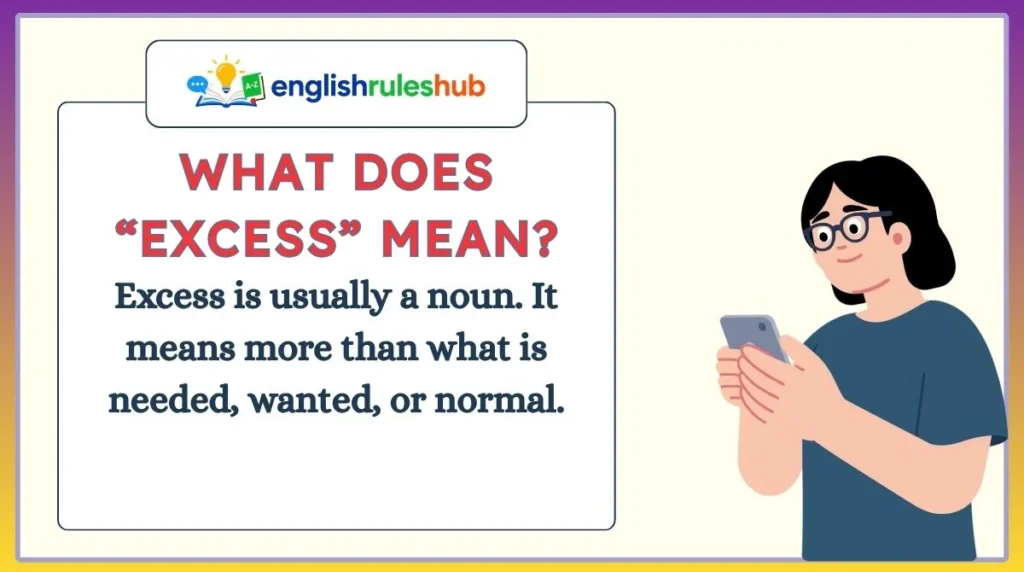
Excess is usually a noun. It means more than what is needed, wanted, or normal.
Think of it as an extra amount of something.
Simple Definition
Excess = too much of something
When to Use It
Use excess when talking about an amount, quantity, or extra part of something.
Grammar Rule
Most of the time:
Excess = Noun
Structure:
- excess + of + noun
- an excess of + noun
- in excess of + amount
Examples of Excess
- There is an excess of sugar in this drink.
- The company had an excess of products in storage.
- Eating in excess can cause health problems.
- We must remove the excess water from the tank.
- The government is concerned about the excess of waste.
- An excess of traffic causes delays.
- The machine produced goods in excess of demand.
- Excess spending can create debt.
Common Learner Confusion
Many students think excess is always an adjective.
Wrong:
- The excess noise was very annoying. ❌
Actually, this sentence is possible because excess can sometimes act as an adjective before a noun, but this usage is less common than the noun form.
For beginners, it is safer to remember:
- Excess = usually a noun
- Excessive = adjective
That simple rule works in most situations.
What Does “Excessive” Mean?
Excessive is an adjective.
It describes something that is too much, too great, or more than reasonable.
Simple Definition
Excessive = too much
When to Use It
Use excessive before a noun or after a linking verb when describing something.
Grammar Rule
Excessive = Adjective
Structure:
- excessive + noun
- be + excessive
Examples of Excessive
- The teacher gave us an excessive amount of homework.
- His excessive spending caused financial problems.
- The noise was excessive.
- The company faced complaints about excessive prices.
- Excessive screen time can affect sleep.
- She showed excessive concern about a small problem.
- The heat became excessive during the afternoon.
- Excessive use of social media can be unhealthy.
Common Learner Confusion
Students often write:
- There was excessive of food at the party. ❌
This is wrong because excessive is an adjective.
Correct:
- There was an excess of food at the party. ✅
Or:
- The amount of food was excessive. ✅
Remember that adjectives describe nouns. They do not usually replace nouns.
Difference Between Excess and Excessive
Although both words relate to the idea of “too much,” they have different grammar functions.
Quick Comparison Table
| Feature | Excess | Excessive |
|---|---|---|
| Part of Speech | Usually a noun | Adjective |
| Meaning | Extra amount | Too much |
| Describes a noun? | Usually no | Yes |
| Can be subject/object? | Yes | No |
| Common Pattern | excess of something | excessive + noun |
| Example | an excess of sugar | excessive sugar |
Usage Difference
Excess focuses on the extra amount itself.
Example:
- There is an excess of sugar.
The sentence talks about the quantity.
Excessive focuses on describing something as too much.
Example:
- The sugar content is excessive.
The sentence describes the sugar amount.
Grammar Logic
Look at these examples:
- We have an excess of inventory.
- We have excessive inventory.
Both are correct.
However:
- Excess of inventory refers to the extra quantity.
- Excessive inventory describes the inventory as too much.
The meaning is similar, but the grammar is different.
Sentence Structure Difference
Using Excess
- an excess of money
- an excess of food
- an excess of information
Pattern:
Excess + of + noun
Using Excessive
- excessive money
- excessive food
- excessive information
Pattern:
Excessive + noun
Meaning Comparison
Compare these sentences:
- There is an excess of traffic in the city.
- The city has excessive traffic.
Both suggest there is too much traffic.
The first focuses on the amount.
The second describes the traffic situation.
That small difference helps native speakers choose the most natural expression.
Grammar Rules You Must Remember
Rule #1: Excess Is Usually a Noun
Correct:
- There is an excess of water.
Correct:
- The factory produced goods in excess of demand.
Wrong:
- There is excessive of water. ❌
Rule #2: Excessive Is an Adjective
Correct:
- Excessive noise makes it hard to study.
Correct:
- The noise is excessive.
Wrong:
- The excessive was annoying. ❌
Rule #3: Use “Of” After Excess
Correct:
- An excess of food
- An excess of money
- An excess of clothing
Wrong:
- An excess food ❌
Rule #4: Put Excessive Before a Noun
Correct:
- excessive spending
- excessive drinking
- excessive pressure
Wrong:
- excessive of spending ❌
Common Mistakes Students Make
Learning the difference becomes easier when you know the mistakes people often make.
Mistake 1: Using Excessive as a Noun
Wrong:
- There was excessive at the party. ❌
Correct:
- There was an excess of food at the party. ✅
Why?
Because excessive is an adjective, not a noun.
Mistake 2: Adding “Of” After Excessive
Wrong:
- Excessive of noise disturbed us. ❌
Correct:
- Excessive noise disturbed us. ✅
Mistake 3: Using Excess Instead of Excessive
Wrong:
- The teacher gave us excess homework. ❌
Better:
- The teacher gave us excessive homework. ✅
Why?
You are describing homework, so an adjective is needed.
Mistake 4: Forgetting the Noun Pattern
Wrong:
- An excess food was wasted. ❌
Correct:
- An excess of food was wasted. ✅
Easy Correction Tip
Ask yourself:
Do I need a noun or an adjective?
If you need a noun, use excess.
If you need an adjective, use excessive.
This simple question solves most mistakes.
Easy Trick to Remember the Difference
A simple memory trick can help.
Think About the Ending
Excessive ends with -ive.
Many adjectives end with -ive:
- active
- creative
- attractive
- expensive
- excessive
So when you see -ive, think:
“This word describes something.”
Think About Excess as a Thing
An excess is a thing or amount.
Examples:
- an excess of food
- an excess of money
- an excess of waste
You can almost imagine a pile of extra items.
Quick Memory Formula
- Excess = extra amount
- Excessive = too much (adjective)
Many students remember it with this phrase:
Excess is the amount. Excessive is the description.
Daily Life Examples
These examples show how native speakers use the words in everyday situations.
Conversation Example 1
A: Why are you tired?
B: I had excessive work today.
Conversation Example 2
A: Why is the bag so heavy?
B: I packed an excess of clothes.
Conversation Example 3
A: Is this coffee healthy?
B: Not really. It contains an excess of sugar.
Conversation Example 4
A: Why did the neighbors complain?
B: The music was excessive.
Conversation Example 5
A: Why are your phone bills so high?
B: Because of excessive data usage.
Conversation Example 6
A: What caused the traffic jam?
B: There was an excess of vehicles on the road.
Conversation Example 7
A: Why did the project fail?
B: There was excessive spending.
Conversation Example 8
A: Why are the shelves full?
B: The store ordered an excess of products.
Conversation Example 9
A: Why is the room so hot?
B: The heat is excessive today.
Conversation Example 10
A: Why did the doctor give advice?
B: Because my sugar intake was excessive.
Practice Section
Choose the correct word: excess or excessive.
1.
There was an ______ of food after the wedding.
A. excess
B. excessive
2.
The company was criticized for ______ prices.
A. excess
B. excessive
3.
An ______ of rain damaged the crops.
A. excess
B. excessive
4.
The noise became ______ during the concert.
A. excess
B. excessive
5.
His ______ spending created debt.
A. excess
B. excessive
Answers
- A — excess
- B — excessive
- A — excess
- B — excessive
- B — excessive
FAQs
What is the difference between excess and excessive?
Excess is usually a noun meaning an extra amount of something. Excessive is an adjective that describes something as too much. The main difference is grammar and sentence function.
Can we use excessive in questions?
Yes. You can use it in questions just like other adjectives.
Examples:
- Is the noise excessive?
- Do you think the price is excessive?
Can we use excess in questions?
Yes.
Examples:
- Is there an excess of water?
- Was there an excess of food at the event?
Here, excess works as a noun.
Is excessive formal or informal?
It works in both formal and informal English. You may hear it in daily conversations, business reports, news articles, and academic writing.
Can excess be an adjective?
Yes, but this use is less common for learners.
Examples:
- excess baggage
- excess weight
In many situations, beginners can safely remember that excess is usually a noun.
Which word is more common in everyday speech?
Both are common, but people often use excessive when describing problems such as excessive noise, excessive spending, or excessive pressure. Excess is common when talking about extra amounts of something.
Final Conclusion
Understanding the difference between excess and excessive is much easier once you focus on their grammar roles.
Excess is usually a noun. It refers to an extra amount of something beyond what is needed or normal. You will often see patterns such as an excess of food, an excess of waste, or an excess of traffic.
Excessive, on the other hand, is an adjective. It describes something as too much. Common examples include excessive noise, excessive spending, and excessive pressure.
A helpful rule is to remember that excess is the amount, while excessive is the description. When you know whether you need a noun or an adjective, choosing the correct word becomes much simpler.
Try using both words in your own sentences every day. Reading, writing, and speaking with them will help you remember the difference naturally.
With regular practice, these two commonly confused words will soon feel easy and familiar.

I am Benjamin Clark, an English language writer passionate about simplifying grammar, vocabulary, and word meanings. I create clear, accurate, and practical content to help learners improve their English skills with confidence every day.