Many English learners hear people talk about cuss words and curse words, but they are often unsure if these terms mean the same thing.
Some people use them as if there is no difference at all. Others believe they have different meanings. This can be confusing, especially for students and non-native speakers.
You may hear these expressions in movies, TV shows, songs, social media posts, or everyday conversations. Understanding them helps you follow conversations more easily and avoid misunderstandings.
Language is not only about grammar. It is also about knowing how people actually speak. Some words are polite, while others can sound rude, angry, or offensive. Learning the meaning of these terms can help you communicate more carefully.
Many learners also wonder whether these expressions are formal or informal, when they should be used, and whether they are acceptable in school, work, or public situations.
By the end of this guide, you will clearly understand the meanings of cuss words and curse words, how they are used, the differences between them, common mistakes learners make, and the grammar rules that are important to remember.
You will also see many real-life examples that make the topic easy to understand.
What Does “Cuss Words” Mean?
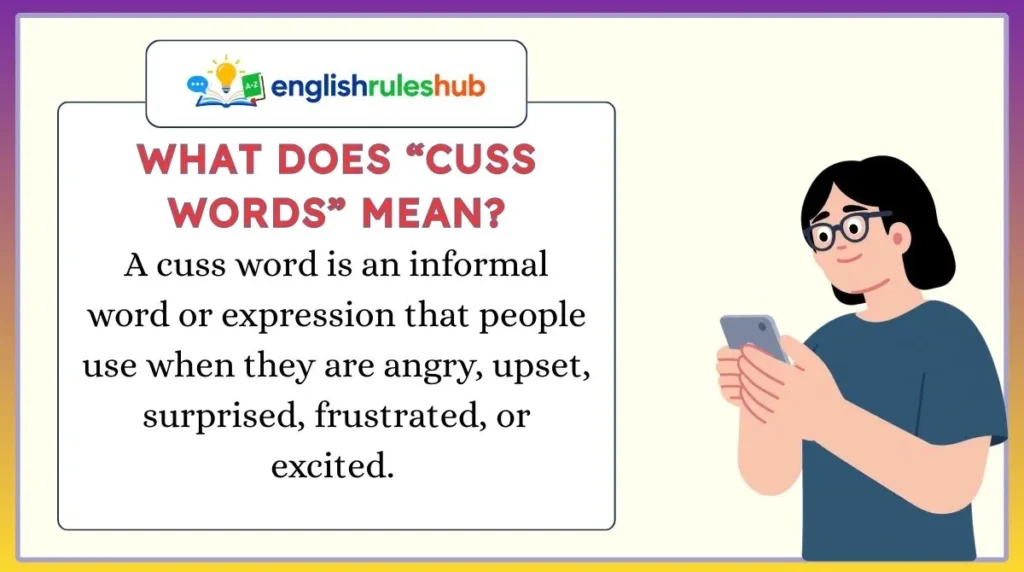
A cuss word is an informal word or expression that people use when they are angry, upset, surprised, frustrated, or excited. In American English, the term usually refers to swear words or bad language.
The word cuss comes from the word curse, but over time it developed its own informal meaning.
When to Use It
People usually use the term cuss word when talking about rude or offensive language.
Examples:
- My parents do not allow cuss words in the house.
- The movie contains several cuss words.
- The teacher asked the students not to use cuss words.
- Some people use cuss words when they get angry.
- He tried not to say any cuss words during the game.
- The child learned a cuss word from television.
- Many workplaces discourage cuss words.
- She apologized after using a cuss word.
Grammar Rule
Cuss word is a noun.
Singular:
- That is a cuss word.
Plural:
- Those are cuss words.
It can also appear in phrases such as:
- use cuss words
- say cuss words
- avoid cuss words
- hear cuss words
Common Learner Confusion
Many learners think cuss word is a formal grammar term. It is not. It is mainly an informal expression, especially common in American English.
People often use:
- cuss words
- swear words
- bad words
to mean nearly the same thing in everyday conversation.
What Does “Curse Words” Mean?
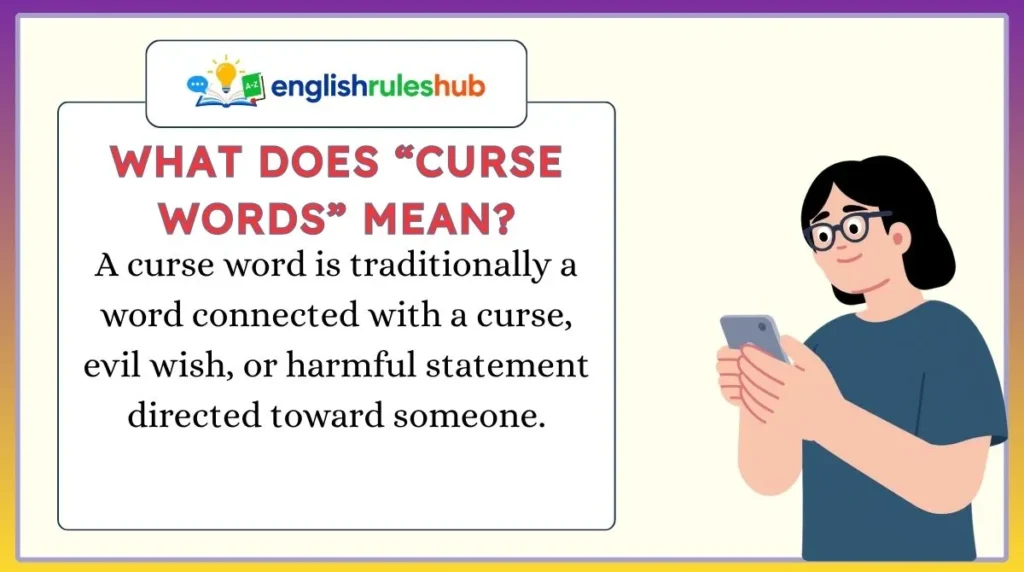
A curse word is traditionally a word connected with a curse, evil wish, or harmful statement directed toward someone. Today, many people also use the term to mean a swear word or offensive language.
Because language changes over time, curse word often overlaps with cuss word in modern English.
When to Use It
You can use curse word when discussing offensive language or words that people consider inappropriate.
Examples:
- The book contains a few curse words.
- Some parents dislike hearing curse words.
- He shouted several curse words after dropping his phone.
- The actor avoided using curse words during the interview.
- Many schools prohibit curse words.
- She was surprised by the number of curse words in the film.
- The child repeated a curse word he heard outside.
- Online games sometimes contain curse words in chats.
Grammar Rule
Curse word is also a noun.
Singular:
- That is a curse word.
Plural:
- Those are curse words.
Common structures:
- say a curse word
- use curse words
- avoid curse words
- hear curse words
Common Learner Confusion
Many learners believe that curse word always means a magical curse. While that was closer to the original meaning, modern English speakers frequently use it to mean a swear word or offensive word.
The exact meaning often depends on context.
Difference Between Cuss Words and Curse Words
Although these expressions are very similar today, there are some small differences in usage and history.
Comparison Table
| Feature | Cuss Words | Curse Words |
|---|---|---|
| Meaning Today | Swear words or bad language | Swear words or bad language |
| Formality | More informal | Slightly more neutral |
| Common Region | Very common in American English | Common in many English varieties |
| Original Meaning | Informal form of “curse” | Words connected to curses |
| Modern Usage | Offensive language | Offensive language |
Usage Difference
In everyday conversation, many native speakers use the two terms interchangeably.
Example:
- He used a cuss word.
- He used a curse word.
Both sentences are understood the same way by most people.
However, cuss word often sounds more casual and conversational.
Grammar Logic
Both expressions function as noun phrases.
Examples:
- The cuss word shocked everyone.
- The curse word shocked everyone.
The grammar structure remains exactly the same.
Sentence Structure Difference
There is usually no structural difference.
Pattern:
Subject + verb + cuss word
Example:
- She said a cuss word.
Subject + verb + curse word
Example:
- She said a curse word.
Meaning Comparison
Historically:
- Curse word = language connected with curses.
- Cuss word = informal variation of curse.
Today:
- Both usually mean swear words or offensive language.
Because of this overlap, most native speakers do not worry about the difference in daily conversation.
Grammar Rules You Must Remember
Rule #1: Both Terms Are Countable Nouns
You can count them.
Examples:
- I heard one cuss word.
- I heard three cuss words.
- He used one curse word.
- She used several curse words.
Rule #2: Use Articles with Singular Forms
When talking about one word, use a or the.
Examples:
- He said a cuss word.
- She heard a curse word.
- The cuss word offended people.
- The curse word appeared in the movie.
Rule #3: Use Plural Forms for More Than One
Examples:
- The song contains cuss words.
- The students learned some curse words.
- Many films contain cuss words.
- Some games include curse words.
Rule #4: They Usually Follow Verbs Like “Say,” “Use,” and “Hear”
Examples:
- Do not say cuss words.
- He used several curse words.
- We heard cuss words outside.
- They avoided curse words during the meeting.
Common Mistakes Students Make
Understanding common mistakes can help you speak and write more naturally.
Mistake 1: Using the Wrong Number
Wrong:
- He said many cuss word.
Correct:
- He said many cuss words.
Tip:
Use the plural form after words like many, several, and a lot of.
Mistake 2: Forgetting Articles
Wrong:
- He said cuss word.
Correct:
- He said a cuss word.
Tip:
Singular countable nouns usually need an article.
Mistake 3: Thinking They Have Completely Different Meanings
Wrong idea:
- Cuss words and curse words are totally different.
Correct understanding:
- In modern English, they usually mean the same thing.
Tip:
Focus on context instead of searching for a huge difference.
Mistake 4: Using Them in Formal Writing
Less Natural:
- The research focused on cuss words.
More Formal:
- The research focused on offensive language.
Tip:
Academic and professional writing often uses more formal terms.
Mistake 5: Using Offensive Language Without Understanding Context
Some learners copy words from movies without knowing their impact.
Tip:
Know the meaning and social effect of words before using them.
Easy Trick to Remember the Difference
A simple memory trick can help.
Think of it this way:
Cuss = Casual
Both words start with the letter C.
This reminds you that cuss word is often the more casual and conversational term.
For curse word, think about the older idea of a curse or harmful statement. This can help you remember where the expression originally came from.
In modern conversation:
- Cuss word = casual name
- Curse word = slightly more traditional name
Most of the time, they refer to the same type of language.
Daily Life Examples
Here are some real-life spoken English examples.
- Please do not use cuss words around the children.
- The coach told the team to avoid curse words during practice.
- My little brother learned a cuss word from a movie.
- Some television shows contain curse words.
- He got angry and shouted a few cuss words.
- The teacher asked everyone to use respectful language instead of curse words.
- I try not to use cuss words when I am upset.
- The game chat was full of curse words.
- My parents never allowed cuss words at the dinner table.
- She apologized after using a curse word during the meeting.
These examples show how the expressions appear in everyday conversations.
Practice Section
Choose the correct option.
1. He said a ______ during the argument.
A. cuss word
B. cuss words
2. The movie contains several ______.
A. curse word
B. curse words
3. Please do not use ______ around children.
A. cuss words
B. cuss word
4. She heard a ______ on the playground.
A. curse words
B. curse word
5. Many schools discourage ______.
A. curse words
B. curse word
Answers
- A. cuss word
- B. curse words
- A. cuss words
- B. curse word
- A. curse words
FAQs
What is the difference between cuss words and curse words?
In modern English, there is very little difference. Both terms usually refer to swear words or offensive language. The main difference is that “cuss word” sounds more informal, while “curse word” reflects the older form of the expression.
Can we use cuss words and curse words in questions?
Yes. Both can be used in questions.
Examples:
- Why did he use a cuss word?
- Did you hear any curse words?
The grammar works the same as other countable nouns.
Are cuss words formal or informal?
The term cuss word is generally informal. It is commonly used in everyday speech. In formal writing, people often use expressions such as “offensive language” or “profanity.”
Are cuss words and swear words the same?
In many situations, yes. People often use cuss words, curse words, swear words, and bad words to describe offensive language. The exact meaning can vary slightly depending on the speaker.
Should English learners use cuss words?
Understanding them is useful because you may hear them in movies, music, and conversations. However, learners should be careful about using them because some words can offend people or sound disrespectful.
Why do people use cuss words?
People may use them to express anger, surprise, frustration, excitement, or strong emotions. The reasons depend on the situation, culture, and speaker.
Final Conclusion
The terms cuss words and curse words often confuse English learners because they look similar and are frequently used in the same situations.
The good news is that modern English treats them almost the same way. Both usually refer to swear words, bad language, or offensive expressions.
The biggest difference is that cuss word often sounds more casual and conversational, especially in American English.
Curse word is slightly closer to the original historical meaning, but most native speakers use it to describe offensive language as well.
Remember the key grammar points: both are countable nouns, singular forms need articles, and plural forms are used when talking about more than one word. Pay attention to context and audience before using any strong language.
The best way to master this topic is through reading, listening, and practice. When you notice these expressions in movies, books, or conversations, observe how native speakers use them.
Over time, the difference will become easy to understand and remember.

I am Benjamin Clark, an English language writer passionate about simplifying grammar, vocabulary, and word meanings. I create clear, accurate, and practical content to help learners improve their English skills with confidence every day.