Many English learners get confused when they see rather than and instead of. Both expressions are used when we choose one thing and do not choose another.
Because their meanings are very similar, students often wonder if they can use them in the same way.
In everyday English, you will hear these expressions in conversations, movies, books, emails, and even at work or school. Native speakers use them all the time when talking about choices, preferences, and alternatives.
For example:
- I drank tea instead of coffee.
- I drank tea rather than coffee.
Both sentences are correct, but there are small differences in style and grammar that learners should understand.
Knowing how to use these expressions correctly can make your English sound more natural and clear. It can also help you avoid common grammar mistakes that many students make.
By the end of this guide, you will understand the meaning of both expressions, learn the important grammar rules, see real-life examples, discover common mistakes, and feel more confident using them in your daily English conversations and writing.
What Does “Rather Than” Mean?
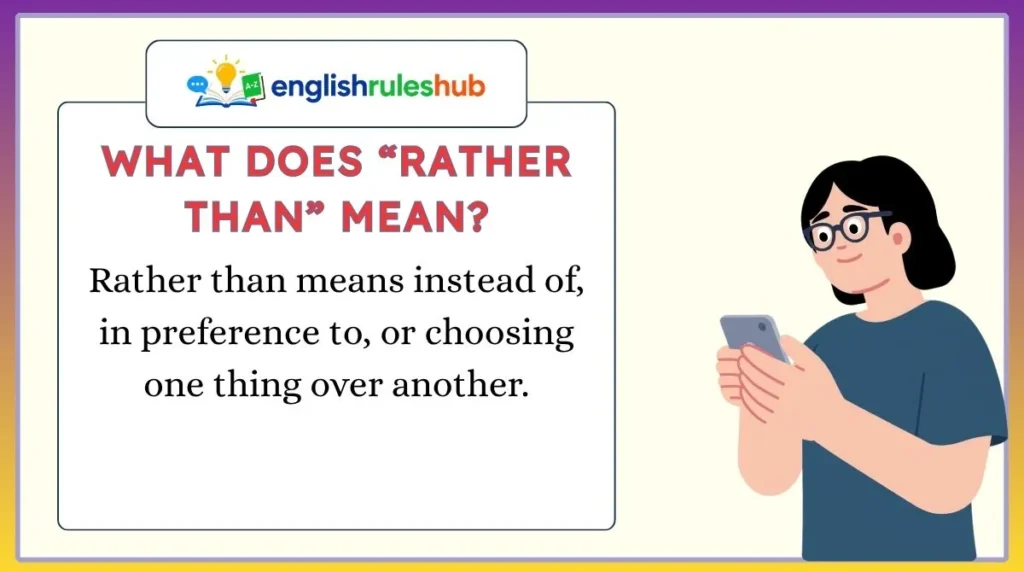
Rather than means instead of, in preference to, or choosing one thing over another.
It is used when someone prefers one option and does not choose another option.
When to Use Rather Than
Use rather than when:
- Comparing two choices
- Showing preference
- Talking about decisions
- Explaining what someone chooses
Grammar Rule
The basic structure is:
Option A + rather than + Option B
Examples:
- I would walk rather than drive.
- She chose the blue dress rather than the red one.
A common grammar point is that similar forms should follow both sides of rather than.
Correct:
- She likes reading rather than watching TV.
Incorrect:
- She likes reading rather than to watch TV.
Examples of Rather Than
- I stayed at home rather than go out.
- She drank water rather than soda.
- We traveled by train rather than by bus.
- He decided to study rather than play games.
- They bought a small house rather than a large one.
- I would cook dinner rather than order food.
- Sarah chose honesty rather than lies.
- The company invested in training rather than advertising.
Common Learner Confusion
Many students think rather than always sounds formal. While it can sound slightly more formal than instead of, native speakers use it in everyday conversations too.
For example:
- I’d rather stay home than go out.
- I’d rather eat pizza than burgers.
These are very common spoken English sentences.
Another confusion is verb forms. After rather than, learners sometimes use the wrong verb structure. Matching the grammatical pattern on both sides usually helps.
What Does “Instead Of” Mean?
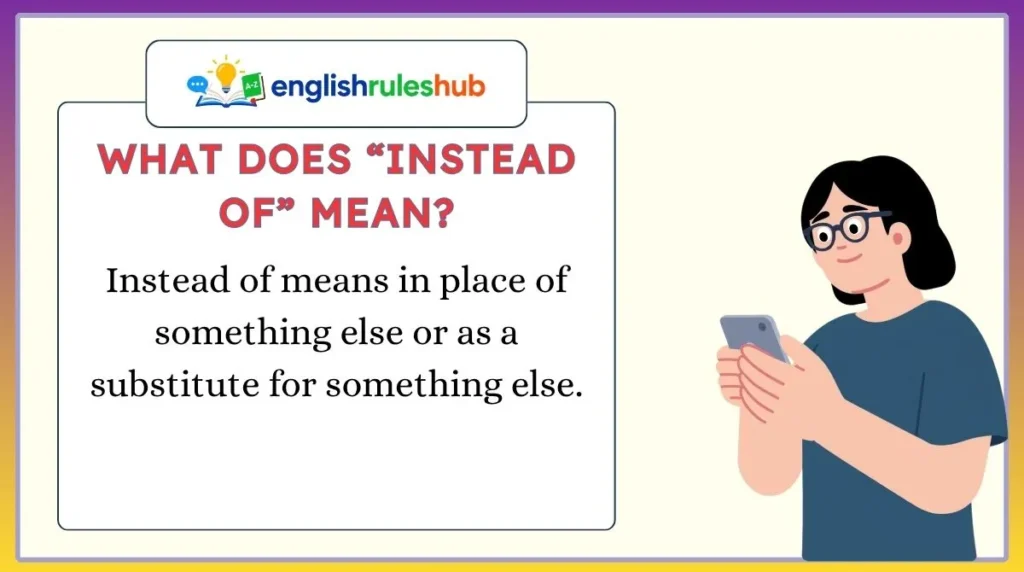
Instead of means in place of something else or as a substitute for something else.
It shows that one thing replaces another.
When to Use Instead Of
Use instead of when:
- Replacing something
- Choosing another option
- Talking about alternatives
- Explaining substitutions
Grammar Rule
The basic structure is:
Option A + instead of + Option B
Examples:
- I had tea instead of coffee.
- We stayed home instead of going out.
After instead of, we usually use:
- A noun
- A pronoun
- A gerund (-ing form)
Examples of Instead Of
- I drank tea instead of coffee.
- She walked instead of driving.
- We watched a movie instead of playing games.
- He bought apples instead of oranges.
- They traveled by train instead of flying.
- Sarah studied instead of sleeping.
- My brother chose water instead of soda.
- The teacher used examples instead of long explanations.
Common Learner Confusion
Many learners use the base verb after instead of.
Incorrect:
- We stayed home instead of go out.
Correct:
- We stayed home instead of going out.
Remember that instead of is usually followed by a noun or an -ing form.
Difference Between Rather Than and Instead Of
Although these expressions often have similar meanings, they are not always used in exactly the same way.
Comparison Table
| Feature | Rather Than | Instead Of |
|---|---|---|
| Main Meaning | Preference | Replacement |
| Common Use | Choosing one option over another | Taking the place of another thing |
| Formality | Slightly more formal | More common in everyday speech |
| Followed By | Nouns, verbs, phrases | Nouns, pronouns, gerunds |
| Focus | Preference or choice | Alternative or substitute |
Usage Difference
Rather than often focuses on preference.
Example:
- I would read rather than watch TV.
The speaker prefers reading.
Instead of often focuses on replacement.
Example:
- I read a book instead of watching TV.
The speaker replaced one activity with another.
Grammar Logic
With rather than, the comparison between two choices is very important.
Example:
- She chose teaching rather than business.
The sentence compares two career options.
With instead of, the idea of replacement is stronger.
Example:
- She entered teaching instead of business.
The sentence shows that one path replaced another.
Sentence Structure Difference
Rather than:
- He worked rather than rested.
- She wrote emails rather than made calls.
Instead of:
- He worked instead of resting.
- She wrote emails instead of making calls.
Notice how instead of is often followed by an -ing verb.
Meaning Comparison
Compare these sentences:
- I’d rather walk than take a taxi.
- I walked instead of taking a taxi.
The first sentence talks about preference.
The second sentence talks about what actually happened.
This difference is small but important.
Grammar Rules You Must Remember
Rule #1: Use Similar Structures with Rather Than
Try to keep both parts grammatically similar.
Correct:
- She likes singing rather than dancing.
Correct:
- She likes to sing rather than to dance.
Incorrect:
- She likes singing rather than to dance.
Rule #2: Use an -ing Verb After Instead Of
Correct:
- We stayed home instead of going out.
Correct:
- He studied instead of playing games.
Incorrect:
- We stayed home instead of go out.
Rule #3: Rather Than Often Shows Preference
Example:
- I would rather eat at home than eat outside.
The speaker prefers eating at home.
Rule #4: Instead Of Often Shows Replacement
Example:
- I ate at home instead of eating outside.
The action at home replaced the action outside.
Common Mistakes Students Make
Learning these expressions is not difficult, but several mistakes appear again and again.
Mistake 1: Using the Wrong Verb Form
Wrong:
- She stayed home instead of go to school.
Correct:
- She stayed home instead of going to school.
Tip:
After instead of, think about adding -ing.
Mistake 2: Mixing Grammar Patterns
Wrong:
- He enjoys reading rather than to watch TV.
Correct:
- He enjoys reading rather than watching TV.
Tip:
Keep both sides similar.
Mistake 3: Thinking They Are Always Identical
Wrong thinking:
- Rather than and instead of are always interchangeable.
Reality:
Many times they are interchangeable, but not always. One often highlights preference, while the other highlights replacement.
Mistake 4: Forgetting the Meaning
Wrong:
- I prefer tea instead of coffee.
While many native speakers understand it, a more natural sentence is:
- I prefer tea to coffee.
- I drink tea instead of coffee.
Tip:
Choose the expression that matches your meaning.
Mistake 5: Overusing One Expression
Some learners use only instead of because it feels easier.
English becomes more natural when you use both expressions correctly.
Easy Trick to Remember the Difference
A simple memory trick can help.
Think of rather than as the word preference.
Ask yourself:
“What do I prefer?”
Example:
- I’d rather stay home than go out.
You are showing your preference.
Now think of instead of as the word replacement.
Ask yourself:
“What replaced something else?”
Example:
- I stayed home instead of going out.
One action replaced another.
Quick Memory Formula
- Rather than = Preference
- Instead of = Replacement
Many students remember the difference much faster using this simple idea.
Daily Life Examples
These examples sound natural in everyday English.
- I took the bus instead of driving.
- I’d rather walk than wait for a taxi.
- She ordered salad instead of fries.
- We stayed home instead of going to the mall.
- He chose science rather than history.
- I’d rather call you than send a text message.
- My brother drank water instead of soda.
- They played football instead of watching TV.
- She bought a laptop rather than a desktop computer.
- I’d rather study now than worry later.
Conversation Example 1
A: Why didn’t you drive?
B: I took the train instead of driving.
Conversation Example 2
A: Do you want pizza or burgers?
B: I’d rather have pizza.
Conversation Example 3
A: Why did you choose that school?
B: I chose it rather than the other one because it was closer to home.
Conversation Example 4
A: What did you do yesterday?
B: I stayed home instead of going out with friends.
These are the kinds of sentences native speakers use every day.
Practice Section
Choose the correct option.
1.
I drank water ______ soda.
A. rather than
B. instead of
2.
She stayed home instead of ______ out.
A. go
B. going
3.
I’d rather read a book ______ watch TV.
A. than
B. instead
4.
He chose teaching ______ business.
A. rather than
B. going
5.
We cooked dinner instead of ______ food.
A. order
B. ordering
Answers
- B — instead of
- B — going
- A — than
- A — rather than
- B — ordering
If you answered all five correctly, you are already using these expressions well.
FAQs
What is the difference between rather than and instead of?
Both expressions compare two choices. Rather than usually focuses on preference, while instead of often focuses on replacement. In many situations, both are possible, but the meaning can be slightly different.
Can we use rather than and instead of in the same sentence?
Yes, it is possible, although it is not very common.
Example:
- Rather than driving, we took the train instead of the bus.
The sentence is grammatically correct.
Can we use instead of in questions?
Yes.
Examples:
- Why did you choose tea instead of coffee?
- Did you stay home instead of going out?
Questions with instead of are very common in spoken English.
Is rather than formal or informal?
It can be used in both formal and informal English. It may sound slightly more formal than instead of, but native speakers use it regularly in everyday conversations.
What comes after instead of?
Usually a noun, pronoun, or -ing verb.
Examples:
- instead of coffee
- instead of him
- instead of running
This is one of the most important grammar rules to remember.
Can rather than be used with verbs?
Yes.
Examples:
- I’d rather stay home than go out.
- She decided to study rather than relax.
It is commonly used with verbs when comparing actions.
Conclusion
Understanding rather than and instead of can make your English clearer and more natural. Both expressions help you talk about choices, alternatives, and decisions, but they are not exactly the same.
A helpful way to remember them is this: rather than often shows a preference, while instead of usually shows that one thing replaced another. Once you understand this idea, choosing the correct expression becomes much easier.
Pay close attention to grammar patterns as well. Remember that instead of is usually followed by a noun or an -ing verb, while rather than often compares similar structures.
The best way to master these expressions is through practice. Try using them when talking about food, travel, hobbies, school, work, and daily activities.
The more examples you read and create, the more natural they will feel.
Keep practicing a few sentences every day, and soon using rather than and instead of will become a normal part of your English.

I am Benjamin Clark, an English language writer passionate about simplifying grammar, vocabulary, and word meanings. I create clear, accurate, and practical content to help learners improve their English skills with confidence every day.