Many English learners get confused by sure and surely because both words come from the same root and often appear in similar situations.
At first, they may even seem to have the same meaning. However, they have different grammar jobs, and using the wrong one can make your sentence sound strange or incorrect.
You might hear someone say, “I’m sure you’re right,” but another person says, “Surely you know the answer.”
Since both sentences sound natural, learners often wonder why one uses sure while the other uses surely. This confusion is very common, especially for beginners and non-native English speakers.
The good news is that the difference is not difficult once you understand a few simple grammar rules. Sure is mainly an adjective.
It describes a person or a feeling of confidence. Surely is an adverb. It changes the meaning of a verb, an adjective, another adverb, or even a whole sentence by showing certainty or strong belief.
Knowing when to use these two words will help you write better English, speak more naturally, and avoid common grammar mistakes.
It will also make your conversations sound smoother because native speakers use both words in everyday situations.
By the end of this guide, you will clearly understand what each word means, when to use it, how they are different, and the grammar rules that make choosing the correct word easy.
What Does “Sure” Mean?
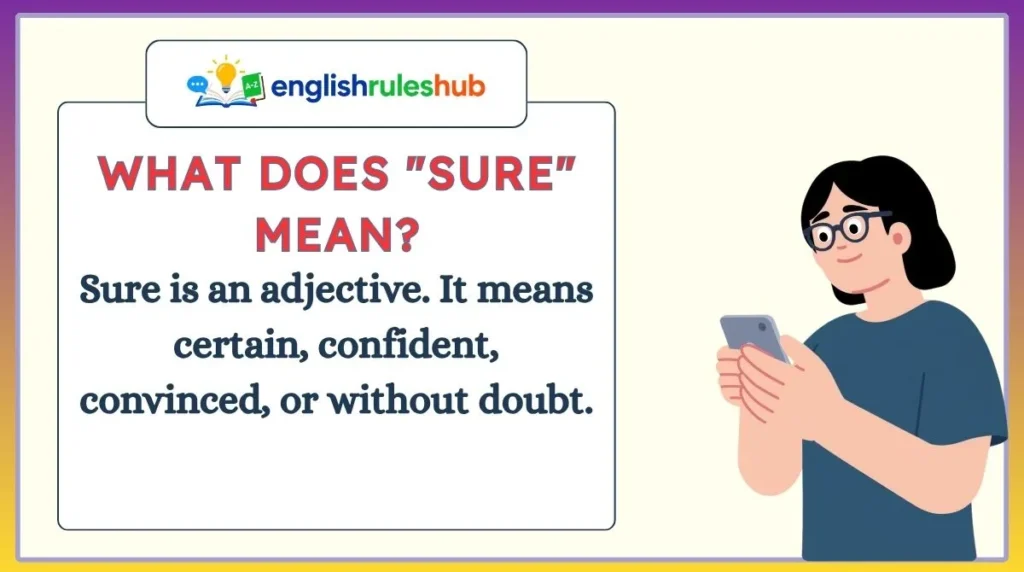
Sure is an adjective. It means certain, confident, convinced, or without doubt.
It describes a person’s feelings, thoughts, or certainty about something. It can also describe whether something is safe or dependable.
When to Use “Sure”
Use sure when you want to describe:
- A person’s confidence
- Being certain about something
- Agreement
- Readiness
- Safety or reliability
Since sure is an adjective, it usually comes:
- After the verb be
- After linking verbs such as feel, seem, become, look
- Before a noun in some expressions
Grammar Rule
Subject + be + sure + (that / about / of + something)
Examples:
- I am sure you can do it.
- She is sure about her answer.
- They are sure of their decision.
Notice that sure describes the subject. It does not describe the action.
Common Uses of “Sure”
1. To show confidence
- I am sure this is the right road.
- She is sure she locked the door.
2. To express agreement
In everyday spoken English, sure often means yes.
Example:
A: Can you help me?
B: Sure!
This is friendly and natural.
3. To show readiness
- Sure, I’ll join you.
- Sure, no problem.
4. To describe safety
- Make sure the ladder is secure.
- Are you sure the bridge is safe?
Example Sentences
- I am sure she will call later.
- He is sure about his decision.
- Are you sure this train goes to London?
- We are sure everything will be fine.
- She looked sure of herself during the interview.
- I’m not sure where he lives.
- They felt sure they had made the right choice.
- Sure, I’d love to come with you.
Common Learner Confusion
Many learners think sure can describe an action.
For example:
❌ He speaks English sure.
This is incorrect because sure is an adjective, not an adverb.
Correct:
✔ He speaks English surely. (Only if you mean “certainly,” though this sounds uncommon.)
More natural:
✔ He certainly speaks English well.
Another common mistake is forgetting the verb be.
Incorrect:
❌ I sure he is honest.
Correct:
✔ I am sure he is honest.
Remember this simple idea:
Sure describes people, feelings, or things—not actions.
What Does “Surely” Mean?
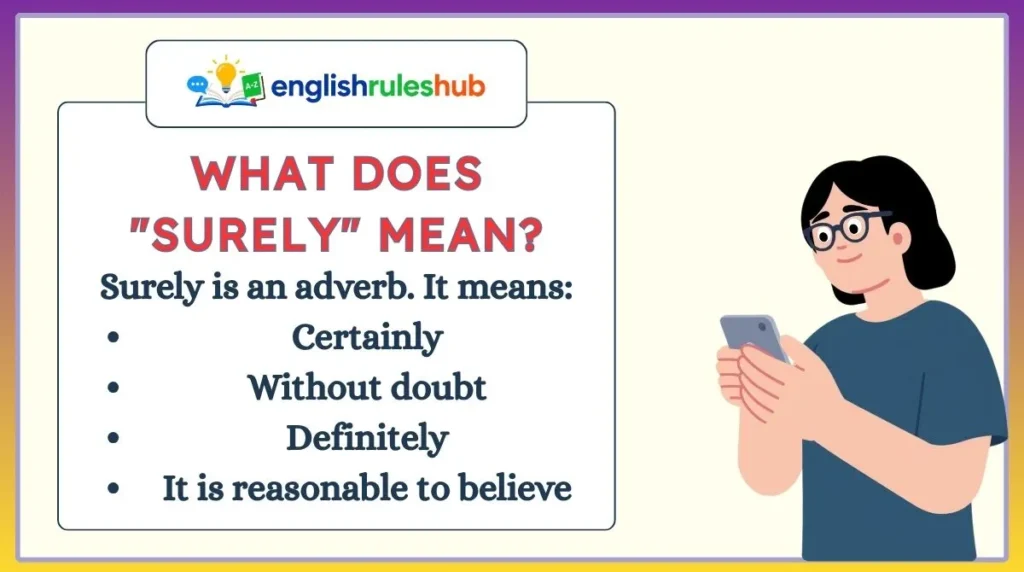
Surely is an adverb. It means:
- Certainly
- Without doubt
- Definitely
- It is reasonable to believe
It usually adds a feeling of confidence or expectation to a sentence.
When to Use “Surely”
Use surely when you want to:
- Express strong belief
- Show certainty
- Emphasize that something is expected
- Politely question something that seems obvious
Unlike sure, surely describes the meaning of a verb or the whole sentence.
Grammar Rule
Surely + sentence
or
Subject + surely + verb
Examples:
- Surely you remember me.
- She will surely succeed.
- We can surely find another way.
How Native Speakers Use “Surely”
Native speakers often use surely when they believe something is obvious.
Examples:
- Surely that’s not true.
- Surely you don’t believe that.
- Surely someone can help us.
Sometimes it sounds like a polite question.
For example:
- Surely you’ve finished by now?
- Surely this can’t be happening.
These sentences show surprise mixed with confidence.
Example Sentences
- Surely you know the answer.
- She will surely arrive on time.
- We can surely solve this problem together.
- Surely there is another way.
- He surely didn’t forget my birthday.
- They will surely understand your decision.
- Surely everyone deserves another chance.
- The weather will surely improve tomorrow.
Common Learner Confusion
Many learners believe surely simply means sure + ly, so they use it everywhere.
For example:
❌ I am surely about my answer.
This is incorrect because after the verb be, English normally uses the adjective.
Correct:
✔ I am sure about my answer.
Another mistake:
❌ She is surely of herself.
Correct:
✔ She is sure of herself.
Use surely only when you want to express certainty about an action or an entire statement.
A helpful tip is this:
- Sure = describes a person or thing.
- Surely = describes certainty about an action or statement.
Difference Between Sure and Surely (Detailed)
Although these two words come from the same root, they do not have the same grammar function. Understanding this difference is the key to using them correctly.
| Feature | Sure | Surely |
|---|---|---|
| Part of speech | Adjective | Adverb |
| Main meaning | Certain, confident | Certainly, without doubt |
| Describes | A person, feeling, or thing | A verb or whole sentence |
| Common position | After be or linking verbs | Before the main verb or at the beginning of a sentence |
| Common in conversation | Very common | Common, but often used for emphasis |
| Example | I am sure. | Surely you remember. |
Usage Difference
The biggest difference is their grammar role.
Use sure when talking about someone’s confidence.
Examples:
- I’m sure you’re right.
- She isn’t sure about the date.
- Are they sure of the answer?
In all these sentences, sure describes the subject.
Use surely when expressing certainty about an event or statement.
Examples:
- She will surely win.
- Surely you understand.
- They surely expected better results.
Here, surely adds emphasis to the action or the whole sentence.
Grammar Logic
Think about this simple rule.
If the word answers:
“How certain is the person?”
Use sure.
Example:
- I am sure.
If the word answers:
“How certain is the speaker that something will happen?”
Use surely.
Example:
- It will surely happen.
Sentence Structure Difference
Structure with Sure
Subject + be + sure + that…
Examples:
- I am sure she is honest.
- We are sure the meeting starts at nine.
- He wasn’t sure what to say.
Structure with Surely
Surely + subject + verb
Examples:
- Surely you understand.
- Surely they know the truth.
or
Subject + surely + verb
Examples:
- She surely deserved the award.
- We will surely meet again.
Meaning Comparison
Consider these two sentences.
I am sure he will come.
This means I feel confident that he will come.
Now compare it with:
He will surely come.
This means it is almost certain that he will come.
The first sentence focuses on the speaker’s confidence.
The second focuses on the certainty of the event.
That small difference changes the meaning slightly, even though both sentences express confidence.
Which Word Is More Common?
In everyday English, sure is much more common than surely.
People often say:
- I’m sure.
- Are you sure?
- Sure!
- Make sure.
Native speakers also use surely, but usually for emphasis, polite disbelief, or formal writing.
Examples:
- Surely that’s impossible.
- Surely you remember.
- This plan will surely succeed.
Knowing this difference helps your English sound more natural and more like a native speaker’s.
Grammar Rules You Must Remember
Learning a few simple rules will help you choose the correct word every time.
Rule #1: Use Sure After the Verb “Be”
When talking about confidence or certainty, use sure after forms of be.
Examples:
- I am sure this answer is correct.
- She is sure she locked the door.
- We were sure everything would be fine.
Remember: be + sure is one of the most common patterns in English.
Rule #2: Use Surely to Add Certainty to an Action or Statement
Use surely when you want to emphasize that something is certain or very likely.
Examples:
- He will surely succeed.
- They surely deserve another chance.
- Surely someone knows the answer.
Remember: surely modifies the action or the whole sentence, not the person.
Rule #3: Don’t Replace Sure with Surely After Linking Verbs
Linking verbs such as be, seem, become, feel, look, appear, remain, and stay are followed by adjectives.
Correct:
- She seems sure.
- He feels sure about his decision.
- They became sure of the result.
Incorrect:
- She seems surely.
- He feels surely.
- They became surely.
Rule #4: “Sure” Is Common in Everyday Conversation, While “Surely” Adds Emphasis
When someone asks for help, native speakers often reply:
- Sure!
- Sure, I’ll help.
- Sure, why not?
When expressing strong belief or polite surprise, they often say:
- Surely that’s true.
- Surely you didn’t forget.
- This problem will surely be solved.
Choosing the right word based on the situation will make your English sound more natural and confident.
Common Mistakes Students Make
Many learners understand the meanings of sure and surely, but they still make mistakes because the two words look almost the same. The main problem is forgetting that sure is usually an adjective, while surely is an adverb.
Once you remember their grammar jobs, choosing the correct word becomes much easier.
Mistake 1: Using Surely After the Verb Be
This is one of the most common errors.
❌ Wrong: I am surely about the answer.
✅ Correct: I am sure about the answer.
Why?
After the verb be, English usually needs an adjective. Since sure is an adjective, it is the correct choice.
Tip: Think of the pattern be + sure.
Mistake 2: Using Sure to Describe an Action
Some learners use sure where an adverb is needed.
❌ Wrong: He will sure come tomorrow.
✅ Correct: He will surely come tomorrow.
or
✅ More natural: He will definitely come tomorrow.
Why?
The word describes the action come, so an adverb is needed.
Mistake 3: Thinking Both Words Always Mean Exactly the Same
Although both words express certainty, they are not interchangeable.
Compare these sentences:
- I am sure she is honest.
- She will surely help us.
The first sentence talks about my confidence.
The second sentence talks about the certainty of the action.
Mistake 4: Overusing “Surely” in Everyday Conversation
Many students believe surely sounds more advanced, so they use it too often.
For example:
❌ Less natural: Surely, I can help you.
✅ More natural: Sure, I can help you.
or
✅ I’m happy to help.
Native speakers usually choose sure in casual conversations.
Mistake 5: Forgetting That “Sure” Can Mean “Yes”
Many beginners only learn the adjective meaning.
However, sure is also a very common way to agree politely.
Example:
A: Can you pass me the salt?
B: Sure!
This sounds friendly and natural.
Easy Correction Tips
Whenever you are unsure, ask yourself these questions:
- Am I describing a person or feeling? → Use sure.
- Am I describing an action or showing certainty about a whole sentence? → Use surely.
- Is the word after “am,” “is,” “are,” “was,” or “were”? → Use sure.
- Do I want to emphasize that something will happen? → Use surely.
These simple questions will help you avoid most mistakes.
Easy Trick to Remember the Difference
A small memory trick can help you remember these words forever.
Think About Confidence vs. Action
Imagine your friend says:
“I am sure.”
This sentence talks about how your friend feels. Your friend feels confident.
Now imagine someone says:
“He will surely win.”
This sentence talks about what will happen. It expresses strong confidence that the action will happen.
So remember this simple idea:
- Sure = describes the person.
- Surely = describes the action or the whole idea.
Another Easy Memory Trick
Notice the ending.
Sure has no -ly, so it behaves like an adjective.
Surely ends with -ly, and many English adverbs end with -ly.
Examples:
- Quick → Quickly
- Slow → Slowly
- Happy → Happily
- Sure → Surely
This trick is not true for every English word, but it works perfectly here.
Real-Life Logic
Imagine a football match.
Your friend says:
“I’m sure our team will win.”
He is talking about his confidence.
A sports reporter says:
“Our team will surely win if they keep playing like this.”
The reporter is talking about the result of the match.
Different focus. Different word.
Daily Life Examples (Very Important)
These examples show how native speakers naturally use sure and surely in everyday conversations.
Example 1
A: Are you sure this is the right bus?
B: Yes, I’m sure.
Example 2
A: Can you help me carry these bags?
B: Sure!
Example 3
I’m not sure where I left my phone.
Example 4
Surely someone has seen your wallet.
Example 5
She will surely call after work.
Example 6
Are you sure you turned off the lights?
Example 7
Surely this problem has a simple solution.
Example 8
I’m sure everything will be okay.
Example 9
The weather will surely improve by tomorrow.
Example 10
Sure, let’s have lunch together.
What You Should Notice
In these conversations:
- Sure often expresses confidence, agreement, or readiness.
- Surely adds emphasis or shows that the speaker believes something is almost certainly true.
Listening to native speakers will help you notice this pattern more easily.
Practice Section
Choose the correct word: sure or surely.
1.
I am ______ that she told the truth.
A. sure
B. surely
2.
He will ______ finish the project on time.
A. sure
B. surely
3.
______ you remember my name.
A. Sure
B. Surely
4.
Are you ______ about your answer?
A. sure
B. surely
5.
The train will ______ arrive before noon.
A. sure
B. surely
Answers
- ✅ A. sure
- ✅ B. surely
- ✅ B. Surely
- ✅ A. sure
- ✅ B. surely
If you answered all five correctly, you have a solid understanding of the difference between these two words. If you missed one or two, don’t worry. Read the examples again and practice using both words in your own sentences.
FAQs
1. What is the difference between sure and surely?
Sure is an adjective that describes confidence or certainty about a person, thing, or idea. Surely is an adverb that expresses certainty about an action or an entire statement. Although both relate to confidence, they have different grammar roles.
2. Can surely be used at the beginning of a sentence?
Yes. Native speakers often place surely at the beginning of a sentence to express strong belief, expectation, or polite surprise.
Examples:
- Surely you understand.
- Surely there is another way.
3. Can I say “I am surely”?
In most situations, no.
The correct expression is:
- I am sure.
After the verb be, English normally uses the adjective sure, not the adverb surely.
4. Is sure formal or informal?
Sure works in both formal and informal English. It is very common in everyday speech, especially when agreeing with someone. In conversations, Sure! is a friendly way to say yes.
5. Is surely common in spoken English?
Yes, but not as common as sure. Native speakers often use surely to add emphasis, express surprise, or show strong confidence that something is true or will happen.
6. How can I remember when to use sure or surely?
Use this simple rule:
- Sure = adjective = describes a person, feeling, or thing.
- Surely = adverb = describes an action or the whole sentence.
If the word comes after am, is, are, was, or were, sure is usually the correct choice.
Final Conclusion
The difference between sure and surely is much easier than many learners think. Both words express confidence, but they play different roles in a sentence.
Sure is an adjective that describes a person’s feeling of certainty, while surely is an adverb that adds certainty or emphasis to an action or a complete statement.
A simple way to remember this is to focus on what the word describes. If you are talking about someone’s confidence, choose sure. If you are emphasizing that something is certain to happen or is very likely to be true, choose surely.
Don’t worry if you make mistakes at first. Even advanced learners sometimes pause before choosing the right word. The more you read, listen, speak, and write in English, the more natural this choice will become.
Keep practicing with real-life conversations, create your own example sentences, and review the grammar rules whenever you need a quick reminder.
With regular practice, you’ll soon use sure and surely correctly and confidently in both speaking and writing.

I am Benjamin Clark, an English language writer passionate about simplifying grammar, vocabulary, and word meanings. I create clear, accurate, and practical content to help learners improve their English skills with confidence every day.