
Many English learners feel confused when they see the words woke up, waked up, and woken up. They all come from the verb wake, so they look very similar.
Because of this, many students think they can use these forms in the same way. That is not true.
You may hear someone say, “I woke up late today.” Then you read a sentence like, “I have woken up early every day this week.”
Later, you might even find “waked up” in a book or dictionary. It is easy to wonder which one is correct.
Learning the correct form is important because waking up is something we talk about every day. We use it when speaking about school, work, holidays, alarms, dreams, and daily routines.
Using the wrong form can make your English sound unnatural, even if people still understand you.
The good news is that the grammar is much easier than many learners think. Once you understand how each form works, you will know exactly when to use it.
You will also learn why one form is very common, another is less common, and one is mostly found in special situations.
By the end of this guide, you will clearly understand the difference between woke up, waked up, and woken up.
You will also see simple grammar rules, easy examples, and helpful tips that make these words much easier to remember.
What Does “Woke Up” Mean?
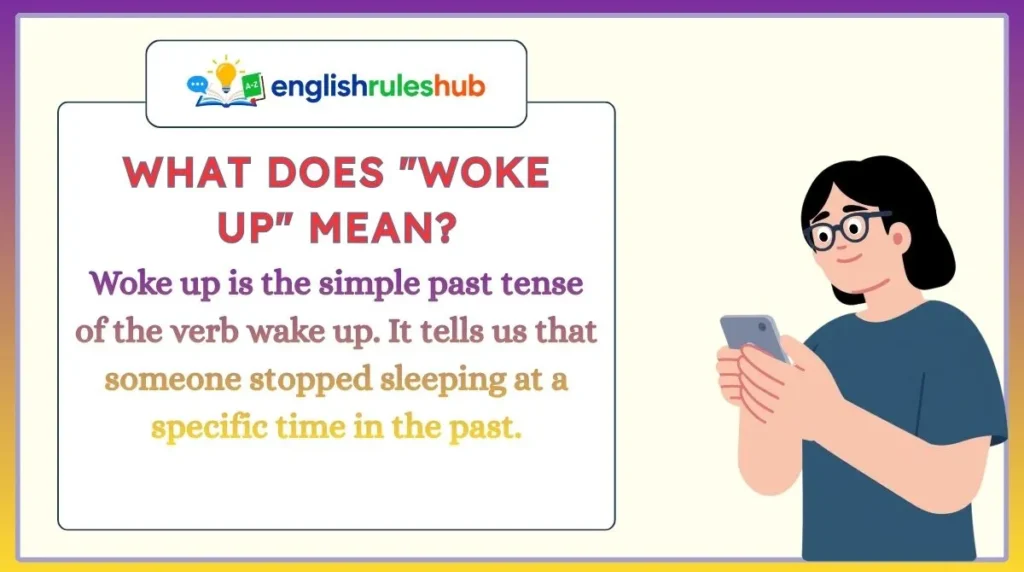
Woke up is the simple past tense of the verb wake up. It tells us that someone stopped sleeping at a specific time in the past.
This is the form that native English speakers use most often when talking about yesterday or any finished time in the past.
Grammar Rule
Subject + woke up + rest of the sentence
Use woke up when the action happened and finished in the past.
Examples
- I woke up at six this morning.
- She woke up before her alarm.
- We woke up early to catch the train.
- They woke up because of the loud music.
- My brother woke up feeling happy.
- The baby woke up during the night.
- He woke up with a sore throat.
- Everyone woke up after the storm ended.
Each sentence talks about a completed action in the past.
When Do We Use “Woke Up”?
Use woke up when talking about:
- Yesterday
- Last night
- Last week
- This morning
- A specific time in the past
- Any completed event
Examples:
- I woke up late yesterday.
- She woke up at 5:30 a.m.
- We woke up before sunrise.
Common Learner Confusion
Many learners say:
❌ I have woke up early.
This is incorrect because have needs the past participle, not the simple past.
Correct sentence:
✅ I have woken up early.
Another common mistake is saying:
❌ I am woke up.
Correct:
✅ I woke up late.
or
✅ I have woken up already.
Spoken English Tip
In everyday conversations, woke up is one of the most common verb forms in English.
Examples:
- What time did you wake up?
- I woke up at seven.
- She woke up really late.
- We woke up feeling excited.
If you are talking about a finished event in the past, woke up is almost always the correct choice.
What Does “Waked Up” Mean?
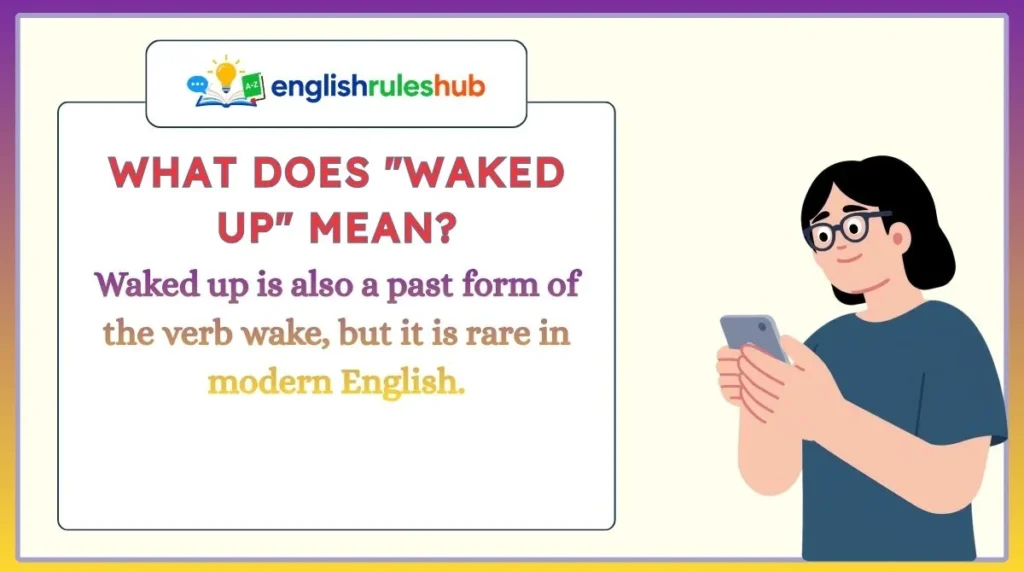
Waked up is also a past form of the verb wake, but it is rare in modern English.
Most native speakers do not use waked up in everyday conversation. Instead, they almost always say woke up.
You may still find waked in dictionaries because it is a recognized form. However, it is much less common and sounds old-fashioned or unusual in many situations.
Grammar Rule
Subject + waked up + rest of the sentence
Although this structure is grammatically possible, it is rarely used in modern standard English.
Examples
- The loud noise waked up the children.
- The phone call waked up my father.
- The barking dog waked up the whole family.
- The thunder waked up everyone in the house.
- The baby waked up suddenly.
- A strange sound waked up the campers.
- The alarm waked up the students.
- The music waked up the neighborhood.
These sentences are grammatically possible, but today most people would naturally replace waked up with woke up.
Modern English Preference
Instead of saying:
- The noise waked up the baby.
Most speakers say:
- The noise woke up the baby.
Instead of:
- I waked up at six.
Most people say:
- I woke up at six.
Why Does “Waked” Exist?
English has changed over hundreds of years. Some verbs have both regular and irregular forms.
The verb wake developed two patterns:
- Regular: wake → waked → waked
- Irregular: wake → woke → woken
Over time, the irregular pattern became much more common in everyday English. Today, most speakers naturally use:
- wake
- woke
- woken
The regular form waked survives mainly in dictionaries, older writing, some regional varieties of English, and a few special uses.
Common Learner Confusion
Many students think that adding -ed always makes the past tense.
That rule works for many verbs:
- walk → walked
- play → played
- clean → cleaned
But wake is an irregular verb in modern English.
So these are the preferred forms:
- Present: wake
- Past: woke
- Past participle: woken
Quick Tip
If you are writing an email, taking an English exam, speaking with native speakers, or learning everyday English, choose “woke up” instead of “waked up.”
It sounds more natural, more fluent, and matches the English used in most conversations, books, newspapers, and classrooms.
Difference Between Woke Up and Waked Up (Detailed)
Both woke up and waked up come from the verb wake. They both describe someone stopping their sleep. Even though they have the same basic meaning, they are not used the same way in modern English.
Today, woke up is the normal choice in everyday English. Waked up is correct in some cases, but it is rare and sounds old-fashioned to many native speakers.
If you want your English to sound natural, use “woke up” in almost every situation.
Comparison Table
| Feature | Woke Up | Waked Up |
|---|---|---|
| Verb Type | Irregular past tense | Regular past tense |
| Common in Modern English | ✅ Yes | ❌ Very rare |
| Used in Daily Conversation | ✅ Very common | ❌ Uncommon |
| Sounds Natural | ✅ Yes | ⚠ Usually not |
| Good for English Exams | ✅ Yes | ⚠ Usually avoid unless your teacher mentions it |
| Found in Older English | Sometimes | More often |
| Preferred by Native Speakers | ✅ Yes | ❌ Rarely |
Grammar Difference
The biggest difference is usage, not meaning.
Both forms talk about a past action, but one is the standard choice.
- Wake → Woke → Woken (modern irregular pattern)
- Wake → Waked → Waked (older regular pattern)
Most grammar books teach the irregular pattern because it is the one used by native speakers today.
Sentence Structure Difference
Both forms follow the same sentence pattern.
Using “woke up”:
Subject + woke up + rest of the sentence
Examples:
- I woke up early.
- She woke up smiling.
- We woke up before sunrise.
Using “waked up”:
Subject + waked up + rest of the sentence
Examples:
- The loud music waked up the baby.
- The storm waked up everyone.
These sentences are possible, but most English speakers would naturally replace waked up with woke up.
Meaning Comparison
The meaning is almost the same.
Both can mean:
- Stop sleeping
- Become awake
- Open your eyes after sleeping
Example:
- I woke up at seven.
- I waked up at seven.
Both describe the same event, but the first sentence is the one people normally say.
Which One Should You Use?
If you are learning English, the answer is simple.
Choose woke up.
It is the form you will hear:
- at school
- in movies
- on television
- in podcasts
- in daily conversations
- in newspapers
- in modern books
Using woke up will make your English sound more natural.
Where Does Woken Up Fit In?
Many learners ask another important question.
If woke up is the past tense, when do we use woken up?
The answer is easy.
Woken up is the past participle of wake.
It is used with helping verbs like:
- has
- have
- had
- was
- were
- been
Examples:
- I have woken up already.
- She has woken up.
- They had woken up before sunrise.
- He has just woken up.
Notice that woken up never stands alone as the main past tense.
Correct:
- I woke up late.
- I have woken up already.
Incorrect:
- ❌ I woken up late.
- ❌ She woken up early.
Quick Comparison
| Sentence | Correct? | Reason |
|---|---|---|
| I woke up late. | ✅ | Simple past tense |
| I have woken up. | ✅ | Present perfect tense |
| I waked up late. | ⚠ Rare | Grammatically possible but uncommon |
| I have woke up. | ❌ | Wrong past participle |
| I woken up early. | ❌ | Missing helping verb |
Which Form Should Beginners Learn?
If you only remember three forms, remember these:
- Wake – present tense
- Woke – simple past
- Woken – past participle
These are the forms you will use almost all the time.
Grammar Rules You Must Remember
Learning a few simple grammar rules will help you avoid mistakes with wake, woke, waked, and woken.
Rule #1: Use Woke Up for the Simple Past
Use woke up when the action happened and finished in the past.
Formula
Subject + woke up + time or extra information
Examples:
- I woke up at six.
- She woke up late today.
- They woke up after the alarm rang.
- We woke up very early yesterday.
Remember, woke up does not need a helping verb.
Rule #2: Use Woken Up After Helping Verbs
Woken up is the past participle.
It must be used with helping verbs such as:
- have
- has
- had
- be
- been
Examples:
- I have woken up.
- She has woken up already.
- They had woken up before breakfast.
- He had never woken up so early.
Incorrect:
- ❌ I woken up early.
Correct:
- ✅ I have woken up early.
Rule #3: Waked Up Is Rare in Modern English
Although dictionaries still recognize waked, it is rarely used in everyday English.
Instead of saying:
- The baby waked up.
Most native speakers say:
- The baby woke up.
If your goal is natural English, choose woke up.
Rule #4: Never Mix the Past Tense and Past Participle
This is one of the biggest mistakes English learners make.
Simple past:
- I woke up late.
Present perfect:
- I have woken up late every day this week.
Wrong:
- ❌ I have woke up.
- ❌ She has woke up.
The helping verb have/has/had always needs woken, not woke.
A Simple Summary
Remember this easy pattern:
| Verb Form | Correct Word | Example |
|---|---|---|
| Base Verb | Wake | I wake up early. |
| Simple Past | Woke | I woke up at seven. |
| Past Participle | Woken | I have woken up already. |
This pattern is the safest and most natural choice for modern English. Once you become comfortable with these three forms, you’ll rarely make mistakes when talking about waking up in everyday conversations.
Common Mistakes Students Make
Many English learners mix up woke up, waked up, and woken up because all three words come from the same verb. Another reason is that many English verbs simply add -ed to make the past tense. Learners often think wake follows the same pattern. In modern English, however, wake is usually treated as an irregular verb.
Here are some of the most common mistakes and the correct way to fix them.
Mistake 1: Using woke after have, has, or had
❌ I have woke up early today.
✅ I have woken up early today.
Why?
After have, has, or had, you must use the past participle. The correct past participle is woken.
Mistake 2: Using woken without a helping verb
❌ I woken up at seven.
✅ I woke up at seven.
Why?
Woken cannot be used by itself. It always needs a helping verb such as have, has, had, was, or been.
Mistake 3: Using waked up in everyday English
❌ I waked up late this morning.
✅ I woke up late this morning.
Why?
Although waked is recognized in dictionaries, woke is the standard choice in modern English.
Mistake 4: Forgetting the helping verb
❌ She woken up already.
✅ She has woken up already.
Why?
The helping verb completes the grammar.
Mistake 5: Mixing verb tenses
❌ Yesterday I have woken up late.
✅ Yesterday I woke up late.
Why?
Words like yesterday, last night, and last week usually take the simple past tense.
Easy Correction Tips
- Think Yesterday = Woke.
- Think Have/Has/Had = Woken.
- Think Waked = Rare.
These three reminders will help you avoid most mistakes.
Easy Trick to Remember the Difference
Grammar becomes much easier when you have a simple memory trick.
Imagine your day starts with an alarm clock.
The alarm rings.
You open your eyes.
Yesterday, this happened.
So you say:
I woke up.
Now imagine your friend asks if you are awake.
You answer:
Yes, I have woken up.
The word have is your clue. Whenever you see have, has, or had, your brain should immediately think woken.
A simple rhyme can also help:
Yesterday I woke.
Have I woken?
Another easy way to remember is this:
- Yesterday → Woke
- Have/Has/Had → Woken
- Waked → Rarely used
Keep this pattern in your mind whenever you write or speak English.
Daily Life Examples
These examples show how native speakers naturally use these words in everyday conversations.
Conversation 1
A: What time did you wake up?
B: I woke up at six.
Conversation 2
A: Are you awake now?
B: Yes, I have woken up.
Conversation 3
A: Why are you so tired?
B: I woke up several times during the night.
Conversation 4
A: Has Emma finished sleeping?
B: Yes, she has woken up.
Conversation 5
A: Did the thunder scare you?
B: Yes, it woke up the whole family.
Conversation 6
A: Why is the baby crying?
B: She has just woken up.
Conversation 7
A: Were you late for work?
B: Yes. I woke up after my alarm stopped.
Conversation 8
A: Has Dad gotten out of bed?
B: Yes, he has woken up and is making breakfast.
Conversation 9
A: Did you hear the birds this morning?
B: Yes. They woke me up before sunrise.
Conversation 10
A: Are the children still sleeping?
B: No, they have woken up and are playing outside.
These are the kinds of sentences you will hear every day in spoken English.
Practice Section
Choose the correct answer.
1. I ______ at seven yesterday.
A. woke up
B. woken up
C. waked up
2. She has ______ already.
A. woke up
B. woken up
C. wake up
3. We ______ because the alarm was loud.
A. woke up
B. woken up
C. waking up
4. They had ______ before the sun came up.
A. woke up
B. woken up
C. wake
5. My brother ______ late this morning.
A. woke up
B. woken up
C. wake
Answers
- ✅ A. woke up
- ✅ B. woken up
- ✅ A. woke up
- ✅ B. woken up
- ✅ A. woke up
If you answered all five correctly, you have understood the main grammar rule.
FAQs
What is the difference between woke up and woken up?
Woke up is the simple past tense. It describes an action that happened and finished in the past. Woken up is the past participle and must be used with helping verbs such as have, has, or had.
Is waked up correct English?
Yes, waked up is grammatically correct, but it is very uncommon in modern English. Most native speakers use woke up instead.
Can I say I have woke up?
No. This sentence is incorrect. After have, has, or had, use the past participle woken. The correct sentence is I have woken up.
Is woke up formal or informal?
Woke up is correct in both formal and informal English. It is widely used in conversations, books, newspapers, and professional writing.
Which form should English learners use?
For modern English, remember these three forms: wake, woke, and woken. These are the forms you will hear and read most often.
Why do dictionaries still include waked?
English has changed over time. Waked is an older regular form that still appears in dictionaries and some styles of writing. However, woke is now the preferred past tense in everyday English.
Final Conclusion
Many learners wonder whether they should say woke up, waked up, or woken up. The good news is that the answer is simple once you know the grammar.
In modern English, woke up is the normal simple past tense, while woken up is the past participle used with helping verbs such as have, has, and had. Although waked up is still recognized, it is rarely used in everyday conversation and writing.
A simple rule can help you remember the difference. If you are talking about something that happened yesterday or at a finished time in the past, use woke up.
If you use have, has, or had, choose woken up. This small grammar rule will make your English sound more natural and more confident.
The best way to master these forms is through regular practice. Read English stories, listen to native speakers, and try making your own sentences every day.
The more you use these verb forms in real conversations, the easier they will become. Before long, choosing the correct form will feel natural.

I am Benjamin Clark, an English language writer passionate about simplifying grammar, vocabulary, and word meanings. I create clear, accurate, and practical content to help learners improve their English skills with confidence every day.

2 thoughts on “Woke Up or Waked Up or Woken Up? The Correct English Grammar Explained (2026)”