
Last updated on September 25th, 2026 at 07:13 am
“In the books” and “on the books” look almost the same, so it is easy to think they can always replace each other.
But they are not exactly the same. The small difference between in and on can change the meaning of the whole expression.
You may hear these phrases when people talk about records, rules, laws, schedules, accounts, achievements, or past events.
For example, someone might say, “That victory is now in the books,” while a manager might say, “The payment is still on the books.”
Both expressions are common in English, especially in everyday speech, business English, sports, and news.
The problem is that many English learners try to understand them as simple prepositional phrases. That does not always work because they are also used as idiomatic expressions.
The good news is that the difference becomes much easier when you connect each phrase with its main idea.
In the books often focuses on something that has been recorded, completed, or remembered as part of a record.
On the books often focuses on something that is officially listed, recorded, active, or still present in official records.
After reading this guide, you will know when to use each phrase, how their meanings differ, which mistakes to avoid, and how native speakers use them in real conversations.
What Does “In the Books” Mean?
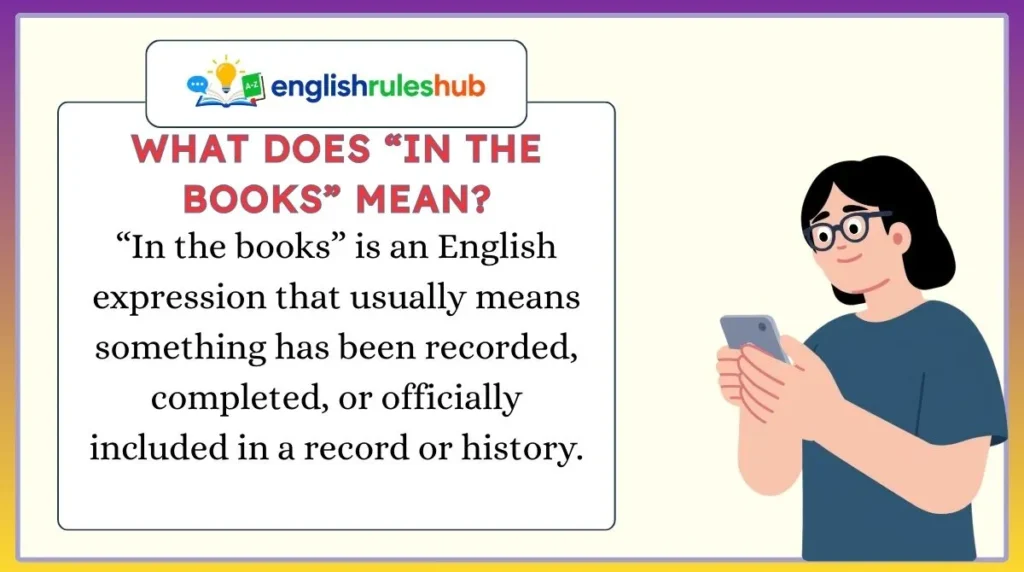
“In the books” is an English expression that usually means something has been recorded, completed, or officially included in a record or history.
Think about a book that contains information about past events. When something is in the books, it has become part of that record.
The phrase can be used in a literal sense, but it is very often used as an idiom.
For example:
“Another successful year is in the books.”
This means the year has finished and is now part of the past record.
Similarly:
“The team’s fifth championship is now in the books.”
The championship has happened, and it is now part of the team’s history.
When Do We Use “In the Books”?
We commonly use in the books when talking about:
- Completed events
- Past achievements
- Historical records
- Results
- Games or competitions
- Finished projects
- Experiences that have become part of the past
- Something officially recorded in a record
The expression often has a feeling of completion.
For example, if a difficult project has finally finished, you can say:
“The project is in the books.”
You are saying that the project is finished and can now be counted as part of the company’s completed work.
Grammar Rule for “In the Books”
The phrase normally appears after a verb such as be, put, or go, depending on the meaning.
Common structures include:
Something + is/was + in the books.
Examples:
“The event is in the books.”
“The season is now in the books.”
Another possible structure is:
Something + goes + in the books.
For example:
“That mistake will go in the books as a lesson.”
Here, the speaker means the mistake will be remembered or recorded as part of the experience.
Examples of “In the Books”
- The final game is now in the books.The game has finished and is now part of the record.
- Another great season is in the books.The season has ended successfully.
- Our first year in business is in the books.The first year has been completed.
- That was one of the best performances in the books.The speaker is connecting the performance with a record or history.
- The election is finally in the books.The election has been completed and its result is now part of the record.
- We worked hard, and the project is officially in the books.The project is finished.
- Her name is now in the school’s record books.Her achievement has been officially recorded.
- That day will go down in the books as a special moment.The day will be remembered as an important event.
A Common Confusion
Learners sometimes use in the books whenever they want to say something is officially listed.
That is not always natural.
For example:
“The new employee is in the books.”
This sounds unusual if you simply mean that the employee is officially registered.
A more natural expression could be:
“The new employee is on the books.”
Here, on the books means the employee is officially listed in the company’s records.
So, remember the main idea:
In the books = part of a record, history, or completed story.
Me Too vs Me as Well vs I as Well
What Does “On the Books” Mean?
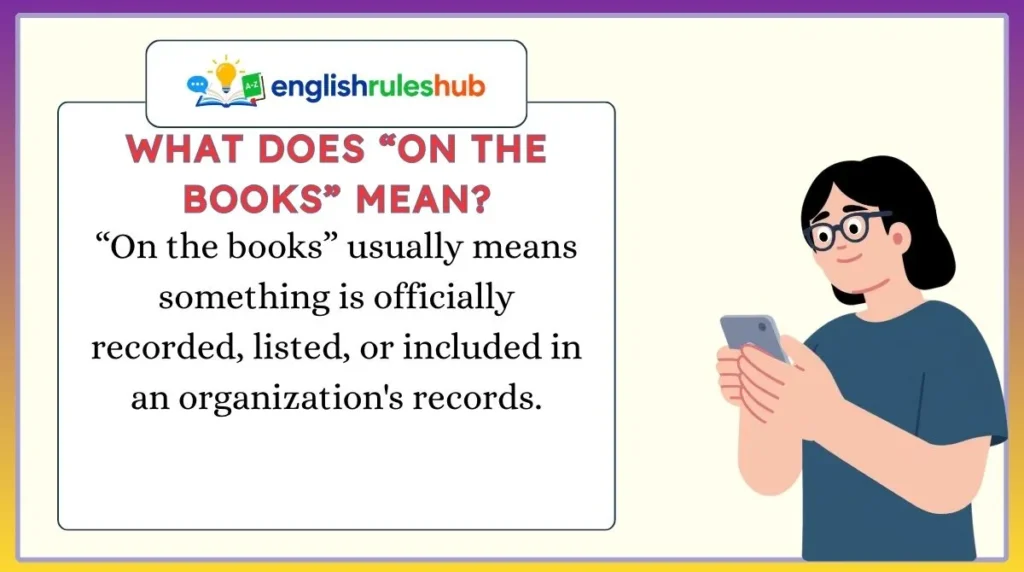
“On the books” usually means something is officially recorded, listed, or included in an organization’s records.
It is especially common in business, finance, employment, law, and official records.
For example:
“The company has 50 employees on the books.”
This means the company officially lists 50 employees in its records.
Another example is:
“The debt is still on the books.”
This means the debt is still officially recorded and has not been removed from the accounts.
The expression can also refer to laws, rules, contracts, or scheduled events that are officially recorded.
When Do We Use “On the Books”?
You will often hear on the books in situations involving:
- Company records
- Financial accounts
- Employees
- Debts
- Laws
- Rules
- Contracts
- Official lists
- Scheduled events
- Registered information
The phrase often has a feeling of official status or continued existence in a record.
For example:
“The old law is still on the books.”
This means the law still officially exists, even if people rarely use or enforce it.
Grammar Rule for “On the Books”
A common structure is:
Something + is/was + on the books.
Examples:
“The law is still on the books.”
“The employee is on the books.”
Another common structure is:
Something + remains + on the books.
For example:
“The old debt remains on the books.”
This tells us that the item is still recorded.
Examples of “On the Books”
- The new law is now on the books.The law has officially been added to the legal record.
- That rule has been on the books for years.The rule has officially existed for many years.
- The company has 100 workers on the books.Those workers are officially listed as employees.
- We still have an old debt on the books.The debt remains in the company’s financial records.
- The contract is on the books for another year.The contract is officially recorded and remains active.
- The manager checked the accounts to see what was still on the books.The manager checked what remained officially recorded.
- Several old laws are still on the books.Those laws officially remain in the legal system.
- The meeting is on the books for Friday.The meeting has been officially scheduled or arranged.
A Common Confusion
Some learners think on the books always means something is physically written on a book.
Usually, that is not what the speaker means.
When a manager says:
“The debt is still on the books.”
they are not talking about a physical book. They mean the debt is still recorded in the company’s accounts.
So, remember the main idea:
On the books = officially listed, recorded, scheduled, or still present in records.
“In the Books” and “On the Books” With “Put” and “Keep”
The expressions can also appear with verbs such as put and keep, which can slightly change the sentence structure.
With on the books, you may see keep something on the books. This means to leave something officially recorded rather than removing it.
“The company decided to keep the old contract on the books.”
The contract remains officially recorded.
You can also use put something on the books when something is added to an official record.
“The accountant put the new expense on the books.”
With in the books, expressions such as put something in the books can focus on recording something as part of a record or history.
“That achievement will go in the books as one of her greatest successes.”
These structures show why the prepositions cannot always be chosen simply by translating in and on. The whole expression and the context determine the intended meaning.
Difference Between “In the Books” and “On the Books” (Detailed)
The biggest difference is the idea behind the expression.
In the books often looks backward. It can describe something that has been completed and has become part of a record, history, or experience.
On the books often describes something that is officially listed or recorded, especially something that currently exists, remains active, or has official status.
Quick Comparison Table
| Expression | Main idea | Common areas | Typical feeling |
|---|---|---|---|
| In the books | Recorded as part of history or a completed record | Sports, events, achievements, projects | Finished or remembered |
| On the books | Officially listed or recorded | Business, finance, law, employment | Official or still existing |
| In the books | Something has happened and is now recorded | Results and completed events | Past/completed |
| On the books | Something is officially present in records | Debts, laws, employees, contracts | Current/official |
1. “In the Books” Often Means Finished
Consider:
“The football season is in the books.”
The season is finished. It has become part of the team’s history.
Now compare:
“The football club has three new players on the books.”
This means the players are officially registered or listed with the club.
The first sentence talks about a completed event.
The second talks about an official current record.
2. “On the Books” Often Means Officially Recorded
Consider:
“The debt is still on the books.”
This means the debt is still present in the financial records.
If you say:
“The debt is in the books.”
the sentence may be understood, but it is not the usual choice when you mean that the debt remains officially recorded.
On the books is much more natural for this meaning.
3. Sports Give Us a Useful Example
Sports are a great way to understand the difference.
Imagine a basketball team wins a major game.
You could say:
“That victory is now in the books.”
The game is over, and the victory is now part of the team’s record.
But a club might say:
“We have five players on the books.”
Those players are officially registered with the club.
So:
Victory → in the books
Players officially registered → on the books
4. Business Gives Us Another Clear Example
Imagine a company has an unpaid invoice.
A manager might say:
“The unpaid invoice is still on the books.”
This means the invoice remains in the company’s records.
After the company pays it, the situation changes. Someone might say:
“Another account has been settled and put in the books.”
The exact wording can vary, but the key difference remains: on the books focuses strongly on official records, while in the books often suggests something becoming part of a completed record or history.
5. Laws Usually Use “On the Books”
When discussing laws, on the books is the normal expression.
For example:
“That law has been on the books since 1995.”
This means the law has officially existed since 1995.
You can also say:
“The government wants to remove the old law from the books.”
This means the law would be removed from the official legal record.
The phrase is strongly connected with official legal records.
6. Sentence Structure
Both expressions commonly appear after be:
Subject + be + in the books
“The season is in the books.”
Subject + be + on the books
“The contract is on the books.”
But their meanings are different.
With in, think:
part of the record or completed story
With on, think:
officially listed or still recorded
“In the Books” and “On the Books” in Business Communication
Both expressions are useful in business English, but they can describe different stages of a business matter.
On the books is common when talking about information that remains part of a company’s current records. For example, a company may have employees, debts, contracts, or financial items that are still officially recorded.
“The company still has several unpaid invoices on the books.”
The sentence focuses on what remains in the company’s records.
In the books can be used when talking about something that has been completed and can now be treated as part of the company’s past activities.
“Another successful quarter is in the books.”
The quarter has finished and is now part of the company’s history.
This difference can be especially helpful in workplace conversations. On the books often points to something that still exists in the records, while in the books can point to something that has been completed or added to the record of what has happened.
Grammar Rules You Must Remember
Rule #1: Use “in the books” for completed events and achievements
When something has happened and is now part of history or a record, in the books is often a good choice.
Example:
“Our first successful event is now in the books.”
The event is finished.
Another example:
“The 2026 season is in the books.”
The season has ended.
Rule #2: Use “on the books” for official records
Use on the books when something is officially listed or recorded.
Example:
“The employee is still on the books.”
The employee is officially listed by the company.
Another example:
“The debt is on the books.”
The debt is officially recorded.
Rule #3: Use “on the books” for laws and rules
This is one of the easiest rules to remember.
When you are talking about a law that officially exists, on the books is very common.
Example:
“That law has been on the books for decades.”
It means the law has officially remained part of the legal system.
Rule #4: “In the books” can focus on history or results
When you are talking about a result, achievement, or memorable event, in the books can show that it has become part of a record.
Example:
“She has another championship in the books.”
The championship has been achieved and is now part of her record.
A useful question to ask yourself is:
“Am I talking about something being officially listed now?”
If yes, on the books is often correct.
If you are talking about something that has happened and is now part of history or a completed record, in the books may be the better choice.
Common Mistakes Students Make
These expressions cause mistakes because the difference between in and on is very small. Learners also translate them directly from their first language, which can lead to unnatural sentences.
Mistake #1: Using “in the books” for a current employee
Wrong or unnatural:
“John is in the books of the company.”
Better:
“John is on the books.”
If you mean John is officially listed as an employee, on the books is the natural choice.
Mistake #2: Using “on the books” for a finished sports season
You may hear:
“The season is on the books.”
Some speakers may understand this, but in the books is the familiar expression when you mean the season has finished and is now part of history.
Better:
“The season is in the books.”
Mistake #3: Thinking “on the books” only means money
It is common in accounting and business, but it is not limited to money.
For example:
“That law is still on the books.”
Here, the expression has nothing to do with money.
It simply means the law is still officially recorded.
Mistake #4: Thinking “in the books” always means physically inside a book
Usually, it is an idiom.
When someone says:
“Another year is in the books,”
they mean the year has been completed and recorded as part of the past.
They are not talking about a physical book.
Mistake #5: Treating the expressions as exact synonyms
This is the biggest problem.
You cannot simply choose in or on because both expressions contain the word “books.”
The surrounding meaning matters.
Compare:
“The law is on the books.”
and:
“The victory is in the books.”
The first sentence focuses on an official legal record.
The second focuses on a completed achievement.
Easy Correction Tip
When you are unsure, ask yourself two questions:
Question 1: Is this officially listed, active, or still recorded?
→ Try on the books.
Question 2: Has this happened and become part of a record, history, or completed story?
→ Try in the books.
This simple test will help you in many situations.
Easy Trick to Remember the Difference
Here is a simple memory trick:
Think “ON = Officially Listed”
The word on can remind you that something is on an official list.
So think:
ON the books = ON the official record
Examples:
“The employee is on the books.”
“The debt is on the books.”
“The law is on the books.”
All three involve something officially recorded.
Think “IN = Inside the History”
For in the books, imagine that an event has gone inside the history book.
For example:
“The final game is in the books.”
The game is finished and is now part of the story.
“Another great season is in the books.”
The season is complete and has become part of the record.
So the easiest memory trick is:
ON = officially listed
IN = part of the completed record or history
This is not a rule for every possible use of the words in and on. It is simply a useful way to remember these two expressions.
Daily Life Examples (Very Important)
Here are some natural examples you might hear in real conversations.
Example 1: After a school event
Student: “How was the school festival?”
Teacher: “It went really well. Another successful event is in the books.”
The event has finished.
Example 2: Talking about a company employee
Manager: “Is Sarah still working here?”
Assistant: “Yes, she’s still on the books.”
Sarah is still officially listed as an employee.
Example 3: Talking about an old law
Person A: “Is that old law still active?”
Person B: “Yes. It’s still on the books.”
The law still officially exists.
Example 4: Talking about a sports season
Coach: “How do you feel about the season?”
Player: “It was tough, but it’s finally in the books.”
The season has ended.
Example 5: Talking about company debt
Accountant: “Have we removed that old debt?”
Manager: “No, it’s still on the books.”
The debt is still officially recorded.
Example 6: Talking about an achievement
Friend: “You finally completed the marathon!”
Runner: “Yes! Another big achievement is in the books.”
The achievement has been completed.
Example 7: Talking about a scheduled meeting
Assistant: “When is the meeting?”
Manager: “It’s on the books for Thursday.”
The meeting has been officially arranged or scheduled.
Example 8: Talking about a completed project
Coworker: “Did you finish the website project?”
Designer: “Yes. It’s in the books.”
The speaker means the project is completed.
Example 9: Talking about registered players
Fan: “How many players does the club have?”
Staff member: “We have twenty players on the books.”
The players are officially registered with the club.
Example 10: Looking back on a busy year
Friend: “That was a crazy year!”
You: “It sure was. But it’s in the books now.”
The year has ended and is now part of the past.
Practice Section
Choose the correct expression: in the books or on the books.
1. The old law is still ________.
2. Another successful season is now ________.
3. The company has 40 employees ________.
4. The project is finally ________.
5. We still have an unpaid loan ________.
Answers
1. on the books
The law officially remains part of the legal record.
2. in the books
The season has ended and is now part of the record.
3. on the books
The employees are officially listed by the company.
4. in the books
The project has been completed.
5. on the books
The loan remains officially recorded.
FAQs
What is the difference between “in the books” and “on the books”?
In the books often means something has been completed or recorded as part of history, a result, or a past record.
On the books usually means something is officially listed, recorded, scheduled, or still present in official records.
For example, a finished season is in the books, while an employee can be on the books.
Can I use “in the books” for a law?
Usually, on the books is the natural choice when you mean that a law officially exists.
For example:
“That law is still on the books.”
This means the law remains part of the official legal record.
Can I say “on the books” about employees?
Yes. This is a common use.
“The company has 25 employees on the books.”
It means those employees are officially listed in the company’s records.
Is “in the books” formal or informal?
In the books is common in everyday English and can sound fairly informal, especially when talking about a completed event.
For example:
“Another season is in the books.”
It is common in sports, business conversations, and casual speech.
Is “on the books” formal or informal?
On the books can be used in both everyday and professional English.
You will often hear it in business, finance, law, employment, and administration. It is a normal English idiom rather than highly formal language.
Does “in the books” always mean something is finished?
Not always, but completion is a very common idea.
For example:
“The season is in the books.”
clearly means the season has ended.
The expression can also relate to something being recorded in a history or record, so the exact meaning depends on context.
Final Conclusion
The difference between in the books and on the books is small, but it becomes much easier once you focus on the main idea behind each expression.
Use in the books when something has been completed, recorded as part of history, or added to a record of events or achievements. You might say, “The season is in the books” after a sports season ends.
Use on the books when something is officially listed, recorded, scheduled, or still present in official records. For example, an employee can be “on the books,” and a law can remain “on the books.”
A simple memory trick can help: ON = officially listed, while IN = part of the completed history or record.
You do not need to memorize dozens of complicated rules. Pay attention to the situation and ask what you really mean.
With a little practice, these two expressions will start to feel natural. Soon, choosing between in the books and on the books will become much easier.

I am Benjamin Clark, an English language writer passionate about simplifying grammar, vocabulary, and word meanings. I create clear, accurate, and practical content to help learners improve their English skills with confidence every day.




2 thoughts on ““In the Books vs On the Books” Meaning, Difference, and Examples (2026)”