
Last updated on September 22nd, 2026 at 07:30 am
English learners often see annual, yearly, and every year and wonder if they all mean the same thing. In many sentences, they do have a very similar meaning.
All three can talk about something that happens once each year. That is why the difference can feel confusing.
For example, you may hear someone say, “We have an annual meeting,” “We have a yearly meeting,” or “We have a meeting every year.”
These sentences can describe the same basic idea. However, the grammar, style, and natural use are not always the same.
This small difference matters because choosing the right expression can make your English sound more natural. Annual is common in formal writing and business English.
Yearly is more general and can work as both an adjective and an adverb. Every year is very common in everyday speech and clearly tells us how often something happens.
The good news is that you do not need to memorize a long list of difficult rules. Once you understand how these expressions work, the choice becomes much easier.
By the end, you will know when to use annual, when to use yearly, and when to use every year.
You will also see common mistakes, simple examples, useful grammar rules, and everyday conversations that will help you use these expressions with confidence.
What Does “Annual” Mean?
Annual means happening once every year or relating to one year.
It is an adjective. This means that it normally comes before a noun or follows a linking verb.
For example:
- an annual meeting
- an annual report
- an annual festival
- an annual fee
- an annual event
When you say annual meeting, you mean a meeting that happens once each year.
Annual is especially common in formal English, business English, academic writing, official documents, and news reports. It sounds clear and professional.
How to Use “Annual”
The basic structure is:
annual + noun
Here are some examples:
- Our company holds an annual meeting in December.
- The school organizes an annual sports day.
- I have to pay an annual membership fee.
- The museum hosts an annual art exhibition.
- The company published its annual report.
- They are planning their annual family trip.
- The town has an annual food festival.
- Employees receive an annual performance review.
In each example, annual describes a noun.
The meeting happens once a year. The fee is charged for a year. The festival takes place once a year. The report covers or relates to a year.
Is “Annual” an Adjective?
Yes. Annual is mainly an adjective.
We normally do not use it in the same way as “every year” when we want to say when an action happens.
For example:
Correct:
We have an annual meeting.
Also correct:
We have a meeting every year.
But this sounds wrong:
Incorrect:
We meet annual.
Why? Because annual is an adjective, not the normal adverb needed after the verb “meet.”
Instead, say:
We meet annually.
or
We meet every year.
This is one of the most important points to remember.
Annual Does Not Always Mean Exactly “Once a Year”
In normal use, annual usually means something happens once each year or is connected with a one-year period.
For example:
The annual conference is in July.
This suggests that the conference takes place once every year.
However, an annual salary is not something you receive only once a year. It means the salary is calculated for a one-year period.
So context matters.
Common Learner Confusion With “Annual”
A common mistake is using annual as if it were an adverb.
For example:
Wrong:
I visit my grandparents annual.
Correct:
I visit my grandparents annually.
More natural in everyday speech:
I visit my grandparents every year.
Another common mistake is thinking that “annual” must always sound very formal. It is certainly common in formal situations, but it can also appear in ordinary English.
For example:
Our annual family picnic is next Sunday.
That sentence is perfectly natural.
The main thing to remember is that annual usually describes a noun.
What Does “Yearly” Mean?
Yearly means once every year or happening each year.
It can be used as an adjective and as an adverb.
That makes it more flexible than annual.
As an adjective, yearly describes a noun:
- a yearly payment
- a yearly meeting
- a yearly tradition
- a yearly review
As an adverb, yearly tells us how often something happens:
- We visit them yearly.
- The price increases yearly.
- The event takes place yearly.
However, although “yearly” is grammatically correct as an adverb, every year is often more natural in everyday conversation.
How to Use “Yearly” as an Adjective
The basic structure is:
yearly + noun
Examples:
- We pay a yearly membership fee.
- The school holds a yearly competition.
- The company gives employees a yearly bonus.
- This is a yearly tradition in our family.
- The website has a yearly subscription plan.
- They conduct a yearly safety check.
- The club organizes a yearly dinner.
- The government publishes a yearly report.
In these examples, “yearly” describes a noun.
How to Use “Yearly” as an Adverb
Yearly can also describe an action.
For example:
The rent increases yearly.
Here, “yearly” tells us how often the rent increases.
More examples:
- The festival happens yearly.
- We review the plan yearly.
- The company checks the equipment yearly.
- The population is measured yearly.
These sentences are grammatically correct.
Still, in casual spoken English, many people would prefer:
The rent increases every year.
We review the plan every year.
The company checks the equipment every year.
So “yearly” is useful, but every year is often the easier and more natural choice in conversation.
Yearly vs Annual
The two words can often be used before the same noun.
For example:
annual report
yearly report
Both can mean a report produced each year.
However, annual often sounds more formal and established, especially with business and official terms.
You will commonly see expressions such as:
- annual report
- annual meeting
- annual income
- annual fee
- annual leave
- annual budget
“Yearly” is also possible in many cases, but it can sound more general or less formal.
Common Learner Confusion With “Yearly”
Some learners believe that yearly and annual are always completely interchangeable. They are close, but their style and naturalness can differ.
For example:
The company released its annual report.
This sounds very natural.
The company released its yearly report.
This is understandable and grammatically possible, but “annual report” is the more common formal expression.
Another point is that yearly can be an adverb, while annual normally cannot.
Correct:
The event happens yearly.
Incorrect:
The event happens annual.
Use:
The event happens annually.
or, more naturally in many conversations:
The event happens every year.
When to Use “Annual” Instead of “Yearly”
Although annual and yearly often have the same basic meaning, they do not always sound equally natural in every situation.
Annual is especially common when talking about official, professional, financial, or organized events and documents.
Expressions such as annual salary, annual report, annual fee, annual meeting, and annual review are very common in professional English.
“Yearly” can often replace “annual,” but the sentence may sound more general or conversational. For example, “The company publishes an annual report” sounds more established and professional than “The company publishes a yearly report.”
This does not mean that “yearly” is wrong. It simply means that English speakers often have preferred combinations.
Learning these common word combinations can help you sound more natural without having to memorize complicated grammar rules.
Difference Between Annual and Yearly
Annual and yearly are very close in meaning. Both can describe something that happens once each year.
The biggest difference is often style and grammar rather than basic meaning.
| Point | Annual | Yearly |
|---|---|---|
| Basic meaning | Once each year / related to a year | Once each year |
| Part of speech | Mainly adjective | Adjective and adverb |
| Common in formal writing | Very common | Less formal |
| Common in conversation | Common | Common |
| Before a noun | Yes | Yes |
| Can describe an action directly | Usually no | Yes |
| Example | annual meeting | yearly meeting |
| Adverb form | annually | yearly |
Annual Is More Formal
If you are writing a business report, official document, school report, or professional email, annual is often the better choice.
For example:
The company will publish its annual report next month.
This sounds professional and natural.
Yearly Is More General
Yearly can be used in both formal and informal settings, but it often feels less official.
For example:
We have a yearly family gathering.
This sounds natural and friendly.
You could also say:
We have an annual family gathering.
That is correct, but it has a slightly more formal sound.
Grammar Difference
The biggest grammar difference is easy to see when we put the words after a verb.
Annual is not normally used as an adverb:
Incorrect:
We check the machines annual.
Correct:
We check the machines annually.
Correct:
We check the machines every year.
But yearly can be an adverb:
We check the machines yearly.
Even then, every year may sound more natural in ordinary speech.
Meaning Difference
In many cases, there is almost no difference in meaning.
Compare:
The school holds an annual meeting.
The school holds a yearly meeting.
Both mean that the school has a meeting once each year.
The difference is mainly about word choice and style.
What Does “Every Year” Mean?
Every year means each year.
It is a phrase that tells us how often something happens. It is especially common in everyday spoken English.
For example:
I visit my parents every year.
This clearly means that I visit them once each year.
Unlike annual, “every year” is not an adjective. It normally works as a time expression or adverbial phrase.
Common Structures With “Every Year”
You can put “every year” at the end of a sentence:
We go to the beach every year.
You can also put it near the beginning:
Every year, we go to the beach.
Both are correct.
Examples:
- We celebrate her birthday every year.
- I buy a new calendar every year.
- The festival attracts thousands of visitors every year.
- Prices seem to rise every year.
- Our family meets every year.
- They travel to another country every year.
- The school organizes a competition every year.
- I call my old teacher every year.
Why “Every Year” Is So Useful
“Every year” is simple and clear. It works especially well when talking about actions.
For example:
We visit our hometown every year.
This is very natural.
You could say:
We visit our hometown yearly.
That is grammatical, but it may sound a little less conversational.
You could also say:
We make an annual visit to our hometown.
This is grammatical, but it sounds more formal and uses a different sentence structure.
Every Year in Questions
You can easily use every year in questions.
For example:
Do you visit your family every year?
Does the festival happen every year?
How often do you travel there?
Do they hold the event every year?
This makes “every year” especially useful for everyday conversation.
When “Every Year” Sounds More Natural Than “Yearly”
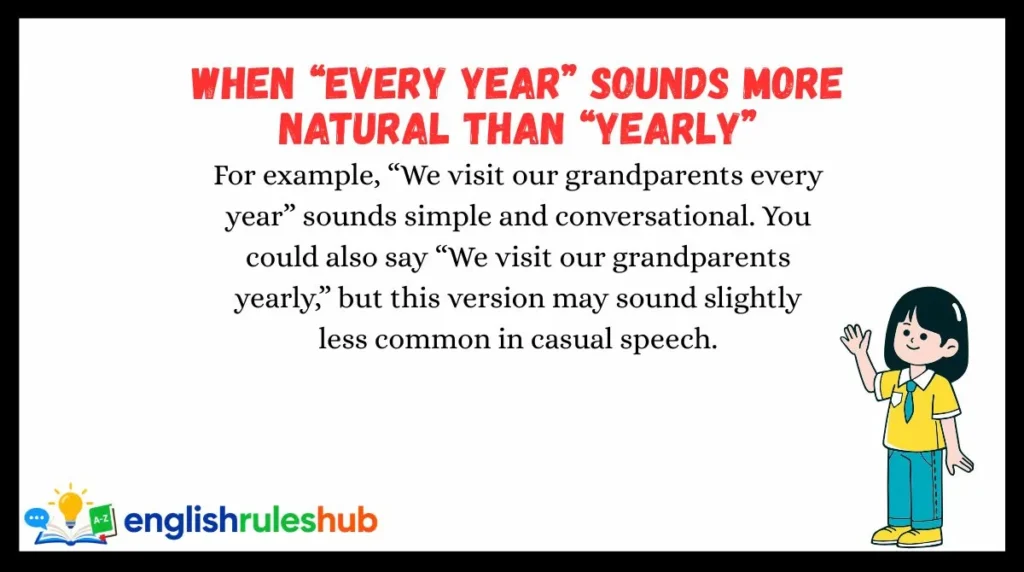
Every year and yearly can both describe something that happens once each year, but “every year” is often more natural in everyday conversation.
For example, “We visit our grandparents every year” sounds simple and conversational. You could also say “We visit our grandparents yearly,” but this version may sound slightly less common in casual speech.
“Every year” is particularly useful when you are talking about personal habits, family traditions, travel, celebrations, or regular activities. It also makes the meaning very clear because it directly tells the listener how often something happens.
For learners, this makes every year a safe and useful choice when you simply want to express the idea of “each year.”
You can use it naturally at the beginning or end of a sentence, such as “Every year, we travel somewhere new” or “We travel somewhere new every year.”
Annual vs Yearly vs Every Year: Detailed Comparison
These three expressions often communicate the same basic idea, but they do not work in exactly the same grammatical way.
| Expression | Main use | Example | Style |
| Annual | Adjective | We have an annual meeting. | More formal |
| Yearly | Adjective/adverb | We have a yearly meeting. | General |
| Every year | Time expression | We have a meeting every year. | Very common in speech |
With Nouns
When describing a noun, both annual and yearly can work.
annual fee
yearly fee
annual celebration
yearly celebration
But some combinations are much more common with annual.
For example:
annual report
is a very familiar phrase.
“Yearly report” is understandable, but it is not always the first choice.
With Verbs
If you want to describe an action, every year is often the easiest choice.
We visit them every year.
You can also say:
We visit them yearly.
But do not say:
We visit them annual.
Use:
We visit them annually.
So there are three useful choices:
- We visit them every year.
- We visit them yearly.
- We visit them annually.
The first is usually the most natural for casual speech.
Sentence Structure
Look at these examples:
Annual:
We have an annual meeting.
Yearly:
We have a yearly meeting.
Every year:
We have a meeting every year.
Notice the structure.
With annual and yearly, the word comes before the noun:
annual + meeting
yearly + meeting
With every year, the phrase usually comes after the main action:
have a meeting + every year
This is an important grammar difference.
Grammar Rules You Must Remember
Rule #1: Use “Annual” Mainly Before a Noun
Annual is an adjective.
Use it to describe something connected with one year or happening once a year.
Correct:
We have an annual meeting.
Incorrect:
We meet annual.
For the second sentence, use:
We meet annually.
or:
We meet every year.
Rule #2: “Yearly” Can Be an Adjective or an Adverb
Yearly has two common jobs.
As an adjective:
We have a yearly meeting.
As an adverb:
We meet yearly.
This flexibility makes yearly different from annual.
Still, remember that “every year” is often more natural when you are speaking casually.
Rule #3: Use “Every Year” for Simple Everyday English
When you simply want to say that something happens each year, every year is a safe and natural choice.
For example:
I visit my grandparents every year.
We celebrate this holiday every year.
The prices go up every year.
You do not need to use a more formal word when a simple phrase communicates the idea clearly.
Rule #4: “Annually” Is the Adverb Form of “Annual”
If you want to use annual with a verb, use annually.
Annual:
The company has an annual meeting.
Annually:
The company meets annually.
You can also use:
The company meets every year.
For most everyday situations, that last version is very easy and natural.
Common Mistakes Students Make
Many mistakes happen because learners know that these words are related to “year” but do not know their grammatical jobs.
Mistake 1: Using “Annual” After a Verb
Wrong:
We travel annual.
Correct:
We travel annually.
More natural:
We travel every year.
The problem is that annual is an adjective.
Mistake 2: Thinking “Yearly” Is Always Wrong
Some learners are taught that “yearly” is incorrect. That is not true.
Yearly is a real and correct English word.
For example:
We have a yearly meeting.
The event happens yearly.
Both are grammatically possible.
The issue is usually not correctness. It is which expression sounds most natural in a particular situation.
Mistake 3: Confusing “Every Year” With an Adjective
You cannot normally put “every year” directly before a noun as if it were one adjective.
For example:
Incorrect:
We attended an every-year meeting.
Instead, say:
We attended an annual meeting.
or:
We attended a yearly meeting.
Or change the sentence:
We attended a meeting every year.
Mistake 4: Using “Annual” When You Mean “Annually”
Wrong:
The company checks the equipment annual.
Correct:
The company checks the equipment annually.
Also correct:
The company checks the equipment every year.
A useful trick is to ask yourself: Am I describing a noun or an action?
If you describe a noun, annual may work.
If you describe how often an action happens, use annually, yearly, or every year.
Mistake 5: Thinking Formal English Is Always Better
A common learner habit is choosing the most formal word because it seems more advanced.
But good English is not about using difficult words.
For example:
We visit our uncle every year.
This is simple, clear, and completely natural.
You do not need to replace it with a more formal expression just to sound intelligent.
Easy Trick to Remember the Difference
Here is a simple classroom trick:
Annual = adjective
Yearly = adjective + adverb
Every year = simple time phrase
Think about three questions.
Question 1: Am I describing a noun?
Use annual or yearly.
annual event
yearly event
Question 2: Am I saying how often an action happens?
Use every year or yearly.
We meet every year.
We meet yearly.
Or use the adverb:
We meet annually.
Question 3: Am I speaking casually?
When you are talking to friends, family, classmates, or coworkers in normal conversation, every year is often the easiest choice.
Think of it this way:
Annual = formal label
Yearly = flexible word
Every year = everyday explanation
This is not a strict rule for every sentence, but it is a very useful guide for learners.
Daily Life Examples
The best way to understand these expressions is to see them in normal conversations.
Example 1: Family Trip
Ali: Do you go anywhere during the holidays?
Sara: Yes. We take a family trip every year.
Here, “every year” sounds very natural because this is casual conversation.
Example 2: Company Meeting
Manager: When is the annual meeting?
Employee: It is scheduled for December 15.
“Annual meeting” sounds natural in a business setting.
Example 3: School Event
Student: Does the school have a yearly sports competition?
Teacher: Yes, we organize one every spring.
“Yearly” works well because it describes the school’s regular tradition.
Example 4: Membership Fee
Customer: How much does membership cost?
Staff member: There is an annual fee of $50.
“Annual fee” is a very common expression.
Example 5: Family Tradition
John: What do you do for the holidays?
Mike: We have a big family dinner every year.
The simple phrase works perfectly in spoken English.
Example 6: Business Report
Manager: Has the annual report been completed?
Assistant: Yes, I sent it this morning.
“Annual report” is a standard business expression.
Example 7: Regular Check
Doctor: How often should I have this check?
Patient: I usually have it every year.
The phrase clearly explains frequency.
Example 8: Club Event
Member: Does the club hold a yearly dinner?
Organizer: Yes, usually in December.
“Yearly dinner” is understandable and natural.
Example 9: Price Increase
Customer: Why is this service getting more expensive?
Employee: The price usually increases every year.
Again, “every year” sounds very natural in conversation.
Example 10: Company Review
Employee: When do we have our performance review?
Manager: We have an annual performance review in January.
Here, “annual” fits the professional setting very well.
Practice Section
Choose the best answer: annual, yearly, every year, or annually.
1. We visit our hometown ______.
A. annual
B. every year
C. annualy
2. The company published its ______ report.
A. annual
B. every year
C. annually
3. The festival takes place ______.
A. annual
B. annually
C. an annually festival
4. We have a ______ family gathering.
A. every year
B. annual
C. every-year
5. The school holds a ______ competition.
A. yearly
B. every year
C. every-year
Answers
1. B — every year
“We visit our hometown every year” is natural and correct.
2. A — annual
“Annual report” is a common formal expression.
3. B — annually
“Annually” is the adverb form needed to describe when the festival takes place.
You could also say:
The festival takes place every year.
4. B — annual
“Annual family gathering” is grammatically correct.
You could also say:
We have a family gathering every year.
5. A — yearly
“Yearly competition” is grammatically correct.
You could also use:
annual competition
FAQs
What is the difference between annual and yearly?
Both can mean something that happens once each year. Annual is mainly an adjective and is common in formal English. Yearly can be an adjective or an adverb and is more flexible. In many sentences, they have almost the same meaning.
Is annual the same as every year?
They can communicate the same basic idea, but they have different grammar. Annual is usually used before a noun, such as “annual meeting.” Every year is a time phrase, such as “We have a meeting every year.”
Can I say “yearly” instead of “annual”?
Often, yes. For example, “annual meeting” and “yearly meeting” can both mean a meeting that happens once a year. However, some expressions are much more common with “annual,” especially formal business expressions such as “annual report” and “annual fee.”
Is yearly formal or informal?
“Yearly” can be used in both formal and informal English. However, annual often sounds more formal, while every year is especially common in everyday conversation. The best choice depends on the sentence and situation.
Can I use annual after a verb?
Usually, no. “Annual” is an adjective, so you normally use it to describe a noun. Instead of saying “The company meets annual,” say “The company meets annually” or “The company meets every year.”
Which is more natural: yearly or every year?
Both can be correct, but every year is often more natural in ordinary conversation. For example, “I visit my parents every year” sounds very natural. “I visit my parents yearly” is also grammatically possible but may sound slightly less conversational.
Final Conclusion
Annual, yearly, and every year are closely related expressions, so it is normal for English learners to confuse them. The good news is that the basic difference is quite simple once you look at their grammar.
Annual is mainly an adjective. You use it to describe nouns, especially in formal or professional English: annual meeting, annual report, annual fee.
Yearly can be an adjective or an adverb. You can say yearly event or the event happens yearly.
Every year is a simple time expression and is extremely common in everyday English: We visit them every year.
When you are unsure, think about the sentence first. If you are describing a noun, annual or yearly may work. If you are talking about how often an action happens, every year is often the easiest choice.
The best way to remember these expressions is to use them in your own daily sentences. After a little practice, choosing between them will feel natural rather than confusing.

I am Benjamin Clark, an English language writer passionate about simplifying grammar, vocabulary, and word meanings. I create clear, accurate, and practical content to help learners improve their English skills with confidence every day.


3 thoughts on ““Annual vs Yearly vs Every Year” The Easy Difference Explained in 2026”