Acumen, acuity, and acuteness are three words that can confuse even strong English learners. They all suggest some kind of sharpness or strong ability, but they are used in different situations.
The confusion often comes from their similar meanings. For example, acumen is connected with good judgment and practical understanding, while acuity often describes a person’s ability to notice or understand something clearly.
Acuteness, on the other hand, usually describes the strong or sharp quality of something.
These words are also more common in formal English, books, newspapers, business writing, academic writing, and professional conversations.
You may not hear them every day in casual speech, but knowing them can make your English much more precise.
The good news is that you do not need to memorize complicated dictionary definitions. Once you understand the main idea behind each word, the difference becomes much easier.
By the end of this guide, you will know what acumen means, what acuity means, what acuteness means, how they differ, which nouns they commonly describe, and how to use each one naturally.
You will also see simple examples from work, school, business, health, and everyday situations. That will help you choose the right word when you write or speak.
What Does “Acumen” Mean?
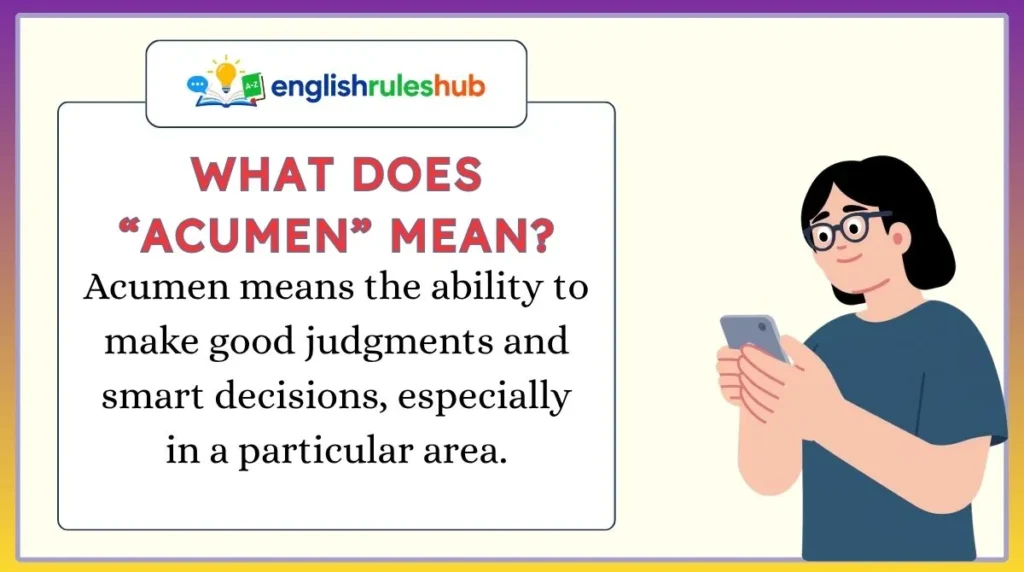
Acumen means the ability to make good judgments and smart decisions, especially in a particular area.
It is often connected with practical intelligence, business sense, or good judgment.
For example, if someone quickly understands how a business works and makes smart business decisions, we can say that person has business acumen.
The important idea is not simply “being intelligent.” Acumen usually means being able to use your knowledge and judgment effectively.
Common uses of acumen
Acumen is especially common with areas such as:
- business acumen
- financial acumen
- political acumen
- commercial acumen
- managerial acumen
- legal acumen
- professional acumen
It is usually used as an uncountable noun.
We normally say:
She has excellent business acumen.
We do not usually say:
She has an acumen.
Examples of “acumen”
- Sarah has strong business acumen.
- His financial acumen helped the company avoid serious losses.
- The manager showed great political acumen during the negotiations.
- Her legal acumen impressed everyone in the courtroom.
- You need commercial acumen to succeed in this industry.
- The young entrepreneur has remarkable business acumen.
- His strategic acumen helped the team find a better solution.
- The company hired her because of her financial knowledge and business acumen.
Notice something important in these examples: acumen is about judgment and understanding that can be applied successfully.
A common learner confusion
Many learners think acumen simply means intelligence.
That is not quite right.
A person can be very intelligent but have poor business acumen. For example, someone may know a lot about mathematics but make terrible decisions when running a company.
So think of acumen as:
knowledge + judgment + practical skill
That combination is what makes the word special.
What Does “Acuity” Mean?
Acuity means the ability to notice, understand, or perceive something very clearly.
It can refer to mental sharpness or physical sharpness, especially the ability to see or hear clearly.
One of the most familiar expressions is visual acuity.
Visual acuity means how clearly a person can see.
For example:
The eye test measures your visual acuity.
Acuity can also describe the mind.
Her mental acuity was impressive.
This means she could think, understand, and respond quickly and clearly.
Common uses of acuity
You will often see acuity with words such as:
- visual acuity
- mental acuity
- intellectual acuity
- cognitive acuity
- hearing acuity
- financial acuity
- analytical acuity
The exact meaning depends on the noun or context around it.
Examples of “acuity”
- The doctor tested the patient’s visual acuity.
- Her mental acuity remained strong even in old age.
- The detective’s analytical acuity helped solve the case.
- His intellectual acuity was clear from the way he explained the problem.
- The athlete has excellent visual acuity.
- The professor was known for his remarkable mental acuity.
- Her sharp financial acuity helped her identify the problem quickly.
- The training program is designed to improve mental acuity.
What makes acuity different?
The central idea of acuity is sharp perception or sharp thinking.
Imagine a camera that can produce a very clear picture. You could describe its image as sharp. In a similar way, a person’s mental acuity means that their thinking is sharp and clear.
This is why acuity often appears with the ideas of seeing, noticing, understanding, analyzing, or thinking.
A common learner confusion
Learners sometimes use acuity when they mean business skill.
For example:
He has excellent business acuity.
This sentence is possible in some contexts, but business acumen is much more natural when you mean practical business judgment.
So remember:
Business judgment → acumen
Sharp perception or thinking → acuity
What Does “Acuteness” Mean?
Acuteness means the quality of being acute, or very sharp, strong, intense, or noticeable.
It is the noun form of acute.
The word can describe several different kinds of sharpness.
For example, something can have:
- physical sharpness
- mental sharpness
- emotional intensity
- strong perception
- serious or intense quality
The meaning depends heavily on the context.
Examples of “acuteness”
- The acuteness of the pain made it difficult for him to sleep.
- She was impressed by the acuteness of his observations.
- The acuteness of the crisis required immediate action.
- The writer captured the acuteness of the problem very well.
- His response showed the acuteness of his understanding.
- The doctor was concerned about the acuteness of the symptoms.
- The acuteness of her hearing allowed her to notice the quiet sound.
- The report shows the acuteness of the economic problem.
Acuteness can describe intensity
This is an important point.
Acuteness is not limited to intelligence.
You can talk about:
the acuteness of pain
the acuteness of a crisis
the acuteness of a problem
These examples show how severe, intense, or strongly felt something is.
It can also describe sharp mental observation:
His comments showed the acuteness of his mind.
In that sentence, acuteness means mental sharpness.
Acuteness and “acute”
Because acuteness comes from acute, understanding the adjective helps.
Acute can mean:
- very sharp
- very severe
- very serious
- highly perceptive
- strongly developed
Therefore, acuteness means the quality or degree of being acute.
Difference Between Acumen, Acuity, and Acuteness
The easiest way to understand the three words is to focus on their main ideas.
| Word | Main meaning | Common area | Simple idea |
|---|---|---|---|
| Acumen | Good judgment and practical understanding | Business, finance, management | Smart practical judgment |
| Acuity | Sharpness of perception or thinking | Vision, mind, analysis | Sharp perception |
| Acuteness | The quality of being sharp, intense, severe, or perceptive | Pain, problems, observations, situations | Degree of sharpness or intensity |
Acumen = practical judgment
If a person understands a business situation and makes a smart decision, acumen is a good choice.
Maria’s business acumen helped the company grow.
The focus is on judgment and practical decision-making.
Acuity = sharp perception
If someone notices details quickly or thinks very clearly, acuity may be the better word.
The detective’s mental acuity helped him notice the small clue.
The focus is on sharpness of perception or thought.
Acuteness = quality or degree of sharpness
If you want to describe how intense, severe, or sharp something is, acuteness may fit.
The acuteness of the pain surprised the doctor.
The focus is on the quality or degree of something being acute.
Compare these three sentences
His business acumen helped him make the right investment.
He has practical business judgment.
His mental acuity helped him understand the complicated report.
His thinking and understanding are sharp.
The acuteness of the problem became obvious after the meeting.
The problem was serious or intense.
The three words are related, but the focus changes.
Grammar and sentence structure
All three words are nouns, but they behave differently in common sentence patterns.
Acumen is often used with a field:
business acumen
financial acumen
political acumen
It is also commonly used after possessive words:
Her acumen impressed the investors.
Acuity often appears with an adjective that tells us what kind of sharpness is meant:
mental acuity
visual acuity
intellectual acuity
It can also be used with of:
the acuity of his analysis
Acuteness is commonly followed by of when we identify what is sharp, severe, or intense:
the acuteness of the pain
the acuteness of the crisis
the acuteness of her observations
This difference in sentence patterns can help you choose the correct word.
Grammar Rules You Must Remember
Rule #1: Use “acumen” for practical judgment
When you mean someone’s ability to make smart, practical decisions, especially in a professional field, use acumen.
Her business acumen helped the company succeed.
Do not use acuity if your main meaning is practical business judgment.
Easy tip: If the sentence is about making smart decisions, think of acumen.
Rule #2: Use “acuity” for sharp perception or thinking
Use acuity when you are talking about someone’s ability to see, notice, understand, analyze, or think clearly.
His mental acuity allowed him to solve the puzzle quickly.
It is also very common in medical and vision-related language:
The doctor checked her visual acuity.
Easy tip: If the idea is sharp seeing or sharp thinking, acuity is often the right choice.
Rule #3: Use “acuteness” for the quality or intensity of something
Use acuteness when you are describing the degree to which something is sharp, intense, serious, or strongly perceived.
The acuteness of the crisis surprised everyone.
You can also use it for physical or emotional experiences:
The acuteness of the pain was difficult to ignore.
Easy tip: If you can naturally replace the word with “how acute or intense something is,” acuteness may work.
Rule #4: Remember that these words are usually formal
All three words can sound more formal than everyday alternatives.
Instead of:
She has excellent business acumen.
In casual speech, someone might simply say:
She is very good at business.
Instead of:
His mental acuity is impressive.
A casual speaker might say:
He thinks very quickly.
This does not mean the formal words are wrong. They are useful when you want precise, professional, or academic English.
Common Mistakes Students Make
Mistake 1: Treating all three words as exact synonyms
This is the biggest problem.
A learner may think:
acumen = acuity = acuteness
They are related, but they do not have exactly the same meaning.
Correction:
- Acumen → practical judgment
- Acuity → sharp perception or thinking
- Acuteness → sharpness, intensity, or severity
Mistake 2: Saying “an acumen”
Because many English nouns can use “a” or “an,” learners may write:
He has an excellent acumen.
A more natural form is:
He has excellent acumen.
Or:
He has great business acumen.
Acumen is generally treated as an uncountable noun.
Mistake 3: Using acumen for eyesight
You would not normally say:
His visual acumen is excellent.
The standard expression is:
His visual acuity is excellent.
Visual acuity is a well-established term for the clarity of vision.
Mistake 4: Using acuity when you mean business sense
A learner might write:
Her business acuity helped the company grow.
While the phrase may be understandable, business acumen is the much more established and natural expression for business judgment.
Better:
Her business acumen helped the company grow.
Mistake 5: Using acuteness when “acuity” is more natural
Compare:
The doctor tested his visual acuity.
This is natural.
The doctor tested his visual acuteness.
This is not the normal expression.
Correction tip: Learn common word combinations instead of translating directly from your first language.
Mistake 6: Thinking acuteness always means intelligence
Acuteness can describe mental sharpness, but it can also describe pain, danger, problems, situations, and intensity.
For example:
The acuteness of the pain worried the doctor.
This has nothing to do with intelligence.
Easy Trick to Remember the Difference
Here is a simple classroom trick.
Think of three kinds of sharpness.
Acumen = sharp decisions
Imagine a business owner looking at a difficult problem and saying:
“I know exactly what we should do.”
That is acumen.
Acumen → smart practical judgment
Acuity = sharp senses or thinking
Imagine someone who can see a tiny detail or understand a difficult idea very quickly.
That is acuity.
Acuity → sharp perception
Acuteness = sharp or intense quality
Imagine a very strong pain, a serious crisis, or an extremely sharp observation.
That is acuteness.
Acuteness → degree of sharpness or intensity
A quick memory line is:
Acumen makes smart decisions. Acuity notices sharply. Acuteness describes how sharp or intense something is.
This one sentence can help you remember the basic difference.
Daily Life Examples
These words are more formal than ordinary conversational English, but you can still see them in real situations.
Example 1: At work
Manager: Why did you choose Ahmed for the project?
Colleague: He has excellent business acumen. He understands customers and makes smart decisions.
Here, acumen means practical business judgment.
Example 2: During an eye test
Doctor: We are going to check your visual acuity today.
Patient: Does that mean my eyesight?
Doctor: Yes. It tells us how clearly you can see.
Here, acuity refers to clear vision.
Example 3: Talking about a smart student
Teacher: I was impressed by Sara’s mental acuity.
Parent: She does understand difficult ideas very quickly.
Here, acuity means sharp thinking.
Example 4: Talking about a serious problem
Reporter: How serious is the situation?
Official: The acuteness of the problem means we need to act immediately.
Here, acuteness describes the seriousness or intensity of the problem.
Example 5: Talking about a business leader
Employee: Why is Mr. Khan so successful?
Employee 2: His financial acumen is excellent. He knows where to invest money.
Again, acumen focuses on practical judgment.
Example 6: Talking about a detective
Police officer: How did she notice that small detail?
Partner: Her analytical acuity is remarkable.
Here, acuity describes sharp observation and analysis.
Example 7: Talking about pain
Patient: The pain suddenly became much stronger.
Doctor: The acuteness of the pain is something we need to investigate.
Here, acuteness refers to the intensity of the pain.
Example 8: Talking about a politician
Journalist: Why did the politician handle the negotiations so well?
Analyst: He showed considerable political acumen.
The meaning is good political judgment.
Example 9: Talking about a difficult question
Teacher: That was a difficult question. How did you answer it so quickly?
Student: I just looked at the key details.
Teacher: Your mental acuity is impressive!
Here, acuity means quick and sharp thinking.
Example 10: Talking about an observation
Writer: Your review was excellent.
Editor: Thank you.
Writer: I especially liked the acuteness of your observations.
Here, acuteness means the sharpness and insight of the observations.
Practice Section
Choose the best word: acumen, acuity, or acuteness.
1. The company hired her because of her strong business ______.
2. The eye doctor measured the patient’s visual ______.
3. The ______ of the pain made the patient seek help immediately.
4. His mental ______ allowed him to understand the problem quickly.
5. Her financial ______ helped her make wise investment decisions.
Answers
1. acumen
The company hired her because of her strong business acumen.
Business judgment is the key idea.
2. acuity
The eye doctor measured the patient’s visual acuity.
Visual acuity is the standard expression for clarity of vision.
3. acuteness
The acuteness of the pain made the patient seek help immediately.
Here, the word describes the intensity of the pain.
4. acuity
His mental acuity allowed him to understand the problem quickly.
The meaning is sharp mental ability.
5. acumen
Her financial acumen helped her make wise investment decisions.
The focus is practical financial judgment.
FAQs
What is the main difference between acumen and acuity?
Acumen usually means good practical judgment, especially in a particular field such as business or finance. Acuity means sharpness of perception or thinking.
For example, business acumen means being good at making business decisions, while mental acuity means being able to think and understand quickly.
Is acumen the same as intelligence?
Not exactly. Acumen includes intelligence, but it focuses more on good judgment and practical understanding.
Someone may be very intelligent but lack business acumen. A person with strong acumen knows how to use knowledge to make effective decisions.
What is the difference between acuity and acuteness?
Acuity usually refers to sharp perception or mental ability. Acuteness is the quality or degree of being acute, which can mean sharp, intense, severe, or perceptive.
For example, we say visual acuity, but we can talk about the acuteness of pain.
Is “business acumen” correct English?
Yes. Business acumen is a very common and natural expression.
It means the ability to understand business situations and make good practical decisions. You can also say financial acumen, commercial acumen, or political acumen.
Is acuity a formal word?
Yes, acuity is somewhat formal. It is especially common in medical, professional, academic, and technical contexts.
For example, visual acuity is a standard medical expression. In everyday speech, people may simply say clear eyesight or sharp thinking.
Can acuteness describe a person’s intelligence?
It can, especially when talking about someone’s sharpness of mind or perception.
For example:
The acuteness of his mind impressed his colleagues.
However, mental acuity is often a more natural choice when you specifically mean sharp thinking.
Can these three words be used interchangeably?
Usually, no. They share the general idea of sharpness, but their focus is different.
Use acumen for practical judgment, acuity for sharp perception or thinking, and acuteness for the quality or intensity of something being acute.
Final Conclusion
Acumen, acuity, and acuteness are closely related words, but each has its own job in English.
Remember the simplest distinction: acumen is about smart practical judgment, especially in areas such as business or finance.
Acuity is about sharp perception or thinking, which is why we commonly hear phrases such as visual acuity and mental acuity.
Acuteness describes the quality or degree of being sharp, intense, severe, or perceptive.
You do not need to memorize every possible use. Start with these three basic ideas and then notice how native speakers use the words in real sentences.
The best way to learn them is through common word combinations. Practice phrases such as business acumen, financial acumen, mental acuity, visual acuity, and the acuteness of the problem.
Once these patterns become familiar, choosing the right word will feel much easier. Keep practicing, and soon these three confusing words will no longer seem confusing at all.

I am Benjamin Clark, an English language writer passionate about simplifying grammar, vocabulary, and word meanings. I create clear, accurate, and practical content to help learners improve their English skills with confidence every day.