Many English learners get confused by worth it and worthy because both words talk about value. At first glance, they seem very similar. However, they are not used in the same way.
You may hear people say:
- “The movie was worth it.”
- “She is worthy of respect.”
Both sentences talk about value, but the grammar is different. The meaning is also slightly different.
This confusion is common because both expressions come from the word worth. When students see the same root word, they often think the usage must be the same. That is where mistakes begin.
Understanding the difference is important because these words appear in everyday conversations, books, movies, social media posts, and workplace communication. Using the wrong one can make a sentence sound unnatural or grammatically incorrect.
The good news is that the difference is actually quite simple once you see the pattern. After learning the meanings, grammar rules, sentence structures, and real-life examples, you will know exactly when to use worth it and when to use worthy.
By the end, you should be able to choose the correct expression with confidence in both spoken and written English.
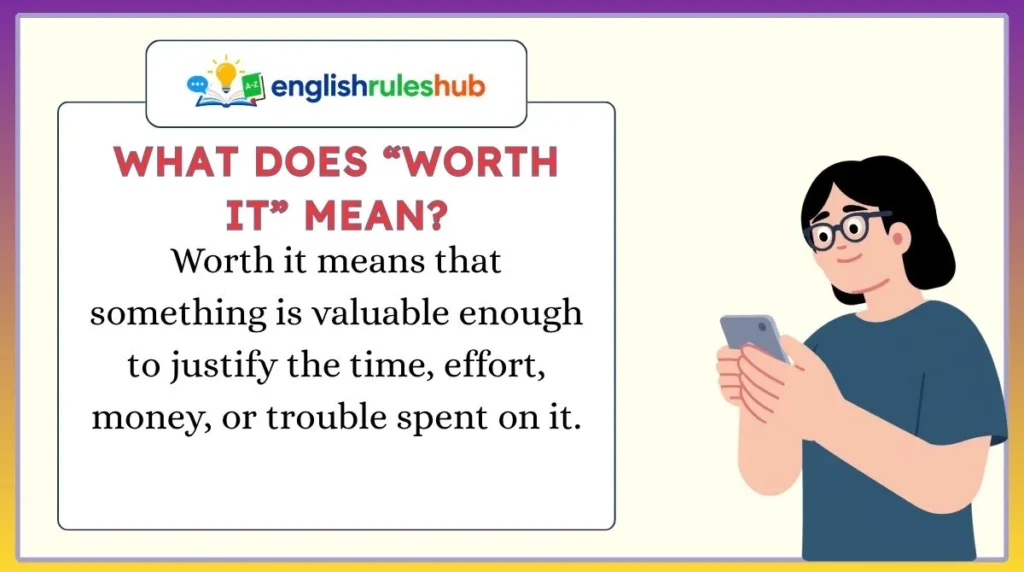
What Does “Worth It” Mean?
Simple Definition
Worth it means that something is valuable enough to justify the time, effort, money, or trouble spent on it.
When something is worth it, the result is good enough to make the experience worthwhile.
When to Use It
Use worth it when talking about:
- Money spent
- Time spent
- Effort made
- Difficult experiences
- Decisions and choices
It is very common in everyday English.
Grammar Rule
The phrase worth it usually comes after a form of the verb be.
Structure:
Subject + be + worth it
Examples:
- It is worth it.
- The trip was worth it.
- The hard work will be worth it.
Example Sentences
- The long drive was worth it.
- Studying every night was worth it.
- The expensive ticket was worth it.
- The vacation was definitely worth it.
- Waiting in line for two hours was worth it.
- Buying that laptop was worth it.
- The extra practice was worth it.
- Moving to a new city was worth it.
Common Learner Confusion
Many students think worth it can describe a person directly.
Incorrect:
- He is worth it.
This sentence sounds incomplete unless the context is very clear.
Better:
- He is worthy of respect.
- The effort was worth it.
Remember that worth it usually refers to an experience, action, cost, or result rather than describing someone’s character.
What Does “Worthy” Mean?
Simple Definition
Worthy means deserving respect, attention, praise, support, or consideration.
When someone or something is worthy, they deserve something positive.
When to Use It
Use worthy when talking about:
- Respect
- Praise
- Recognition
- Attention
- Trust
- Support
- Admiration
Grammar Rule
Worthy is an adjective.
Common structures:
Subject + be + worthy of + noun
Subject + be + worthy + to-infinitive (less common)
Example Sentences
- She is worthy of respect.
- The charity is worthy of support.
- He is worthy of praise.
- Their work is worthy of recognition.
- The book is worthy of attention.
- The teacher is worthy of admiration.
- This cause is worthy of our help.
- The athlete is worthy of the award.
Common Learner Confusion
Students often replace worthy with worth it.
Incorrect:
- She is worth it of respect.
Correct:
- She is worthy of respect.
The phrase worthy of is the natural structure.
Think of worthy as meaning deserving.
Difference Between Worth It and Worthy
Although both expressions relate to value, they focus on different ideas.
| Feature | Worth It | Worthy |
|---|---|---|
| Meaning | Valuable enough to justify effort, time, or money | Deserving respect, praise, or attention |
| Word Type | Expression | Adjective |
| Focus | Result or experience | Person, thing, or quality |
| Common Structure | Be + worth it | Be + worthy of |
| Everyday Use | Very common | Common but more formal |
| Example | The trip was worth it. | The project is worthy of praise. |
Usage Difference
Worth it focuses on whether an action or experience gave a good result.
Example:
- The training was difficult, but it was worth it.
The speaker means the positive result justified the effort.
Worthy focuses on whether someone or something deserves respect or attention.
Example:
- The training program is worthy of praise.
The speaker means the program deserves praise.
Grammar Logic
Notice the difference:
Worth it
- Talks about value after an experience.
Worthy
- Talks about deserving something.
Compare:
- The concert was worth it.
- The singer is worthy of admiration.
The first sentence evaluates an experience.
The second sentence describes a person.
Sentence Structure Difference
Worth It
Subject + be + worth it
Examples:
- The wait was worth it.
- The purchase was worth it.
- The risk was worth it.
Worthy
Subject + be + worthy of + noun
Examples:
- The team is worthy of respect.
- The book is worthy of attention.
- The leader is worthy of trust.
Meaning Comparison
Look at these examples:
- The hike was worth it.
- The guide was worthy of praise.
The first sentence talks about the hiking experience.
The second sentence talks about the person leading the hike.
This small difference changes the meaning completely.
Grammar Rules You Must Remember
Rule #1: Use “Worth It” for Results and Experiences
Use worth it when judging whether something produced a valuable outcome.
Example:
- The exam preparation was worth it because I passed.
The focus is on the result.
Rule #2: Use “Worthy” for Deserving Something
Use worthy when someone or something deserves respect, praise, or attention.
Example:
- The scientist is worthy of recognition.
The focus is on what the person deserves.
Rule #3: “Worthy” Is Often Followed by “Of”
The most common structure is:
worthy of + noun
Examples:
- worthy of praise
- worthy of trust
- worthy of respect
- worthy of attention
Sentence:
- The report is worthy of attention.
Rule #4: Do Not Use “Worth It Of”
This is a common grammar mistake.
Incorrect:
- She is worth it of respect.
Correct:
- She is worthy of respect.
Correct:
- The effort was worth it.
Keep these structures separate.
Common Mistakes Students Make
Mistake 1: Using Worth It for People
Wrong:
- She is worth it of admiration.
Correct:
- She is worthy of admiration.
Why?
Because admiration is something a person deserves.
Easy Tip
If you can replace the word with deserving, use worthy.
Mistake 2: Using Worthy for Experiences
Wrong:
- The vacation was worthy.
While not impossible, native speakers usually say:
- The vacation was worth it.
Why?
Because you are evaluating an experience.
Mistake 3: Forgetting “Of” After Worthy
Wrong:
- He is worthy respect.
Correct:
- He is worthy of respect.
Easy Tip
When using worthy, remember that of is usually your best friend.
Mistake 4: Thinking They Mean Exactly the Same Thing
Wrong idea:
- worth it = worthy
Reality:
Their meanings overlap around value, but they are not interchangeable.
Compare:
- The journey was worth it.
- The traveler was worthy of praise.
Different focus, different meaning.
Mistake 5: Translating Directly From Another Language
Many languages use one word for both ideas.
English separates them.
That is why learners often make mistakes.
Always ask yourself:
- Am I talking about an experience?
- Or am I talking about something deserving respect?
The answer will guide your choice.
Easy Trick to Remember the Difference
A simple memory trick can help.
Think About the Letter “Y”
The word worthy ends with Y.
Think:
Y = You deserve it.
When a person, cause, book, idea, or organization deserves something, use worthy.
Examples:
- worthy of respect
- worthy of praise
- worthy of support
Think About Results for “Worth It”
When you finish something and ask:
“Was the result good enough?”
Use worth it.
Examples:
- Was the movie worth it?
- Was the trip worth it?
- Was the effort worth it?
Quick Test
If you can ask:
“Was it worth the time, money, or effort?”
Use worth it.
If you can ask:
“Does it deserve respect, praise, or attention?”
Use worthy.
Daily Life Examples
These examples sound natural in everyday conversations.
- The new phone was expensive, but it was worth it.
- The movie was three hours long, yet it was worth it.
- Studying every weekend was worth it in the end.
- That restaurant is worth it if you love good food.
- She is worthy of everyone’s respect.
- The charity is worthy of support.
- His actions are worthy of praise.
- The community project is worthy of attention.
- The long flight was worth it because the beach was beautiful.
- The young athlete is worthy of recognition.
Conversation Example 1
A: Was the concert worth it?
B: Absolutely. It was amazing.
Conversation Example 2
A: Why do people support that organization?
B: Because it is worthy of support and helps many families.
Conversation Example 3
A: Was all that hard work worth it?
B: Yes, I finally got the job.
Conversation Example 4
A: Why is she receiving an award?
B: Because her work is worthy of recognition.
Practice Section
Choose the correct option.
1.
The long journey was _____.
a) worthy
b) worth it
2.
She is _____ of respect.
a) worthy
b) worth it
3.
Buying the computer was _____.
a) worth it
b) worthy of
4.
The charity is _____ support.
a) worth it
b) worthy of
5.
All the extra practice was _____.
a) worth it
b) worthy of
Answers
- b) worth it
- a) worthy
- a) worth it
- b) worthy of
- a) worth it
FAQs
What is the difference between worth it and worthy?
Worth it means something gave enough value to justify the effort, money, or time spent. Worthy means deserving respect, praise, attention, or support. One focuses on results, while the other focuses on deserving something.
Can we use worthy and worth it interchangeably?
No. They have different grammar patterns and different meanings. In some situations they seem related, but replacing one with the other often creates unnatural English.
Can we use worth it in questions?
Yes. It is very common in questions.
Examples:
- Was it worth it?
- Is the course worth it?
- Will it be worth it?
These are natural everyday expressions.
Is worthy formal or informal?
Worthy is usually a little more formal than worth it. You often see it in books, speeches, news articles, and professional writing. However, it is still common in everyday English.
Can worthy describe a person?
Yes. It frequently describes people.
Examples:
- She is worthy of respect.
- He is worthy of praise.
- They are worthy of recognition.
In these cases, the person deserves something positive.
What words commonly follow worthy?
Common combinations include:
- worthy of respect
- worthy of praise
- worthy of trust
- worthy of attention
- worthy of support
- worthy of admiration
These combinations are widely used in English.
Final Conclusion
The difference between worth it and worthy becomes much easier once you focus on their main purpose.
Use worth it when talking about whether an experience, purchase, effort, or decision produced enough value. It answers the question: Was the result good enough?
Use worthy when talking about someone or something that deserves respect, praise, support, trust, or attention. It answers the question: Does it deserve something positive?
A helpful way to remember the difference is this: worth it looks at the outcome, while worthy looks at what deserves recognition.
The more examples you read and hear, the more natural these expressions will feel. Pay attention to them in conversations, movies, podcasts, and books.
Try making your own sentences every day. With regular practice, choosing between worth it and worthy will soon become automatic, and your English will sound clearer and more natural.

I am Benjamin Clark, an English language writer passionate about simplifying grammar, vocabulary, and word meanings. I create clear, accurate, and practical content to help learners improve their English skills with confidence every day.